


Novel 3
This is a page for newsletter subscribers only that shares the developing ideas for my current work in progress, which I think will be called The Village of Souls.
In essence, it is the story of a one-hundred year old man on the day he dies. He is Australian, in a care home in Melbourne, but his carer is a Nepalese woman. He was once a mountaineer in Nepal and the tragic events on an expedition there have marked him forever. Her life is more complicated than we might imagine, too, and as they spend this final day together, we learn their stories.
Below are updates from previous newsletters as the ideas have developed. You can click on the date for each one to read the full newsletter and see more photos.
Jan 2024
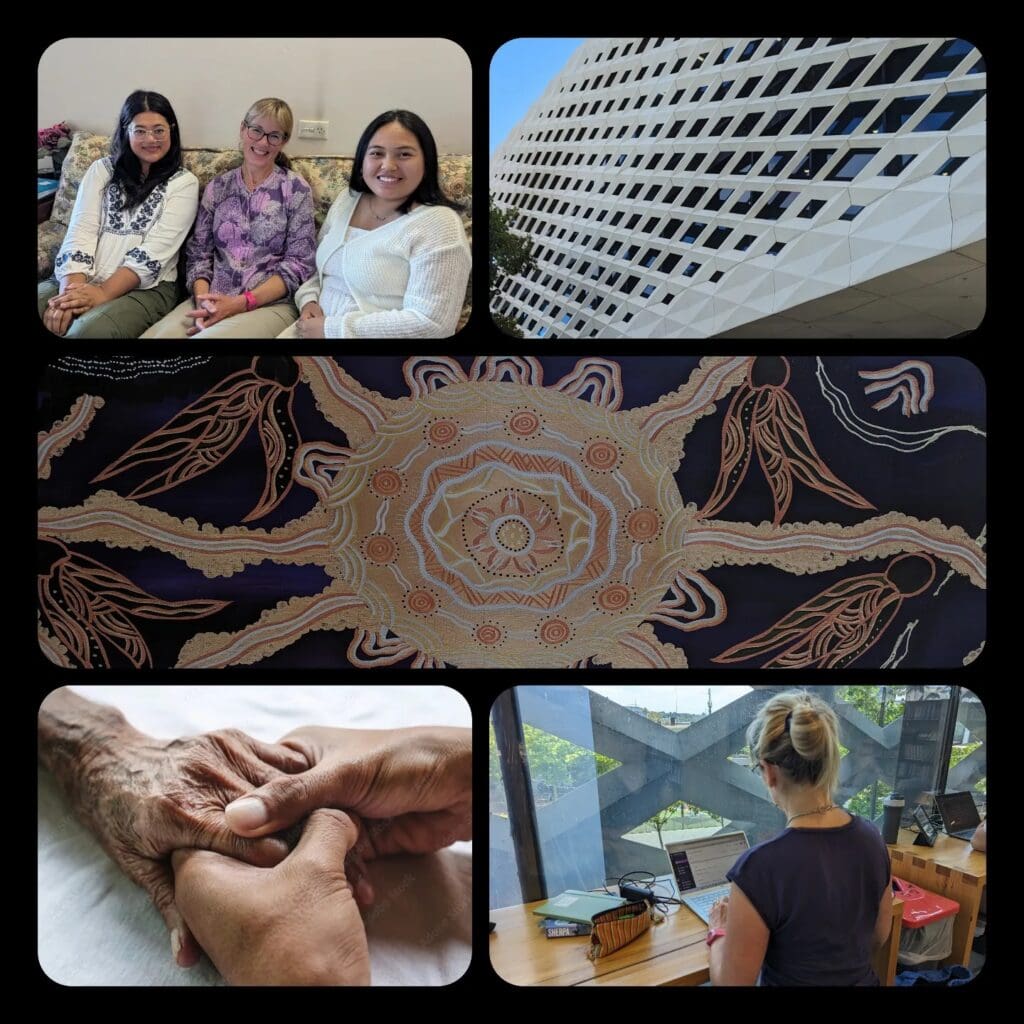
Some of you may have seen this image collage on social media and the caption: What do these things have in common? They all relate to the new novel I have just begun, which is set in Australia where I am now, seeing family and diving into research. I’ll be sharing the ideas and progress of the book only through my newsletter, starting next week, so sign up now to get the inside story!
I have felt for some time that I wanted my next novel to be set in Australia, an element of my heritage that I have not explored much in my writing, apart from a few short stories. At this point, I don’t think it will explicitly explore indigenous experience, as I lack the depth of relationship, listening and understanding to do justice to that, but I acknowledge that every Australian story rises from their land and their history.
The hands in the photo express the work of carers for the elderly. This story takes place in a care home where a one-hundred year-old man is my central character. One of my first jobs out of University, while I was waiting for my Australian teaching qualifications to be processed in Scotland, was cleaning in a residential home. I then got a job as a care assistant. And then facilitated an extended project doing reminiscence work among people with dementia, transcribing their life stories for them and their families, before all was forgotten. Some of these stories were compiled in an anthology I Remember Sunny Days.
The stories also informed my first play, The Long Way Home, about a Scottish woman with dementia and her younger sister who returns from Australia to care for her. Initially performed in three theatres in Scotland’s Central Belt, it was subsequently adapted for BBC Radio Scotland in 1997 by director Crawford Logan. The last ever live play transmission, it was beautifully performed by Sheila Donald and Gwyneth Guthrie, both now passed away.
In a bizarre twist of fate, I wasn’t able to attend the performances because I was back in Nepal – home of my childhood – doing language study in a mountain village. That was the beginning of 4 years of work there, mainly teaching in a small international school in Kathmandu while Alistair worked in a hospital.
And, interestingly, Nepal is a part of this story, too: the beautiful women in my photo are Nepalis who work in aged care here in Melbourne. The Nepalese are much in demand in Australia as carers because of their gentleness, compassion and respect for elders; residential homes are blessed to have many of them. But there is much more to their stories and skills than one might imagine, so that is the second thread of my book. The old man’s carer is a young Nepali woman.
The action takes place across one day. His last day. But also – fleetingly – across the hundred years before. In particular, the years he was in Nepal, climbing mountains. Mountains have been the common theme in all three of my books so far, and it seems they’re not done with me yet.
That’s all I know about the story right now, but it’s good to be here, reading, meeting people, researching, thinking, starting to write.
Feb 2024
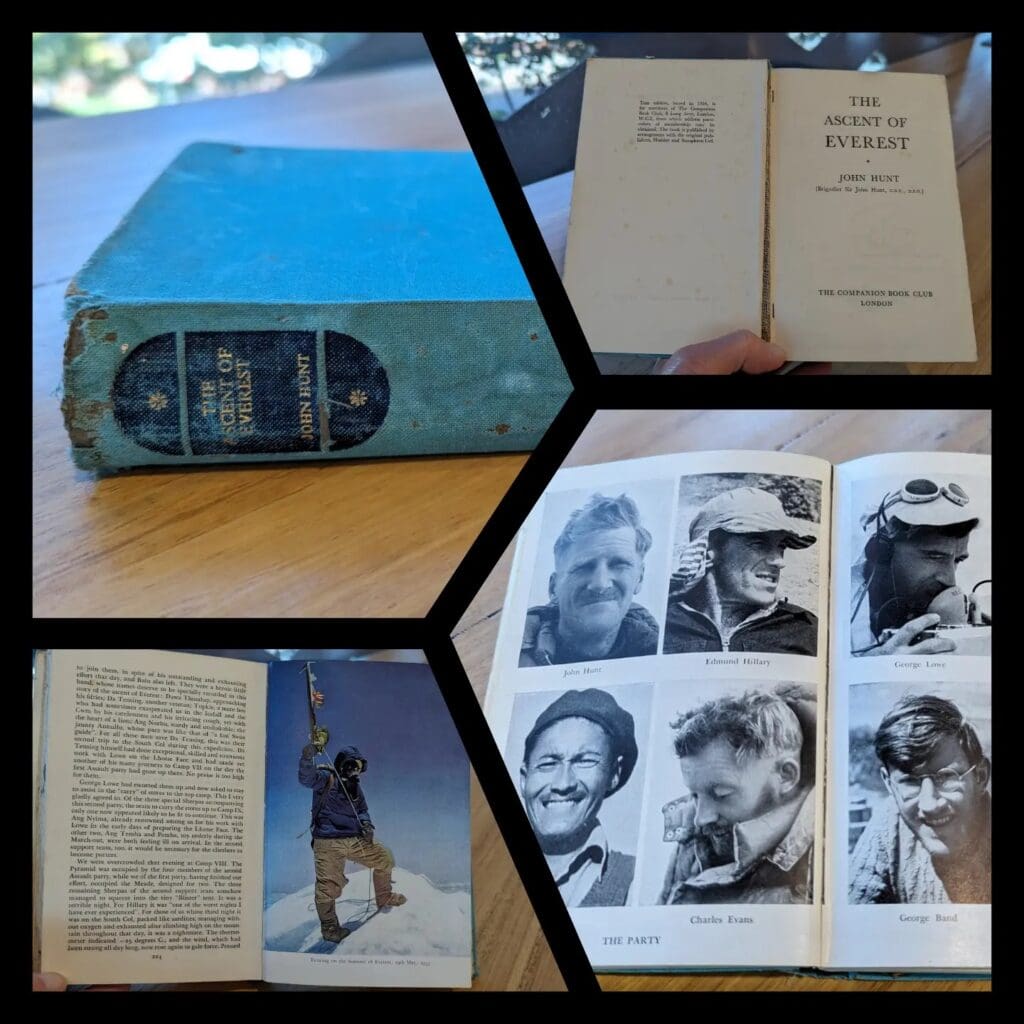
And now to the new book; the current novel; the work in progress. Some of you may have seen me share these images of an original 1954 edition of John Hunt’s ‘The Ascent of Everest’. I was wowed to find it on my parents’ bookshelves during this visit. They have had a strong relationship with Nepal for nearly 60 years, living and working there on and off across that time. I was born in Kathmandu and spent much of my childhood in Nepal, some of it in a mountain village. You can read a little of that story on my website in Under Fishtail Mountain and Return to Fishtail Mountain.
In my last newsletter I shared that I am setting this story in Australia and using the extended time here for the kind of research I can’t do in Scotland or on the internet. I had decided the central character – a one-hundred-year-old man in a care home – was once a mountaineer in Nepal, but I needed to learn what it was like for him in his climbing hey-day: the 1950s and 60s.
What better book to stumble on than Hunt’s. I devoured it and went on to watch the documentary of the expedition – a freely available film which I hadn’t even known about. I watched it with my parents and husband, Alistair, whom I met in Nepal. (We later worked there together and, as the emergency department lead in Patan Hospital, he actually tended Sir Edmund Hillary after his heart attack in the early 90s.) Watching, we were fascinated by all the things we remember and those that have changed beyond recognition. On a world-changing expedition, the filming itself is an extraordinary feat – and the melodramatic 1950s score made me laugh.
So, the mountain literature is helpful for filling in the old man’s backstory, but what about his Nepalese carer? Well, another book on my parents’ shelves has opened up her world to me in ways I have found very moving. That, and a further interview with Hitu, one of the carers I shared about last month. I’ll tell you more about both in my March letter.
March 2024
In my last letter I promised a bit more news about the research. Before leaving Australia, I was glad to have another interview with Hitu, one of the Nepali women who works in aged care. Listening to her talk about the contrasts between life in Melbourne and life in Nepal were fascinating. Here are some of the things she values about each culture:
NEPAL
– family closeness – they will not abandon you
– kindness – people are quick to help
– it feels safe
– people share readily and include everyone
– people enjoy the little things
AUSTRALIA
– people are broad-minded and not judgemental
– good government, law and order – things are straight-forward and clear
– medical care, especially in emergencies
– social provision – support for people seeking work, housing and training
– people are friendly and warm
One of the things I valued about my research time in Australia was the opportunity to raid my parents’ bookshelves and their memories. In their mid-eighties, they might set multiple alarms to remind them of daily tasks, or shake their heads at forgotten names (sounds like me, in my mid-fifties…) but having worked in South Asia since 1966, they can still summon conversation in Gurung, Nepali, Hindi and Urdu, and patiently answered all my questions.
April 2024
Meanwhile, my work on the current novel continues. I have decided that the central female character comes from the Gurung ethnicity in Nepal. It is the people group and language my parents have worked among for over 50 years and it was a Gurung village where I spent some of the first seven years of my life. Because of Facebook, I’ve been able to reconnect with some of the people I played with as a kid and have asked for their memories of village life. One is MimSyo (pronounced mimshaw) who joined me in a wonderful video call recently. She has lived in Perth, Australia for several years, so I had blithely assumed the conversation would be in English. Not so! Clearly, she was sticking to Nepali! Mine is very rusty, but we muddled through, and I enjoyed the language stirring again.
Having decided my character would be Gurung, I was intrigued to discover a book on my parents’ shelves, Love and Honour in the Himalaya: Knowing another culture by the anthropologist Ernestine McHugh. In contrast to all her academic publications, this was a personal memoir of her time among the Gurungs in the 1980s. It was so beautifully written and such a potent evocation of Nepal at that time and the Gurung way of life, that I felt a piercing homesickness. Deeply moved by it, I sent an email to McHugh’s old university email, fully expecting it to land in an unchecked mailbox. Wonderfully, she got it! She sent the most gracious reply, and has kindly agreed, all being well, to read my first draft.
May 2024
During this week away I have focused on working out the story of his expedition. When was he there? The late 1960s, I think. Where exactly was he? Probably the Annapurnas. I know it fairly well as that’s where the Gurung village of my childhood is and I have done a number of treks in the region. What scale of expedition? Official or not? How many others were with him? Who are they and how much do we find out about them? In fact, who is he? What is relevant about his life before and after this expedition? More importantly, what kind of man is he? What drove him? How was he changed?
I’m not sure I know the answers to these questions yet, so much of the week has involved deep thinking, wrestling with the options, scribbling on scraps of paper, drafting sections and then contending with more questions. Never good at decisions, I find the sheer scale of them for a novel daunting. Every important choice sets off a whole chain of consequences – and shuts down others. It feels like a very complicated and ever-shifting puzzle, or trying to find my way through dense jungle.
One of the staff here at Kilmalieu asked me the other day, “So, how do you write a book?” I wish I knew. Somehow, I did it three times before, but for the life of me, I can’t remember how. This feels completely different; uncharted and impenetrable. Perhaps a little like the mountain that my character must climb.
Something underlying all my books, however, is reading, and I’ve enjoyed that this time, too. (So much easier than writing!) This week I finished Peter Mathiessen’s The Snow Leopard, about his 1973 journey into the mountains of Dolpo in north-west Nepal. His writing about nature and landscape is some of the finest I have come across and his reflections on Buddhism were very interesting, but sometimes I found his descriptions and attitudes towards local people deeply uncomfortable. Written 50 years ago, it perhaps reveals the different lens of its time but I felt John Hunt’s Everest account written 20 years earlier showed greater admiration and respect.
But the reading that intrigued me most this week was Wilfrid Noyce’s Climbing the Fish’s Tail. A veteran of that 1953 first ascent of Everest, his book describes the 1957 attempt on Machapuchare. 150 feet below the summit they had to turn back because of weather and impassable ice columns and the mountain was subsequently declared out of bounds by the Nepalese government because of its ‘sacred’ status. In reality, many mountains in Nepal are understood to be the abode of the gods – not least Everest – so the special status of this one is disputed.
But it will always be special to me as it was the mountain that rose above the village of my childhood. I wrote about it in The Hidden Fires and in my blog posts Under Fishtail Mountain and Return to Fishtail Mountain. The latter describes my family’s reunion visit there in February/March 2020 – just before Covid shut down the world. It was my last visit to Nepal – though hopefully not my last ever. So, is Machapuchare the peak my character tries to climb? I’ve added that question to my heap of ‘Decisions to Be Made’ – a heap that is rapidly assuming Himalayan proportions.
June 2024
|
|

|
|

|
|

|
|

|
July 2024
Immediately after that trip, my next stop on the tour of discovery was Cambridge. This enchanting and ancient University city is the base of Kings College Fellow and Emeritus Professor in anthropology, Dr Alan Macfarlane, who has done significant work on the Gurung people of Nepal. He and his wife, Sarah Harrison, have made his life’s work available in an incredible online archive of films, books and other texts, which is a goldmine. I wrote to thank them for this generosity and to explain my novel project. He replied almost immediately with enthusiasm and said he’d met me in Pokhara when I was a baby!
He warmly invited me to visit, booked me a room at King’s College and welcomed me with open arms when I walked across the quad to him. ‘You are audacious!’ he chuckled. Unwittlingly, I had sailed past the ‘Keep off the lawn’ sign, making the same error as Virginia Woolf in A Room of One’s Own. ‘Only the Fellows and Scholars are allowed here.’
Alan’s room of his own at Kings used to belong to the poet Rupert Brookes, so I felt in great literary company as he, Sarah and I talked and talked about Nepal, Gurungs and so much more. He then donned his gown and we swept into the chapel for the graduands’ final service, replete with the full choir. Afterwards, we spilled onto the back lawn looking over the River Cam and a wildflower meadow, enjoying champagne in the late sun.
I felt enormously grateful that such beauty exists and that I could be a part of it. Much of Alan’s work has been about Modernity and the loss of ‘enchantment’. But on that golden evening in Cambridge, it seemed to me that magic has never left us, if only we have eyes to see.
|
||
|


Oct 2024
|

I am enormously grateful to the several kind people who are lending their books, receiving all my questions and responding with thoughtfulness and helpful pointers. Equally, I am thankful for the friends and family who take me away from the desk and remind me of everything else in life that is worthy of my attention. (Sileas is particularly good at this.) I could not do without both kinds of support.
Nov 2024
My first home was in Nepal, cradled in the House of Snow, which is what Himalaya means. The village where I spent much of my early childhood lay across a fertile green plateau and we looked up to the white peaks of the Annapurnas, but almost never getting snow at our level. It is back to this landscape that my writing now leads me.
|

|
|
|

|
|
|
