


Creag Dhubh is the first hill Scottish writer Nan Shepherd climbed on her journey into the Cairngorms, described in her book The Living Mountain. It means ‘black crag’, but on the day we walk, its slopes are lost in white cloud. Captivated by these ‘forbidden’ mountains from childhood, she made this approach as a young woman, alone and excited by her own daring. It was ‘blue cold and brilliant after heavy snow’. For us, there is also cold and snow, but the earth is sodden and the skies heavy.

Nevertheless, it is exciting. I have been up the Cairngorms often, but this is my first time following Shepherd on this route via Creag Fhiaclach, one of the last remaining stands of montane scrub in this fragment of ancient Caledonian forest. We take what she calls the ‘unpath’, across humpy, heathery ground. Here are spiky, fragrant junipers, Scots pines with red bark and needles of unfailing green, and birch, their lichened trunks rising through a haze of purple branches, beaded with water droplets.

Like Shepherd, we ‘toil’ up the slope, slower with each snow-sinking step. But unlike her, we do not reach the breath-catching view of Glen Einich down the other side. Instead, we walk deeper and deeper into mist. By the time we reach the scrub, the dwarf trees appear like the ghosts of departed bonsai. We hear red grouse gurgling, but see only their prints and two drifting feathers.

Checking map, compass and aspect of slope, we climb higher, till even the rocks disappear and there is nothing but white. No seam now between sky and snow, up or down, here or there. Tiny brown tendrils flicker across my vision and disappear like smoke. I am dizzy. For a moment we believe the cloud might dissolve to a singing blue sky, but a hard stare renders only blankness.

When Shepherd gained the top, she ‘jumped up and down… laughed and shouted.’ We save that for another day. It has taken too long to get this far already and we must turn home before the short day turns dark. As we plough slowly back, knee deep and led by the voice of a buried stream, the lightest motes of snow begin to fall.
This article first appeared in The Guardian Country Diary.
When Lily, a young girl from a troubled background, becomes pregnant, she insists she is still a virgin. A host of professionals swing into action. Lily becomes increasingly isolated: her belief is diagnosed as delusion, there are suspicions of abuse, and the unborn baby is shown to be severely disabled. But despite all of this, her conviction that God has chosen her for a miracle finds proof in the most unexpected ways.
That is the summary of my radio play, Immaculate, that was broadcast on BBC Radio 4 exactly ten years ago today. Featured in the Daily Telegraph’s Radio Choice, Gillian Reynolds’ summary concludes with: ‘hard choices and small miracles lie ahead.’ Seeing the anniversary turn up in my calendar brought back powerful memories and made me clamber up into the loft to find the box labelled Merryn Writing Archive, and dig out the Immaculate folder.
The work began with an intial idea in January 2010, of a girl with a miserable life who believes she has had an immaculate conception. Like the germ for Of Stone and Sky, it woke me in the middle of the night. That shows you the mysterious workings of the unconscious mind, or of the Great Spirit, or both. It also shows how long it can take to make a radio play – 20 months from conception to birth, pun intended. Of course, some plays take a lot longer or a lot less. I have ideas and entire scripts dating back many years that are sitting around un-used. So far. You never know when the time will be right.

But I sent that initial idea in a paragraph to David Ian Neville, radio drama producer at BBC Scotland who replied: “Happy New Year! Yes that’s an interesting idea. The question is what really happened to Lily? Do you have thoughts on that? Be interested to know more.”
So, actually, the work began much earlier, when I did David’s Radio Drama Lab in 2005, a highly successful collaboration between BBC Scotland and the Scottish Book Trust. Several years, ideas and scripts later, we made The Colour of Light together, broadcast on Radio Scotland in 2009. The story of a mother whose adult son cuts off contact, it recounts a heartbreaking experience that is much more common than we might realise.
But even that was not my first play, or even my first play on the radio. That was The Long Way Home, way back in ‘97 and ‘98 and it’s a whole story in itself, for another day.
Flipping back through the Immaculate folder now, I am reminded of how much ideas change and thankful for the rigorous process that hones them, though it’s very difficult at the time. At first, Lily lived on the 23rd floor of a tower block in Glasgow with a wastrel mother. But I couldn’t make this Morag woman work. I can see that my page of notes about her begins, ‘at the moment a bit of a female Rab C Nesbitt’. She didn’t make the cut. By the final version, Lily is living in a children’s home and though she talks to her mother, we never hear the conversation. Another cast-off was some guy called Peter. My notes about him begin ‘Who is he?’ and the page ends ‘Does it matter?’ Clearly, not enough.

As characters came and went and the story evolved, David pushed me on the question of what happened to Lily. What was the origin of this baby? Even if the mystery remained open for the listener, I needed to know or I couldn’t write her convincingly. I agreed. But did I know?


My process involved a constant shifting between paper and laptop, between writing scenes and copious notes to myself, between index cards to re-arrange elements and filling out tables with headings like What Happens and How it’s Told. The notes to self take all forms, from spider diagrams, to dense pages of writing, to flow charts. One such page is intriguingly headed: IF – there was sex with three columns: consensual, contractual and rape, with notes under each. The next page starts IF – there was no sex. Under that, one sentence: this becomes a slightly mythical story.

There’s always a lot of research for me. My folder includes an NSPCC calendar that was not just a source of information but a handy place to chart Lily’s pregnancy. There’s an NHS Scotland leaflet on medical confidentiality for under-16s and a training DVD on looked-after children. I have interview notes with social workers, foster parents, an adolescent psychiatrist, the police and a children’s home director. There are sheets labelled ‘voices’ that include phrases and pronunciation from different regions of Scotland including the 15-year-old girls from Kingussie High School where I was a supply teacher at the time. Back in 2011, apparently, they said things like ‘rad dude’ and ‘gnarly’.
From the beginning, David was both patient and persistent, always challenging me to draw out the best. He worked with me through the countless drafts, conversations, developments, synopses and treatments (seven versions) until Immaculate was ready for the hoops of the Radio 4 commissioning process. This involves a pre-offer stage followed by a full-offer round till, finally, the thrilling phone call that, yes, this play has been bought. (Believe me, I’ve had quite a few of the other kind of phone call.) There was still considerable work to do, though, and I ended up with ten drafts of the script. It’s painful, all that making things out of thin air and then having to take them apart and re-make them again. And again. And again. ‘The only kind of writing is rewriting,’ said Ernest Hemingway.
At last, by late June 2011 it was time to stop re-writing and start recording. Although this was a Scottish play, it couldn’t fit into the Glasgow studio schedule, so we were booked for Maida Vale. I hopped on the train in the Highlands and can still remember gazing in wonder as the spires of Edinburgh, Newcastle and Durham slipped past and thinking to myself: here I am, heading to London to make an Afternoon Play for BBC Radio 4! What’s more, they’re putting me up in a hotel! I felt I had arrived.
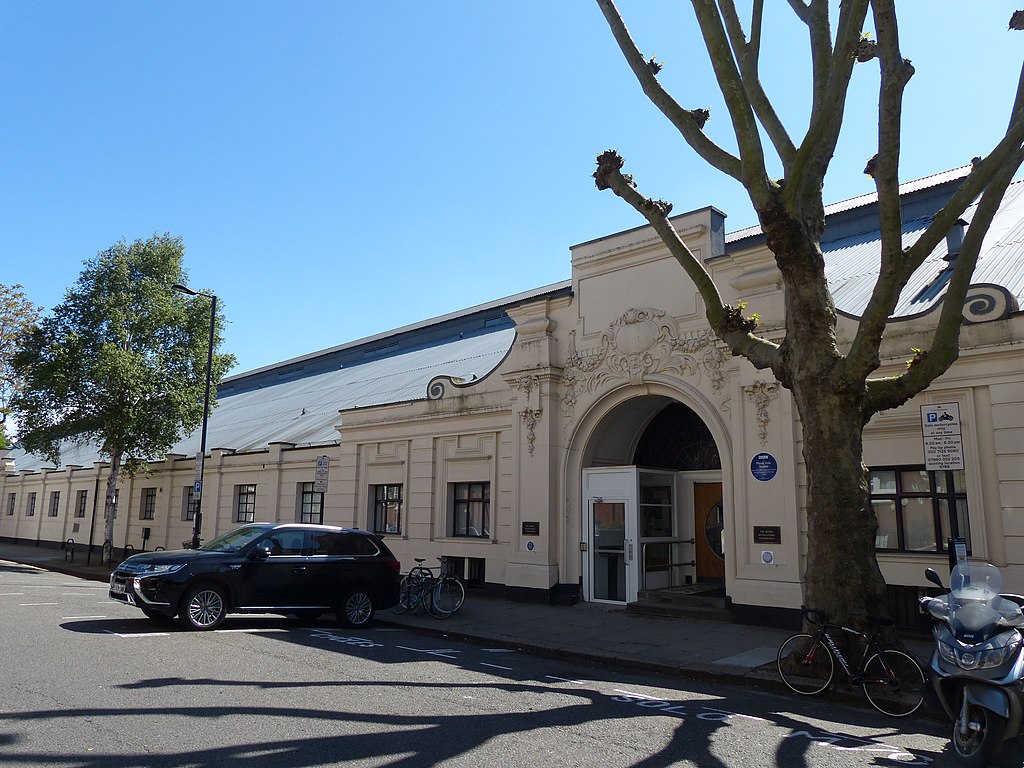
The next morning in the studio, David had assembled a rare cast that included Jenny Lee and Ken Drury as kindly Street Angels and Ali Craig as Lily’s boyfriend. Jane Whittenshaw, who played Lily’s Care Home manager, did the first read-through in a flawless Glaswegian accent, but when David asked her to go Geordie instead, to distinguish from other characters, she pulled that off without batting an eyelid. ‘My main memory of Immaculate,’ she told me yesterday, ‘is the extraordinary story.’ We also had Cathleen McCarron as Lily’s GP, who said, ‘I remember David constantly trying to get me to be more “doctor-ish” because I was way too invested in Lily and rather lacking in professional detachment!’ What I remember is Cathleen sidling up to me on the second day to ask what really happened to Lily. I think I mumbled something about mystery.

Jane Whittenshaw Cathleen McCarron


The most demanding role, of course, was the central character of 15-year-old Lily, herself, that was brought to life with exceptional sensitivity by Helen Mackay. On broadcast, Immaculate featured as Paul Donovan’s Pick of the Day in The Sunday Times Culture section, where he wrote, ‘Merryn Glover’s wonderful drama comes from Scotland – where Roman Catholicism has twice the following it enjoys in England and Wales – but does not rely on doctrine or delusion. To say more would be to spoil it. Outstandingly well acted, particularly by Mackay, who comes from Thurso and is a rising star.’
Helen, who did much of her early training through Eden Court in Inverness, remembers the experience well. ‘It was my first ever radio play and it really opened the door for me to lots more opportunities. Playing a character like Lily comes with great responsibility but it was written so truthfully and with such heart that it made my job so easy in a way. I remember auditioning for the part and thinking I have to play this role.’ She was absolutely right.
The legendary old Maida Vale studios have hosted musical legends from the Beatles to Adele to the BBC Symphony Orchestra. I always knew music would be important for Immaculate, but it took me a while to find the right sound. A list of Motown songs reveals an early tangent. Then at some point I remembered a folk song I loved called The Great Storm is Over which I first discovered when the Fiddle Puppet Dancers came to Celtic Connections in the mid ‘90s. Originally by Bob Franke, it was written when his daughter was diagnosed with an orthopedic condition, and the tune and lyrics for ‘the little lame child’ were perfect for Immaculate. Getting permissions proved challenging, however, so David brought in musician Megg Nicol to record it in studio, which was utterly beautiful. Finally, Helen singing the last chorus gave us the heart-stopping close to the play.
Helen Mackay Megg Nicol


John Bungey of The Times said, ‘there are shafts of light in Merryn Glover’s touching drama’. The voices of each of these talented performers were undoubtedly some of them. And there were the invisible shafts, too, the production assistant, Sue Meek, and the sound wizards, Roger Danes, Marc Wilcox and Jill Abrams, who quitely wove the whole thing together. And David, from first idea to final edit, the midwife. For each play I have written, I have found it the most moving thing that all these people come together in a room to bring my words to life; to put flesh on bones; to animate the vision. Writing can be solitary, but play-making is always community.

Three months after recording, our family set off for a seven-month sabbatical, and so it happened that by the time of broadcast on the 2nd of November, we were in Kathmandu. A group of friends came round and we sat in the evening shadows of the living room to listen, the recording punctuated by the occasional bark of a dog or roar of a motorbike or ringing of a temple bell. But it transported us back to the living rooms and streets of Scotland where a young woman believed, against all odds, that she was chosen for something sacred.
Jane Anderson of the Radio Times said, ‘It is a profoundly uplifting story… It is Lily’s pure, unselfish love for her baby that brings a shine to these otherwise dark proceedings.’
But the question remains. What really happened to Lily?
You can listen to Immaculate on Audible.

Setting off for an overnight climb and camp in the Cairngorms, our mountain guide friend, John, tucked a shepherd’s crook down the side of his pack and led us, a small flock of two, down the trail from the Sugarbowl carpark. Passing through woods of birch, rowan and oak, we came out beside a rocky stream bed where a new, sturdy footbridge spans the Allt Mor. It replaces an old bridge that had been cracking under years of mountain weather and the changing tempers of the burn. An old, lichen-spattered stone still sits beside it, and you can just make out the words Utsi Bridge.

It is named for Mikel Utsi, a Swede who visited in 1947 and saw a habitat so reminiscent of the reindeer pastures of Lapland, and so abundant in lichens – reindeer’s chief food – that he was convinced the creatures could thrive here. He was right. The Cairngorms, which are the largest area of high ground in the British Isles, are often called a small slice of the arctic, with a tundra-like environment on the tops. Reindeer were, in fact, native here, once upon a time, but the last traces of them date from 800 years ago. These include the 12th century Orkneyinga Saga that recounts the Earls of Orkney hunting red deer and reindeer in Caithness. A low lying, boggy landscape at the far north-eastern tip of Scotland, the conditions there would no longer support reindeer, so, evidently, a combination of over-hunting and climate-change wiped them out.

By April 1952, however, Utsi and his wife, Dr Ethel Lindgren, had secured all the necessary permissions and preparations to found their Reindeer Company, and shipped across two bulls and five cows from Sweden. The reindeer settled and thrived and more have been added to their number every few years to maintain a healthy gene pool. Now 150 strong, the herd is split between the Cairngorms and the Cromdale hills.

We crossed the Utsi bridge and walked up the forested trail on the other side, coming out onto the open moor. Ahead is Airgiod-meall, ‘Silver Hill’ in Gaelic, which was the new reindeers’ first home. Although they now roam freely across 10,000 acres, the herd are still privately owned and are routinely brought into an enclosure here for extra feed, care and management. This practice follows the ancient traditions of reindeer herding that go back thousands of years and span nine countries and 30 different people groups, mainly in the arctic regions of the world. Of the 5 million reindeer on the planet, 3 million are completely wild and the rest are semi-domesticated in close relationship with the people who follow their migratory patterns. Traditionally, they are a resource for transport, meat, milk and skins, though the Cairngorm ones provide only pleasure for their many visitors.

Half way along our walk, in a cleft shrouded in mist, we come across part of the herd. They are lying quietly together in a patch of grass, all facing the same way and all motionless apart from their rhythmic chewing. It looks like a solemn ritual or the reindeer equivalent of a mindfulness retreat. They are unafraid and undisturbed by us stopping to take photos and gaze at them. We don’t move close, but their thick pelts, furry antlers and large, dewy eyes are captivating. Accustomed to people, they sometimes wander across for a greeting and in hope of food. But if this ever happens, never feed them unless guided by their herders.

This human bonding to once-wild animals goes back into our most ancient history and deepest instincts and lies at the root of our relationship with sheep. Most of the world’s domesticated varieties have their origin in the wild mouflon sheep from the Caspian region of Eastern turkey. Among the earliest animals to be domesticated (though well after dogs), they were first tended in what was then Mesopotamia about 10,000 years ago. Initially kept for meat, milk and skins, it was only later that wool became a valuable resource. Gradually, through migrations and trading, sheep farming has travelled to every continent (including, briefly, to Antarctica!) with adaptations across a vast range of climates and cultures.

Sheep play a significant role in the history of Scotland, triggering the Highland Clearances and changing landscapes from coastal areas right up to the hilltops. They’re an important element of the rural community where I live, in the upper valley of the Spey, which stretches across the north-east of the Cairngorm mountains. And – much to my surprise – they formed a key thread in my novel, Of Stone and Sky. Surprise, because I didn’t really know much about them before a shepherd strode into my imagination one night and compelled me to tell his story.

In my post last month, I talked about that night eight years ago and of our recent camping trip in the Cairngorms on the summer solstice. It was both the anniversary of the book’s conception as well as an opportunity to plant a copy at the top of Angel’s Peak, which features in the novel.

I registered the deposit on BookCrossing.com and await with interest to learn its destiny. That was the same trip where we saw the reindeer and John carried a crook. He brought it, because, in the story, the shepherd disappears and leaves a strange trail of his possessions leading up into the Cairngorm mountains. The last to be seen is his crook, caught in the cliff on Angel’s Peak. Although, is it really there? The presence of the crook remains as much of a mystery as the vanishing of the man.

John’s crook, like many in sheperding families, has been passed down through the generations. It was made by his great-grandfather, John Fairbairn, who was a tenant farmer on lands in the Borders of Scotland. Like many crooks, the shaft is made of hawthorn, varnished to a honey brown. It is also surprisingly short, though we don’t know if it once broke or the maker was just a very small man. But while many crook handles are a simple curve, often made of smooth buffalo horn, this one is a perfectly curling sheep’s horn. In fact, it would be useless for hooking a sheep by the neck, so probably served more as a walking stick.

Another fascinating feature of the crook is the story of the ewe from whom it was made, which is partly told in the horn. On its edge, there are two clear cuts. This passage from early in Of Stone and Sky, explains their significance:
‘On one of the gates, a length of plastic twine flipped in the breeze where Colvin had tied a ewe by her horn so he could check later if the lambs were feeding well, as her teats were so large. She was the last to birth and he had made two cuts in her horn. As every shepherd round here knows, ewes that are barren or need help with delivery get one cut, and if either event occurs another year, a second. But big teats warrant two cuts straight away, and two cuts mean a difficult mother not worth the effort. She will be sold for mutton.’
We do not know what John Fairbairn’s ewe did to deserve her fate, but it’s somehow comforting that he nevertheless memorialised her in the making of his crook, carried her for the rest of his days, and that her memory lives on in the family’s hands. To crown it all, she has now risen to the heights of Angel’s Peak and a starring role in the climax of Of Stone and Sky.

To see the Cairngorms Reindeer, in their base at Glenmore or on a walk up the hill, visit their home site here. For a guided walk in the Cairngorms – or anywhere in Scotland – with John Lyall, who is a climber, a qualified British Mountain Guide and a member of the Cairngorms Mountain Rescue Team contact him on john.j.lyall@btinternet.com. To get a copy of Of Stone and Sky, see here.

I am woken ridiculously early by the light spearing round the sides of the blackout blind and through my eyelids. At 6.30 it finally prises me out of bed and propels me to walk. On my doorstep, I look east to the sun cresting the top of the Feshie hills into a clear sky. Three oystercatchers hightail it overhead, making their beeping calls, and our resident blackbird flaps up to the chimney pot with an answering warble. In the bare aspens by the railway line, I am stopped by a crazy, constantly changing tune and my binoculars find a songthrush, its dappled breast softly shining. Moving on through the woods, an orchestra warms up with all the cheeps, whistles, pips and hoots of un-numbered birds: the robins, doves, chaffinches, crows, pigeons, tits, wrens and more. Some flit across my way, others perch high on spindly branches, while others remain hidden in the dark canopy of the evergreens.

I am a writer, living in Badenoch, the wide strath where the River Spey is born and begins its looping, langurous journey to the sea. When we first moved from Stirling to this fold of the Cairngorms 15 years ago, I didn’t know much about the flora or fauna of the area. I knew the place was beautiful and special, and held so much we wanted for raising our young sons, but I didn’t understand quite how remarkable it was. Gradually, as I have explored deeper, further and higher – climbing up into the mountains, wandering far along glens and corries, biking through forests, swimming and boating the lochs and rivers – I have discovered more and more dimensions to this place. Most importantly, I have learned to explore by doing nothing but sitting. This past year of covid restrictions, in particular, has taught me how much comes from stillness.

Slowly, the story of this landscape, its living creatures and growing things has grown in me and out of me into my writing. Like any author, I have always kept journals, filled with everything from scrappy notes, poems, beginnings of fiction and the occasional record of my strange dreams. But since moving here, ever more of the pages have been given over to capturing my outdoor experiences. Nature is colonising my notebooks. I started a folder divided by months and wrote observations at my kitchen table when I got back from walks, building a layered seasonal record. Looking back, the early entries were focused mainly on landscape, weather and trees, and there were few birds I knew on a first name basis.

Latterly, I am learning the birds. Not just their names but their voices and the patterns of their flight. I now have binoculars and a field notebook that I take with me to capture what’s happening as I see it, lest I forget. And I do forget. I may witness a raucous murder of crows in the ancient oaks, but if I do not note it down, it recedes into the general blur of bird and bush. And the taking note means the living world is taking shape. What used to be little more than indistinguished brown fluttering things are becoming distinct and recognisable creatures. Now I don’t just see a bird, I see the flash of citrine green on its back feathers and the gold of its eye.

On this day, once I get down to the lochside, it feels like holy ground. The grass is still furred with frost that twinkles in the sun like a scattering of glitter, tiny sparks of red, blue and green. A breath of mist rises off the marshland where even haggard tree stumps and fallen logs are graced by light. At my favourite spot, I look across the water to an island massed with trees and crowned at one end by a large, craggy nest. It is the home of the ospreys. They have, once again, made their astonishing journey from west Africa to these waterways in Scotland to breed, flying alone but usually returning to the same nest and the same partner. For me, watching their summertime domestic arrangements is better than any television soap opera. The whole loch becomes part of the drama, as more and more migrants arrive and fight feather and claw for territory, a mate, some food, safe hatching and survival. But you won’t notice any of it unless you pay attention.

I too am a migrant, though a lucky one as I don’t need to fight to get by. An Australian citizen, I was born in Kathmandu and grew up in Nepal, India and Pakistan. I had the privilege of moving through many striking landscapes, but never stayed long enough – or paid attention long enough – to gain a deep knowledge about the flora and fauna. My house here by the Spey is the longest I have lived anywhere in the world and it has become another kind of journey – rather than exploration across a wide geography, it is a journey of depth into one place. But the more you know, the more you know you don’t know. I am not remotely expert and doubt I ever will be; I am, and will probably remain, a besotted beginner.

Perhaps because I have moved so much, a sense of place has always been important in my writing. Words are a powerful way to hold on to a place, to take it with me and remember it, woven into the fabric of my life. My first novel, A House Called Askival, was set in the mountains of north India where I went to school, but was written in Scotland. The writing was a way of reaching back, of summoning again the lost spirits of that time and place. My second novel is set here in the Cairngorms, and was written here. Seven years after we moved, the rising sun was up to its tricks again. It was the summer solstice and that time it got me out of bed at 4am and made me write. These were the first words: “A story. A land. A people. This place of beauty and history, of loss and hope. A shepherd.”

From the beginning, it was clear how much that story was about the landscape, the wildlife and the plants, as much as the people. But the people are part of the landscape and it is part of them. It is a story about how the two cannot be separated, how they have shaped each other, for better or worse, for these thousands of years. It is a story about how both people and land need healing.

That story has become Of Stone and Sky, which launched on the 6th of May. In the novel, the shepherd, who has just finished lambing, suddenly disappears, leaving a strange trail of his possessions up into the Cairngorm mountains. Driven to discover the forces that led to his vanishing, his foundling sister and prodigal brother tell a story that circles out to embrace the entire community, its history and the landscape that shapes them. Both a mystery and a political challenge, it is a story of love, loss and redemption.

In 2019, as the work of writing the novel was coming to a close, I got my dream job as Writer in Residence for the Cairngorms National Park. Across that year and across the vast span of the Park, I led workshops with all kinds of people, listening to their stories of life in this exceptional place, their encounters with bird and beast, their wanderings in mountain, waterway and forest. I encouraged participants to think not just about flora and fauna but about people, too. We are natural. We belong here. We are not alien invaders or an invasive species, though we behave like both too much of the time. We need to learn what it means to be part of nature and not at odds with it.

Out of the National Park residency, the Scottish publisher Polygon made me an irresistable invitation: to write a contemporary response to Nan Shepherd’s The Living Mountain. Her classic work has come to be regarded as one of the finest books on landscape and nature in the UK and I’ve now read it multiple times. Just like walking in this place, every return reveals new things. This daunting but profoundly joyous project has become a kind of love letter back to her and the mountains she treasured so deeply. Called The Hidden Fires: A Cairngorms Journey with Nan Shepherd, that book is due out in spring 2022.

And so there is a three-way conversation. One part is me, with my notebooks and my laptop; the second is Nan Shepherd and the many other writers, naturalists and Cairngorms-wanderers who are teaching me to better see and understand this place; and the third is the landscape itself, the living world, the birds and the beasts who are speaking tales strange, beautiful and true, if only I have ears to hear.


This article first appeared in The Sunday Post.
The ospreys are back! It’s that exciting time of year in the Cairngorms when some of our most iconic species return for their summer breeding and the dawn chorus gets louder and longer each day. Spring is bursting at the seams, with lime green needles poking out on the larches, the willow catkins opening to a yellow fuzz and blossoms gracing the cherry trees. And as our quiet strath warms up like an orchestra, the bird-life on the loch becomes a daily show that I can hardly bear to miss.


The bravura performance, for me, is always the ospreys. I wrote about their return recently for the Guardian Country Diary. The oldest newspaper column in the world, with a daily article and dozens of contributors, it attracts readers from all around the globe. Here are two comments after my piece on Christmas Eve:
“I read Country Diary every morning here in my little corner of the States. You all have brought so much peace and comfort in a year that sorely tried us all.”
“You and all the other Country Diary contributors and commenters have given us all a window into a different world during these stressful times. You are all greatly appreciated.”
You can read my article here.
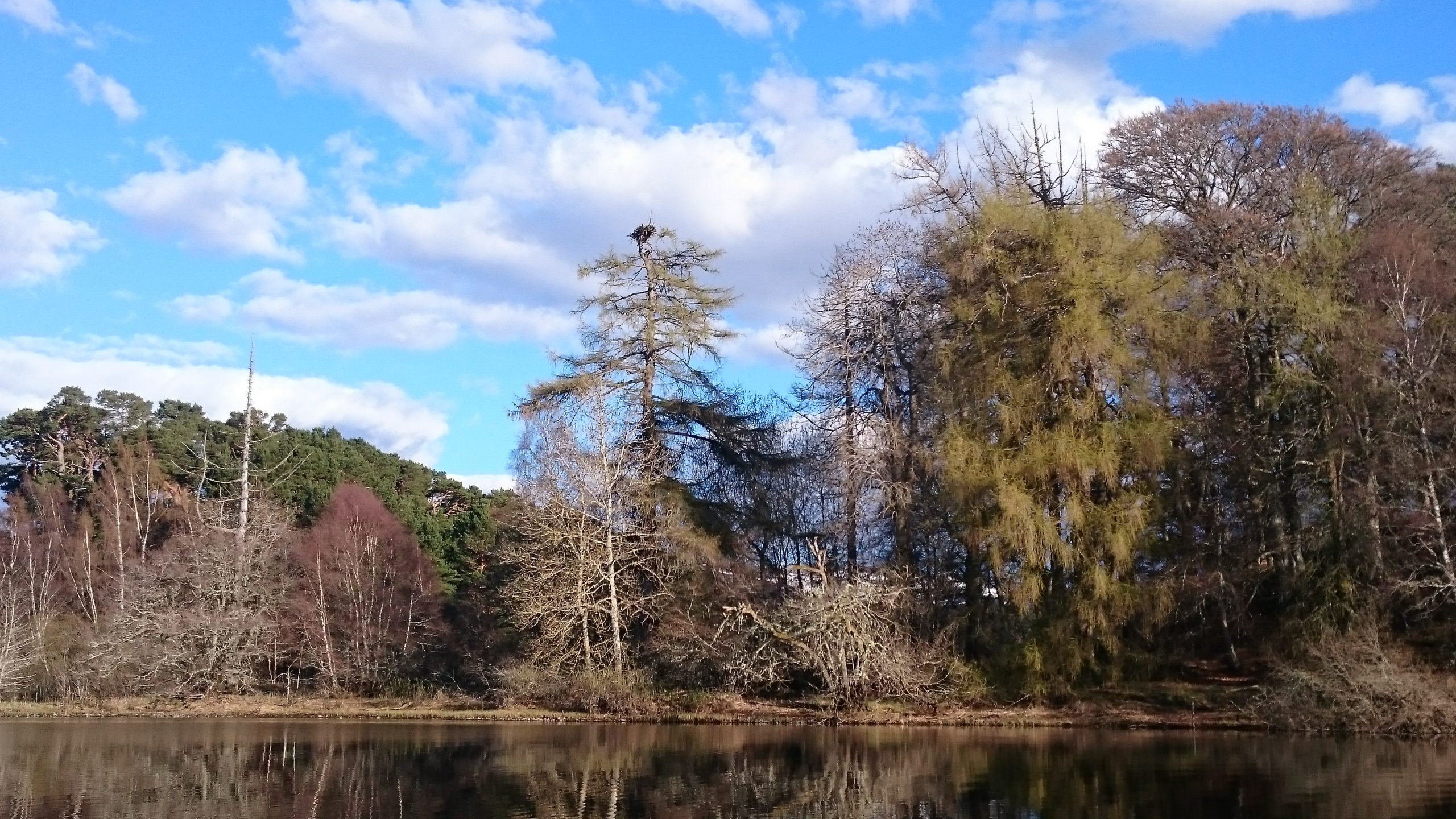
Nature and wildlife are also an important feature of my new novel, Of Stone and Sky. One of the characters, Alex, doesn’t like people very much but adores birds, taking as much time as possible to watch them on his own. This is the beginning of a chapter called Osprey, in the month of August when Alex is 14:
“Before the light, Alex was up, slipping slow and silent through the dark to the loch. The osprey chicks would fly for the first time today, he knew, he knew. He had studied them every day, perched on the edge of the nest as their father circled the loch in protection, swooped like an arrow for fish and brought it back, settling on a branch nearby to keep watch. Alex knew the little ones were ready and he would watch over them with their father.
When he got to the lochside, the dark sky was beginning to glow, turning green like a mallard’s feathers, green like the walls of Tess’s room, green like the inside of his head when he closed his eyes. He sat at the tree foot and watched till the black bulk in the loch became the island of trees and he could make out the nest, till the sun rose behind the mountain and the father bird rose from his roost. And he watched through his binoculars, heart leaping, as the two little ones fell from the tree and rose and fell and rose again. And he was alone with them and drank the air and fed on the light and breathed the smell of trees.
And in his listening and in his stillness he heard another thing. A wrong thing. There were people coming. Not quiet and slow like Bird People, but talking and laughing and pounding their feet.”
To find out why the people’s arrival brings even more distress than Alex could have imagined, and what happens when he strangely volunteers to help with shooting grouse, read Of Stone and Sky. The novel is coming out with Polygon Books on May 6th and the digital launch that day – 7pm BST – is free and open to all. I’d love to see you there! The Eventbrite booking is here.
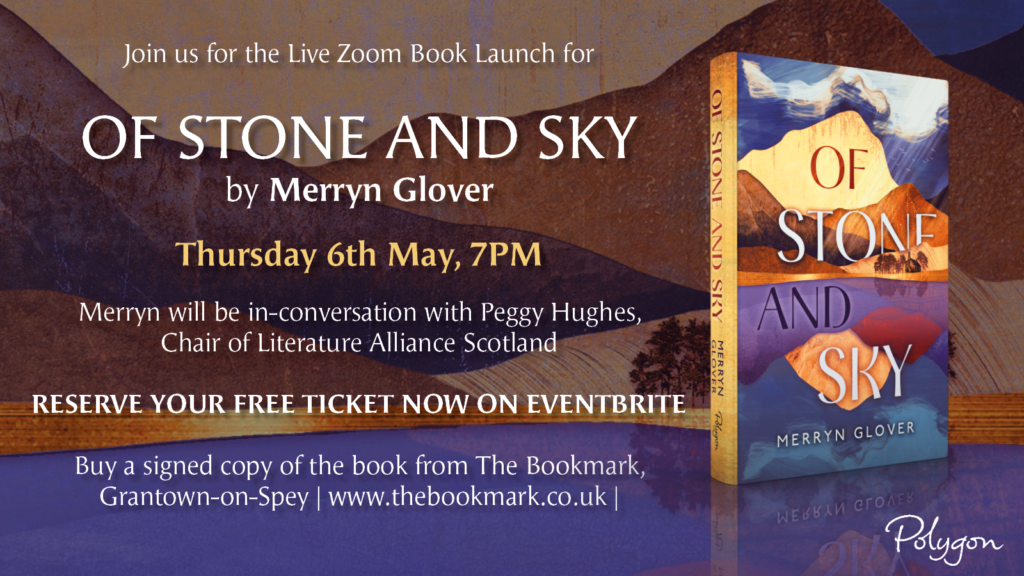
And scroll down on this page for how you can get the book.
It started well. The party included my new husband, Alistair, and three friends, all experienced climbers. I was the only newbie but, hey, I’d grown up in the Himalayas, wasn’t afraid of heights and enjoyed a bit of light scrambling. I’d also recently finished a drama and dance teaching degree, so was fairly flexible and up for a bit of improvisation. The weather looked benign and though the climb they’d picked on the Cobbler – Recess Route – was graded ‘Very Difficult’, everyone was confident I’d be fine. Just fine. Flattered, I believed them. What could possibly go wrong?

I soon found out.
When we got to the crag and started roping up, the clouds began gathering and the views disappeared into fog. That was a disappointment, but not a disaster. Yet. Two of the friends set off together, spidering their way up a nearby route as the other three of us agreed that Al and Myles would take it in turns to lead while I stayed in the middle. It was a multi-pitch climb and I couldn’t see the top from where we stood, but what I could see appeared jolly enough and Myles scaled the first slab without a hair out of place.
I felt a little wobbly following him, but not too bad and I was pleased to reach the top of it. In the chimney that came next, though, I was fumbling to get a good hold and realised this climbing malarkey was trickier than it looked. The mist was now coiling up the hill and I could no longer see the ground. I fleetingly wondered if I could just drop down and maybe do a bit of scrambling instead, but an elaborate plan was underway and I didn’t want to spoil anything. The damp of the cloud began to settle on us, my fingers turning white, the rock turning wet.
At the end of that pitch we got to a tiny ledge and Myles started up the deep chimney round the corner. “Can I just stand at the edge here and watch what you do?” I asked.
Worryingly, he said no.
I sat down beside Al and listened to Myles huffing and puffing and swearing his way up. As the fog billowed around us, I wondered why on earth my nearest and dearest had chosen a climb labelled ‘Very Difficult’ for my first one? Why not ‘Easy’ or ‘Beginner’? I no longer felt flattered by their confidence; I felt betrayed. At another volley of curses from the bowels of the rock, I secretly pondered my chances of getting helicoptered off by Mountain Rescue. Clearly, they were nil.
Then Myles’ faux-cheerful voice sang out from the heavenlies, “False alarm! Perfectly fine!” I laughed. He didn’t detect the irony. Of course it was fine. Just fine.
I worked my way up through the drizzle, wedging myself against wet rock, clutching and clinging to slippery holds, and just managing to supress my own swearing, though not the rattling of my teeth. I was not afraid of heights; I was afraid of the ground, a long way down. On the final pitch I have an abiding memory of Alistair above me straddling the chock stone with both legs shaking. It’s what climbers affectionately call ‘disco leg’ but feels nothing like the joyous abandon of an 80s dance floor. If that was happening to him, what on earth awaited me? I quietly promised myself I would never do it again. At last, crawling over the top, I collapsed onto the grass.
“Did you enjoy that?” Myles asked eagerly.
“I hated it.”
Everyone, including my dear husband, stared at me in astonishment. “But you were laughing!”

“It was laugh or cry.” I’d known I couldn’t fall apart during the climb because that was only going to make it worse for everyone – including me – and there was no escape; no way out but up. I did laugh again, though, at the relief of being alive and the joy that it was over. Forever.
Later, over hot drinks and marital reconciliation back at the house, we read The Cobbler entry in Alistair’s copy of Classic Rock, and were stunned to notice the author had also taken ‘a young female eager to grasp the rock’. What a shame we hadn’t read this beforehand, as John MacKenzie explains that ‘if the cloud is down and wetness is in the air, it is just not worth it: schist is more like soap in those conditions.’ His companion was taken through a worse ordeal than mine with heavier rain ‘washing away her climbing career… In one day she had completed the process of initiation and enthusiasm, experience and caution, and finally the realization of terror, that mere climbers take forty years to undergo.’
I slurped my hot chocolate, feeling both profound sympathy with her and pride to have accomplished – and ended – an illustrious climbing career in an afternoon. I’m even more proud now I know Recess Route has been upgraded to Severe.

Since then Alistair and I have laughed over it and while I did try one or two other climbs, the thorough dousing of that first eager flame seems to have done it for me. Fortunately for us, we both still love mountains and walking and have continued to share that happier ground. But we learned our lesson and offer now our Seven Commandments For Converting Your Companion to Climbing otherwise known as The Cobbler Code, which can, in fact, be applied to just about any adventure sport.
- Start easy – It sounds obvious, but experienced climbers often forget how much skill and fitness they’ve gained and how it feels for a beginner. Do something you can guarantee will be a success and build on that.
- Explain jargon – I didn’t know that ‘Very Difficult’ is actually fairly easy in climbing terms with anything less than Difficult just scrambling. Make sure your partner understands what you’re talking about. Mountaineering Scotland has a handy break-down.
- Explain what to expect – Talk them through what is likely to happen but also what can’t be guaranteed – like the weather. How long will the whole thing take? Be realistic rather than optimistic. Is there a lot of hanging around, faffing with gear, waiting for others, etc?
- Start short – Plan a route that is fairly quick with the option to add more, for example a series of single-pitch climbs. Give your loved one choices along the way and avoid them feeling trapped. “Do you want to do another one or go for coffee?” If they get too scared, miserable, tired or cold (or all of them) with no way out, they’ll simply vow never to do it again. They might make a few dark promises regarding you, too.
- Watch the weather – I know it’s hard in Scotland, but do wait for a fine day. As with The Cobbler, an experience that’s quite innocuous in the dry can become sinister on a foul day. Best site in Scotland is the dedicated Mountain Weather Information Service.
- Encourage and empathise – Don’t patronise but do cheer them on and share how you felt when you were learning. (As long as it wasn’t ‘I was a natural!’) This is a good time to be clear you have brought them because you love their company, not just so they can hold the rope. (Which is why you brought them, right? Be honest, now…)
- Know your loved one – Do they like jumping in at the deep end with a sink or swim attitude? (Not me.) Or do they prefer taking things step at a time and feeling in control? (Me.) If you’re not sure, ask them. And don’t argue when they change their mind…
Whatever happens, don’t let them feel a sense of failure if they don’t embrace climbing, and do forgive them if they burst into tears, shout or spit on your gear. This is probably your fault, not theirs. Though shared adventure sport can be a rewarding part of relationships, it’s not essential. I bailed out of climbing pretty quickly, but have been happily roped to Alistair for life.

This article was first published in the November issue of Scottish Mountaineer, re-posted with kind permission.
Millions of people around the world are celebrating Diwali, the Festival of Light, and it always takes me back to South Asia where I was born and brought up. I returned to work in Nepal with my husband in the late 90s and early 2000s and here is a memory from exactly 20 years ago, first published in the Guardian Weekly. Most of the photos in this post are by kind courtesy of Rowan Butler, whose work can be seen on his site Yaksnap.

This is Bhai Tika, the day for worshipping brothers. My own brother, unworshipped, is sprawled on the grass watching his son and mine at play. It is a late autumn evening in Kathmandu, and the air is whispering of snow. The poplars shiver, casting a handful of leaves to the wind.
My niece charges past and shouts, pointing to the north. There – above the valley of houses, above the eyes of Swayambunath temple, above the wooded hills and a parting drift of cloud – are the mountains. They are shining, white and gold and unearthly as if a veil had just been lifted on the plains of heaven.
Bhai Tika is the last day of Tihar, the Nepali festival of light. In India they call it Diwali, and it is one of the most important events in the Hindu calendar. It celebrates the myth of Rama who rescued his wife Sita from the demon king Ravana. When they returned triumphant to their own city of Ayodhya, the people of the city welcomed them with thousands of oil lamps.

So today, Hindus light up their homes, don new clothes and gather with loved ones for days of feasting and ceremony. In Nepal, the emphasis is on the goddess Laxmi. She is the goddess of luck and wealth, her curvaceous form swathed in a bright sari, gold coins pouring from her palms. In one of the poorest countries of the world, maintaining good relations with Laxmi is vital, and her image adorns nearly every home.

In the classically Hindu spirit of all-embracing devotion, worship at Tihar is offered not only to the goddess of wealth, and one’s brothers, but also to crows, cows and the humble dog. The devout leave out offerings of sweets and rice in woven leaf plates for their animal friends, and many a flea-bitten street mongrel can be seen sporting a garland of marigolds and a red splash of powder on its forehead.

It is a time of riotous celebration, with fireworks exploding through the streets, and bands of musicians playing wild tunes. Bedraggled school-children go door to door with a drum and a limited repertoire of songs that they shout, rather than sing, until you pay them to go.
In a recent trend reflecting the rise in western influence here, some of the wealthier teenagers assemble rock bands on the backs of trucks and regale their neighbours with the very latest in Nepali, Hindi and American pop.

This usually decorous society loses its head a bit, as men drink and gamble, and young folk carouse in the streets and throw loud parties. There is, inevitably, excess and brawling, so my doctor husband works nights in the hospital emergency department to patch up the casualties.
But this is a beautiful season. A month after monsoon, the skies are washed clean, the rice has been harvested and the great Himals appear for lingering moments at the rim of the valley. They are like queens emerging on balconies to gaze briefly down on their subjects before gliding back behind curtains of cloud, as if they believed we could not bear the force of their beauty for any longer.

Here in the valley, young boys fly colourful paper kites from roof tops, as women can be seen picking their way gracefully across muddy streets in saris of vermillion, turqouise and parrot green. Scarlet poinsettias splay out against the sky, bougainvillaeas hang heavy with bunches of deep pink, while trumpet lilies echo the white of the distant snows. Everywhere are the brilliant marigolds: in garden beds, balcony flower pots and in garlands draped above doors and around the necks of dogs and brothers.

Tonight, I bid farewell to my brother and his family and take my son home in his pushchair, bumping and bouncing over the ruts. Darkness is gathering softly and the night smells of firecrackers and smoke. A couple of dogs trot beside us as we pass houses where lights are winking on. We turn in at our gate, stepping around the mandala – the geometric design drawn in powder on the ground. From it, a line of red mud leads towards the landlord’s door. The way is lit by flickering oil lamps. It is all to entice Laxmi to visit and bestow prosperity.
The landlord and his sister meet us at our door with warm greetings and a plate of food – lentil cakes and hard-boiled eggs rolled in spicy sauce. I carry these into the kitchen where the curtains are billowing with the cool breeze. My son pulls closer into my arms. I don’t know where Laxmi is tonight, but beauty has swept in and poured her gifts at my feet.

“October is the coloured month,” Nan Shepherd wrote in The Living Mountain her now-celebrated account of her relationship with the Cairngorm range of Scotland. Here, where I live on the Spey side of those mountains, it is radiantly true. Somehow this transitional time gathers the full spectrum of colours, shades and tones and spills them across the landscape and into our spirits.
Fragments from my journal over the years testify to its moods.
Magical morning with a low mist rising slowly. A clear, pale sky full of the promise of blue, brushed with feathers of grey cloud. The forests ring with the light piping and trilling of birds and thousands of cobwebs stretch across the heather, glittering. The loch is grey and muted, the smooth water broken by a duck’s turn. The mist now is thinning and glowing gold. A disappearing veil, a vanishing breath.

It is a season of contrasts, of shifting temperatures, weather and light, both across the month and within any day. Something within us turns, too, recognising the cycles of laying down and letting go in order to journey forward.
Woke to the first frost of the year and sunshine. Then a sudden, beating rainstorm in the afternoon and when it cleared, the far hills to the east were dusted with white.
It is usually early October when we get the first snow up on the Cairngorms, lying like the ermine cape of a queen, answered by the pure white of the swans on the loch, the ancient stone church and the high clouds. The harbinger of winter, it can suddenly fill the valley in deep drifts this month and send children charging forth with shouts and sledges, but then just as quickly disappear again.
The first week of October brought astonishing weather with temperatures in the low teens. The mornings started in a white blur of frost and mist, then the sun burned through and turned the sky to clear cobalt. A vast brightness, the beginnings of autumn gold, patches of apricot and orange, blushes of red.

The trees are the glory of this time, especially those that are changing, their shades of green losing themselves in the colours of fire. The yellows, bright singing as canaries; the brazen, blazing oranges; the reds of berries and extravagant leaves splashed across the forest. All of it falling. All of it dying. These are the colours of death, of trees that cannot keep pouring out new life but must gather it in to hold fast against winter and wind.

As darkness draws closer around each day, the hours of light become more intense, the lowering sun pierces, the colours glow. We reach out to it, longing for it to last but knowing it is already slipping away, that its potency is its transience, the unbearable radiance of its passing. We ache at all this beauty and loss, knowing this is death; but knowing also, this is life.
The air gets colder and loses all the lazy grassy smells of summer. Instead there is a sharpness, a bracing touch on the cheek. The shadowy folds of the woods crumble into damp, rot and fungus, the odours of rich earth rising with the rain. These are the smells of deep-down, life-giving death.

Our strath falls quiet. The flocks of holiday makers are gone, the bikers and boaters and booted walkers have dwindled. The traffic has thinned, the sports cars zoomed away, the campervans and caravans rattled south. By the middle of the month, many of the breeding birds have flown their nests, too, and the raucous gathering of the skies and waters has hushed. The cries of those that remain are all the keener.
A grey heron flies up the River Spey, a giant bird with an abrasive croak. All pointy beak, elbows and knees, like a living missile firing north.
In October, only the wind gets louder.
A violent storm with gales of 70 miles per hour battering the north and east of Scotland. Trees have come down, branches fallen, twigs with clusters of leaves strewn everywhere. In the valley, a steady, pounding rain and the roof of the school begins to leak.

Then there are days emptied of all colour and sound, where even the sky has vanished.
Down by the loch in the morning, the world is deep in fog and the water perfectly still. There is no texture and no movement, just a soft grey milky-ness hiding everything. The island, the trees, the rushes emerge like brush strokes in a pale wash, delicate and half-formed as a Japanese painting. The only shining thing is the string of spider webs along the wooden planks of the bridge.

After the endless light of Highland summer and the gentle settling of September, October dusk falls at dinner time, charcoal soft and tugging us home to the smells of wood smoke in cold air. Night unfurls herself, taking ever more time and space, spreading brighter stars and bigger moons across her black beauty. There will be owls and firesides. There will be dark.

And there will be day.
A walk along Speybank looking across to the risen sun above the Feshie hills. Mist ghosting across the surface of the river; mist resting in a downy layer against the slopes. Clouds hang motionless above the ridge, holding their breath as beams of sunlight pierce them. The long grasses by the water are all the shades of rough metal – pewter, silver, copper – and the brassy leaves of the aspen glow and tremble, as if filled by the Spirit. The skin of an oak leaf is slick and beaded with dew; the rock-rippling of the burn carries on under birdsong; I hold still. From the dark conifer forest beyond the fields, a lone bird lifts above the trees, white wings flashing in the light. A skein of geese furrows the sky, calling and calling. A single gold leaf falls to earth.

This article was first published on the LandLines Project Blog
Friends and faithful readers of Writing the Way, I cannot tell you how happy I am to share this news with you. Below is today’s press release from Scottish independent publisher, *Polygon:
FACT AND FICTION: TWO-BOOK DEAL FOR MERRYN GLOVER’S CAIRNGORMS
Polygon, an imprint of Birlinn Limited, has signed Merryn Glover to a two-book deal for a novel and a non-fiction work each set in the Cairngorm mountains. Glover was the first writer in residence at the Cairngorms National Park and has won Creative Scotland support for both projects.
Polygon has bought World All Language rights from Cathryn Summerhayes at Curtis Brown and will publish novel Of Stone and Sky in Spring 2021 and The Hidden Fires: A Cairngorms Journey with Nan Shepherd in 2022.
Of Stone and Sky is a multi-generational family story set in the Scottish Highlands. After shepherd Colvin Munro disappears, a mysterious trail of his twelve possessions leads into the Cairngorm mountains. His foster sister Mo and prodigal brother Sorley are driven to discover the forces that led to his disappearance. Spanning almost a century, the novel is a paean to the bonds between people, their land and way of life. A profound mystery, a political manifesto and a passionate story of love, the novel is shot through with wisdom and humour.
The Hidden Fires is Glover’s response to Nan Shepherd’s The Living Mountain. Drawing from her upbringing in the Himalayas and gradual adaptation to Scotland’s hills, she contrasts her own Cairngorm experiences with Shepherd’s. Exploring the same landscapes and themes of the classic work, she challenges herself and the reader to new understandings of this mountain range and its significance in contemporary Scotland.
Edward Crossan, Editor at Polygon, said: ‘I am thrilled that we are publishing Merryn Glover, an exceptional writer. Her moving and profound novel, Of Stone and Sky, was commissioned on the strength of its compelling narrative and elegant prose. Her non-fiction work, The Hidden Fires, which uses The Living Mountain as its guiding light, is a poetic piece of nature writing, a fitting tribute to Nan Shepherd, and is so vital now, more than ever.’
Glover is the author of A House Called Askival (Freight, 2014), four radio plays for BBC Radio 4 and BBC Radio Scotland and numerous short stories. She was born in Kathmandu and grew up in Nepal, India and Pakistan. Australian by citizenship, she lives in the Highlands and has called Scotland home for over 25 years.
Glover said, “I am honoured and excited to be published by Polygon, a proud, independent Scottish publisher and the perfect home for these books, so rooted in Scotland. I am also delighted that Polygon matches the international vision and wide reach that is so important in my work”

- Polygon Books is an imprint of Birlinn Limited, Scotland’s largest independent publisher. It publishes literary fiction, poetry, and books on popular culture from award-winning writers such as Liz Lochhead, Norman MacCaig, Jenni Fagan, Stuart Cosgrove, and the author of The No. 1 Ladies’ Detective Agency, Alexander McCall Smith. Polygon was originally established by students of Edinburgh University, including a young Gordon Brown, in the late 1960s. It became part of Birlinn Limited in 2002. In 2018, Polygon was the home of the Centenary Edition of the Novels of Muriel Spark.
- Press release on Polygon’s site here.
I have a bright red hand-written postcard on my desk. It reads: “Dear Merryn, How lovely to write, write, write! Everything is online at the moment, which is so fantastically useful, of course, and also rather dull! I was so amazed at the wonderful three way coincidence that Askival created. What a lovely thing. Wishing you a happy day. Speak soon, Love, Kat”
The coincidence was one of those joyous, surprising gifts that arrive just when you need a boost. It began when Kat, a perfect stranger, ordered A House Called Askival via Amazon. I sent the book, enclosing a personal note, and was delighted to get a message of thanks and a request for another copy for her friend, Dave, who had connections with Nepal and Scotland. I sent it to her, inscribed to him, and Kat and I struck up an email exchange about life in lockdown with two sons. Mine are home from Uni and entertaining themselves making music and mess in equal measure, while hers are still primary age. I admired her cheerfulness and creativity with home-schooling and how she makes time for reading in the midst of extra-busy motherhood. I shared with her the anthology Stay at Home! Poems and Prose for Children in Lockdown and was chuffed when her boys’ Head Teacher used it in her Google classroom to inspire creative writing.

It turns out that Kat’s book group in the south of England are reading Askival. It was suggested by a member of the group who is the mother of the partner of a former colleague of mine from Kingussie High School! Word does get around. That in itself was a happy coincidence and plans are afoot for me to meet the group via video when they’ve finished it. (I’ve already met with a US book group via Facebook Messenger video, and it was easy and fun. Do get in touch if you’d like me to meet with yours. Lots of platforms and formats possible and completely free!)
A few days later, I dropped an email about a Society of Authors question to a writer contact whom I’ve only met online and got an immediate reply: “How strange that you should write today! Last night a friend gave me a signed copy of Askival inscribed ‘For Dave, enjoy this journey to India’. I don’t think she knows I know you. I can’t wait to read it.” As I said in my reply to him, what a weird and wonderful circle; what a small and beautiful world.

Kat & son sharing Askival smiles
It still gives me a thrill every time a new reader discovers A House Called Askival. Eight years in the making, it was originally published in hardback in 2014 by Freight Books with the paperback coming out the following year. I have so many happy memories of those two years and the book events which started at the Cup Tea Lounge in Glasgow, which had once been the Bank of India – how fitting! And to celebrate the paperback launch in 2015, we climbed Askival on the island of Rum, left a copy on top registered with BookCrossing and enjoyed what happened next:
Then in July of 2015 I had a two-week, Do-it-Yourself book tour of North America, sparked by an invitation to speak at my Indian high school’s reunion in Minnesota. Arriving in Boston on US Independence Day, I went on to Chicago, St Paul and Toronto, re-connecting with dear friends from many eras of my life and making so many new ones. You can read the story of that very special time here.

Before my event at SubText Books, St Paul
Even better than a new reader is when they tell me what the book has meant to them. Here’s a message from a teenager right after launch:
I just finished reading Askival.Yes, it’s 12:30, I stayed up to finish it because I couldn’t put it down… I don’t think I have an adequate vocabulary to describe how I feel about it, I just love it a whole lot. I just needed to tell you that I hate you for making me so sad but also congratulations because it’s a beautiful kind of sadness.
And here’s another from last month, from a man in his 60s:
Dear Merryn, it’s midnight, my wife is asleep, I’ve just reached the end of Askival and I’m lying here howling—well, not out loud, but certainly requiring a large handkerchief. So, so beautiful, I can almost feel that dawn breaking. Thank you.

Sunrise in Mussoorie, where A House Called Askival is set. Photo: Steve Alter
And there have been many in between. I treasure every single response, keep as many as possible and reply to everyone who writes to me. There are also a goodly stack of reviews online including from India, such as the blogger BookstopCorner: “This heart-touching story provides a stunning outlook as well as the most remarkable view on my very own country and it’s enriching history.” Amazon and Goodreads give a wide range of reaction and if you haven’t already, adding yours there is a huge help to me. Even a short sentence makes a big difference.
This feels like a good time to celebrate A House Called Askival. It’s fifteen years since the summer I started writing it, seven years since I signed that first exciting book contract and five years since the paperback tours. More significantly, September 5th marks 100 years since Mahatma Gandhi launched the Non-Cooperation Movement in his first campaign to move India towards self-governance. The struggle took 27 years but at midnight on August 14th & 15th 1947, the newly-formed Pakistan and India gained independence. These events are a key thread in Askival, which explores issues of religious conflict on political, family and individual levels and draws from the stories that eye-witnesses shared with me. Following three generations of an American family and their close Indian ties, the book is ultimately about reconciliation.
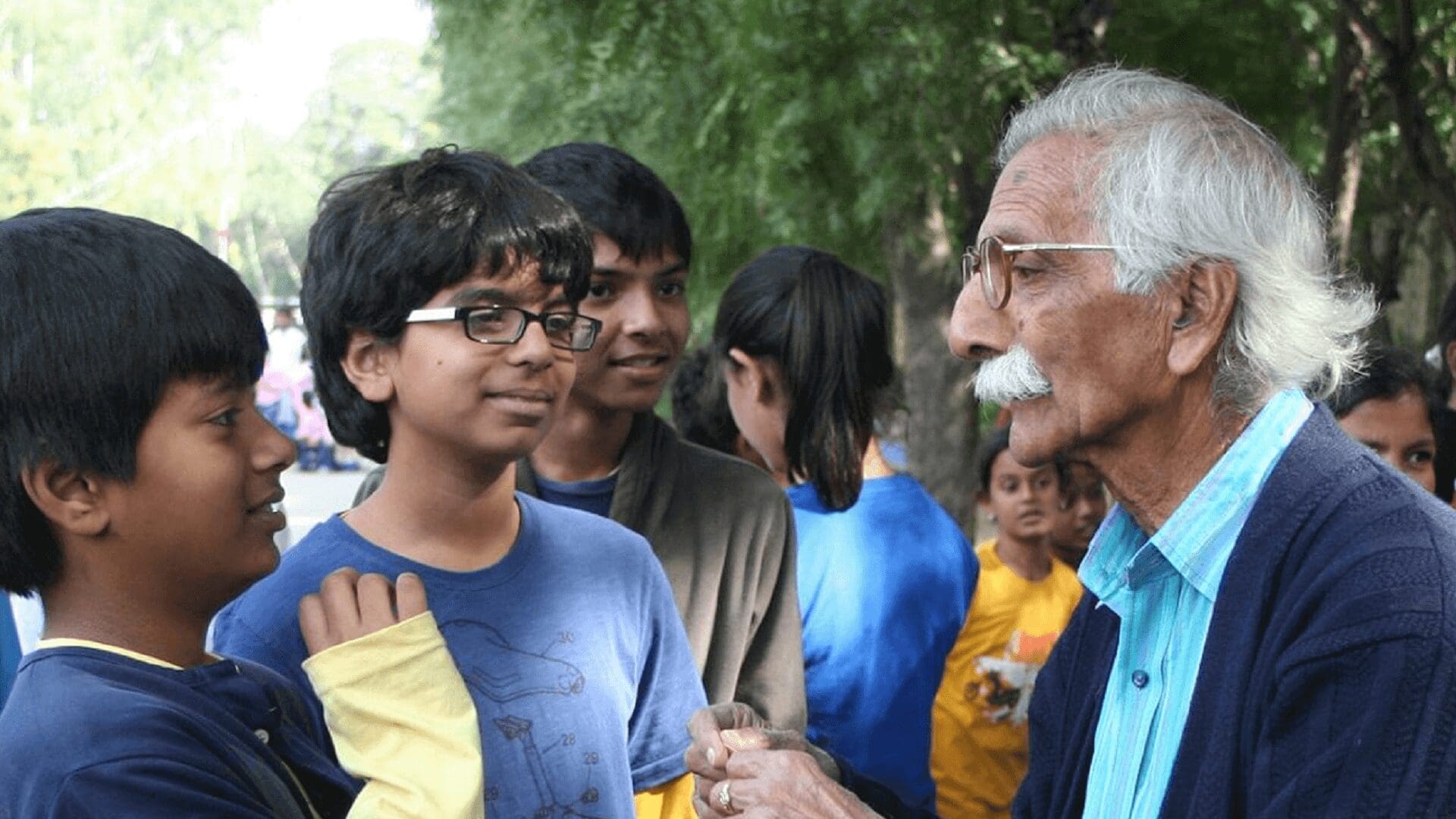
Kavi Singh, one of my informants who was in Mussoorie in 1947
To mark Independence celebrations, and South Asian Heritage Month in the UK, I’m making the e-book available on Kindle from 9th to 15th of August at the discount price of 99p UK / 99c US (and equivalent in other locations). For anyone who still prefers a paper copy, I have almost run out of Freight’s original edition, which I bought when the company went under, but I am setting up an account with a printer who supplies online retailers, bookstores and libraries. You can get a personally signed copy from me and any orders received by 15th August will get the special discount rate of £6.99 + postage – while stocks last! Drop me a note if you’re keen.
Till then, thank you again to everyone who has bought or borrowed A House Called Askival, read, recommended, reviewed and written to me about it. And if you haven’t already, I would love for you to discover it. A story only exists in the telling, and for that there must be a listener. I am honoured each time a new listener lends me their ear, and even more when they tell me something of their story in return. Do join in.

Thank you for reading this post. To stay in touch with upcoming book and event news, I’d love you to sign up for my newsletter here and/or meet me on Facebook, Instagram or Twitter. And hopefully, one day, in person!