


On May 1st I got this email:
“I am putting together a collection of poems and short prose by children’s authors in Scotland for ebook publication. Titled Stay at Home! Poems and Prose for Children by Authors Living in Scotland – it will help children come to terms with the changes we are experiencing under lockdown… I would like to invite you to make a contribution, and very much hope you will be able to take part.”
The email had been sent by Joan Haig, whom I’ve only ‘met’ on Twitter but whose debut novel Tiger Skin Rug has been winning much praise since its publication earlier this year. It was immediately clear to me that this inspirational project was in the best possible hands as her emails were packed with information, step-by-step timeframes, instructions and spreadsheets. Oh how I love organised people! Even more, though, she was brimming with infectious enthusiasm. The cherry on the cake – or the raspberry, more aptly – was the publisher, Cranachan.
Cranachan is the name of a beloved Scottish dessert made of toasted oatmeal, whipped cream, whisky and raspberries which is often served at Hogmanay or Burns Suppers. It’s also the name of a dynamic independent publisher of children’s books based on the Outer Hebridean island of Lewis, run by the equally dynamic Anne Glennie. With a diverse selection of titles from Barbara Henderson’s historical fiction to Caroline Logan’s fantasy series, it punches far above its weight and, being small, can be nimble. Perfect, then, for a project like this.
Of course I said yes.
The only startling piece of information in Joan’s super-organised email was the plan to launch by the end of May. Gulp. It certainly focused the mind and I jumped right in, looking down the list of potential topics, grouped in three broad categories:
Life in Lockdown The ups and downs of self-isolation.
Everyday Superheroes Celebrating the keyworkers who are helping us through the pandemic.
The World Beyond Our Windows Nature, wildlife, cultures, castles in the sky, stars & space…
Having seriously caught the poetry bug last year in my residency with the National Park, I chose to write a poem on rainbows celebrating our everyday super-heroes.

Spotted in my village
So how do you write a poem? Like all writing, there will be ideas humming around your head, but the piece only really begins when words hit the page. This time I started by thinking about what we associate with each colour in the rainbow. As ever, Google gives entertaining results and wastes a lot of time. (All essential writer’s ‘research’, of course.) So, there are the obvious things, like green grass and blue sky, but what about the feelings and meanings generated by each colour? Quite serendipitously, I came across an interesting radio 4 programme The Story of Colour that explored different understandings across time and cultures. Fortunately for the children of Scotland, I decided against referencing Newton and Goethe in my poem, though it was a close call. Finally, I pondered which ‘everyday superheroes’ to include and which colour best expressed what they do for us.
After a few drafts, I sent it out to readers for feedback. Two were good friends, both mothers who have worked as early years educators; another was my poetry buddy Karen Hodgson Pryce, who is getting increasing and deserved publishing success and who always improves my work; and the final and crucial readers were my 6 year-old godson Jonathan and his 9 year-old brother, Micah. Their conscientious Mum got them each to read the draft aloud to her and then emailed their responses back to me. Wonderfully, they both enjoyed it and, interestingly, had different levels of understanding around the metaphors, which I felt was age-appropriate.

Junior literary consultants hard at work
Having absorbed the feedback and tweaked the poem over a week or so (which can include taking a comma out and putting it back in the next day), I sent it off and got ready for the digital launch. Like half the planet, I’d already discovered and got sort-of accustomed to Zoom during coronavirus, but had never before attended a virtual book launch, far less contributed to one. It was an honour to be asked to read, so I uploaded a rainbow photo as my background, posted launch invites and found clothes that didn’t look like pyjamas.
Thus, on the afternoon of 28th of May 2020 we held the launch of Stay at Home! It was fun to see Joan, Anne and all the other writers popping onto my screen for the pre-launch meeting, everyone waving and calling out hellos. They included Maisie Chan , Alastair Chisolm and Linda Strachan, who has not only written dozens of books for children but also the Writers’ and Artists’ Guide to Writing for Children and YA. Some folk were on Zoom for the first time and there were kids and other house-mates wandering past or talking from the side-lines. A wee boy asked if he could eat the whole brownie and I’ve no idea what his Mum wanted, but the rest of us said yes.
Once ‘attendees’ were with us (invisible and muted, alas), we had a welcome from Joan, readings and Q&A. It was fitting to kick off with Chief Chebe’s hilarious story Abiba’s Zoom and interesting to hear from illustrator Darren Gate, whose cover captures all the creativity and love holding families together behind lockdown. Look out for the tiny mouse and the gorilla on the bicycle inside the book, too!

But just as everyone was having a fabulous time, our call got cut off. (My moment of poetry fame so cruelly wrenched from me!) After a few frantic texts to and fro, the contributors re-assembled an hour later to record the second-half, although we had, of course, lost our audience. Fear not, the whole thing is stitched together and posted on the Cranachan YouTube channel. (I’m at 35:10. Thanks for asking.)
Finally, there is a wonderful section at the back of the book called Your Turn packed with ideas for children to do their own creative writing in response to the pandemic. It includes prompts like Lockdown for Dummies and Nessie on the Loose. Teachers and home-schooling parents, this gold.
Everyone involved in Stay at Home! has donated their time and skills, so the book is completely FREE. You can find it here to download and read on any device. Do please spread the word so it can be used and enjoyed as a gift from children’s writers in Scotland to kids all over the world.

Contributors to the Stay at Home! anthology
Finally, you might be wondering why I got invited. Snap. I can only hope it wasn’t a terrible mistake but that some little bird told the organisers I have written a novel for children which is currently out on submission. Anyway, thanks to Stay at Home! I can now definitely say I am a published children’s writer.
Here, then, is Rainbows. Wherever you are and whatever lockdown has meant for you and your loved ones, I do hope these words touch you.

Ullapool
Rainbows
Red is for rosy apples and warm winter gloves
for carers working everywhere with hearts full of love.
Orange is for oranges, bright as the rising sun
for teachers making videos so learning can be fun.
Yellow is for buttercups, bananas and busy bees
for bin lorries passing by and budgies eating cheese.
Green is for gardens and finches in the hedge,
for farmers and food workers bringing healthy veg.
Blue is for rivers and the tears of our goodbyes,
for doctors, nurses, cleaners and all angels in disguise.
Indigo is for evenings and bedtime stories told
with families who treasure us and teddies to hold.
Violet is for dreaming from the cloud-boat of your bed,
going on great adventures in the worlds inside your head.
Rainbows are bright colours held together in one rope;
light in stormy weather, rainbows are for hope.
It’s the Cairngorms Nature at Home Big 10 Days! This WAS going to be the Cairngorms Nature Big Weekend and I WAS going to be over with the rangers in The Cabrach in Morayshire leading a family story-making session. Hopefully, all of that can still happen next year, but in the meantime the folks at Cairngorms Nature have organised a fantastic programme of virtual events from 15th to 24th May. That means people all around the world can enjoy this exceptional place while staying safely at home.
To mark the event, I’m sharing a nature poem each day on Instagram and Twitter. The ten together make up a series called The High Tongue, printed below, which were my contribution to our Shared Stories anthology last year. Exploring the names of ten of the Cairngorm mountains, each title begins with the anglicised version, followed by the Gaelic spelling (if different) and then the translation, which is explored in the rest of the poem. They are all Cairngorms Lyrics. This is a new poetic form I invented last year as Writer in Residence for the Park and you can read all about it here. (For pronunciation of the Gaelic names, look out for a recording I’ll post soon of me reading them all.)
Ben MacDuie – Beinn MacDuibh
The Mountain of the Son of Duff

High King of Thunder
Old Grey Man
Chief of the Range
Head of the Clan


Cairn Gorm – An Càrn Gorm
The Blue Mountain

Rainbow height:

blaeberry
bog         brown
red         deer
snow        white
blackbird
dog         violet
moss        green
bright

The view from the top of Cairngorm
Carn Ealer - Carn an Fhidhleir
Mountain of the Fiddler

She plays the rock
with the bow of the wind
for the stars to dance


Cairn Toul – Càrn an t-Sabhail
The Barn Shaped Mountain

Storehouse of stone

Boulders shouldering like beasts
in this dark byre

Hail drumming the watershed

Cairn Toul
Ben Vuirich – Beinn a’ Bhùirich
Mountain of the Roaring

Once the haunt of wolves
       howling at night

             now just their ghosts
                             in failing light


Coire an t-Sneachda – Coirie an t-Sneachdaidh
Corrie of the Snow

Bowl of white light
black rock       wind run        ice hold
hollow of the mountain’s hand

Coire an t-Sneachda
Beinn a’ Bhuird
The Mountain of the Table

Giants gather in clouds of black
for a bite and a blether,
bit of craic.


Ben A’an – Beinn Athfhinn
Mountain of the River A’an

in a cleft of silence
hidden loch       secret river
   name breathed out
      like a sigh

Loch Avon
Braeriach – Am Bràigh Riabhach
The Brindled Upland

freckled speckled wind rippled
  shape shifting fallen sky
dark    light    shadow     bright
              land up high


Am Monadh Ruadh
The Red Mountains

Range of russet hills
forged in fire at first sunrise
old rust rock
glowing still

Am Monadh Ruadh
A month ago I was in Nepal. The month since has been the most tumultuous in my living memory as the world has struggled to come to grips with the coronavirus. But at the same time, for me personally, it has become one of the quietest months as the dear friends who were sharing our home moved to separate accommodation, my external work dried up and local traffic dwindled. That is one of the many anomalies of this pandemic. While the whole world shares the crisis, at no time have the differences in our lives been so stark.

Women laying foundations in Kathmandu

A luxury club just around the corner
On every level, I am one of the lucky few. My extended family are in good health, with incomes and safe, comfortable homes in countries providing free medical care and financial assistance. None of us have small children to educate and entertain, nor are we in tiny flats several floors up a tower block, or worse: both. In fact, my own family live in the Cairngorms National Park with some of the UK’s most beautiful landscape on our doorstep. Perhaps more significantly, our families are harmonious and enjoying the time together; there is little risk of domestic violence or impending divorce.
But we don’t take the credit for this. All the privileges listed above make it so much easier to have happy families. Where people struggle with financial crisis, inadequate housing, little access to green spaces and chronic poor health, as well as the cumulative effect of these challenges down through generations, it is almost inevitable that relationships crack under the strain. And that very loss of supportive family connection only intensifies all the other problems, trapping people in downward spirals.
I am certainly not suggesting that everyone in straitened circumstances has broken relationships. Far from it. Many are part of strong family and community networks that defy the odds in sustaining loving, happy homes. But to do so they have to work a heck of a lot harder. And in times of extreme additional pressure, like the pandemic, it is these families that are most vulnerable. It is these families I ache for when I am lucky enough to cycle to a lochan in the Caledonian pinewoods and listen to nothing but wind, water and birds.
It is these families I keep wishing could somehow be evacuated from urban sink estates to all the empty holiday houses in this beautiful, wide-open space. I know why that’s not possible: health services here don’t have capacity for the influx, nor the medical records and history; supermarkets and other infrastructure wouldn’t cope; there would be huge risk of bringing infection to a relatively safe area. But it throws into sharp relief the fundamental in-balances in our country: how it is possible for some people to own two houses, both in nice areas, when others are homeless?

Uath Lochans, Glen Feshie
But beyond the very real challenges of the poor in this country, I find my thoughts return continually to Nepal. I am hearing from friends there about the effect of the government’s very strict and sudden lockdown in mid-March, with no notice or time to prepare. It was introduced despite only three confirmed cases in the country and no deaths. Naturally, there is enormous anxiety about how Nepal could possibly cope if and when the wave hits. As my friends who work in one of Kathmandu’s major hospitals said, “If the wealthiest nations in the world struggle to contain death rates, we can only imagine what it will look like in a country where a UNICEF survey found that 53% of health facilities across the country lack a handwashing facility with soap and water (questions about numbers of ventilators are likely superfluous).”
But they are not alone in recognising that the greater challenge for Nepal is injustice and that draconian lockdown measures crush the poor. Those such as the brick factory labourers who already live in crowded hovels earning a pittance for doing filthy work which has now stopped; shop-keepers unable to sell anything; cooks, cleaners, guides and porters in the collapsed tourist industry, which is by far Nepal’s biggest source of income. And there is no promise of government financial aid.

Shacks built on a rubbish heap, Kathmandu
A similar disaster, though on a much bigger scale, is being played out in India, another country close to my heart. For an insightful on-the-ground account read Vivek Minezez’ piece in The Guardian. Essentially, the picture is the same: the virus threat and government response exposes and exacerbates the gap between rich and poor. Meanwhile, in Africa, there are mounting concerns about the abuse of human rights and political power in the way lockdowns are enforced. Again, it is the already marginalised and oppressed that suffer most. A friend in South Africa works for U/Turn, a homelessness charity. Quite apart from the people they serve, some of their staff live in crowded townships where people feel more threatened by starvation and violence than coronavirus.
If Covid19 is teaching us anything, it must be that we are both inextricably connected and deeply divided. We can learn from both, by working better together to share resources to protect public health – not just freak pandemics but the long-running diseases like tuberculosis and malaria that take millions of lives every year – but also to change the structures and systems of global injustice.

Giving a polio vaccine, Nepal. Photo: Ian Smith
Those tasks will take time and demand that the privileged amongst us use our power and voice to lobby our governments, large corporations and international bodies. But in the meantime, if you would like to do something TODAY to help the world’s poorest communities at this devastating time, here are some organisations at the frontlines that I commend to you:
U-Turn in South Africa equips people with skills and work opportunities to overcome homelessness.
Dignity and Freedom Network aims to see the poor, marginalised and outcastes of South Asia transition to living in Dignity and Freedom.
United Mission to Nepal, works for fullness of life for all, in a transformed Nepali society. It is facing a critical need right now to save its two hospitals
Friends of Patan Hospital, Kathmandu
WaterAid has teams in 28 countries across the world, working with partners to transform millions of lives every year by improving access to clean water, toilets and hygiene.
Ghachok village sprawls across a sloping plateau below Machapuchare – Fishtail Mountain – one of the most striking in Nepal. At the centre of the Annapurana range, the peak rises in a sharp triangle that has never been climbed, since a failed attempt in 1957 when it was declared sacred and out of bounds. The mountain stood like a shining guardian over much of my early childhood in the Gurung village that now falls just within the Annapurna Conservation Area Project.
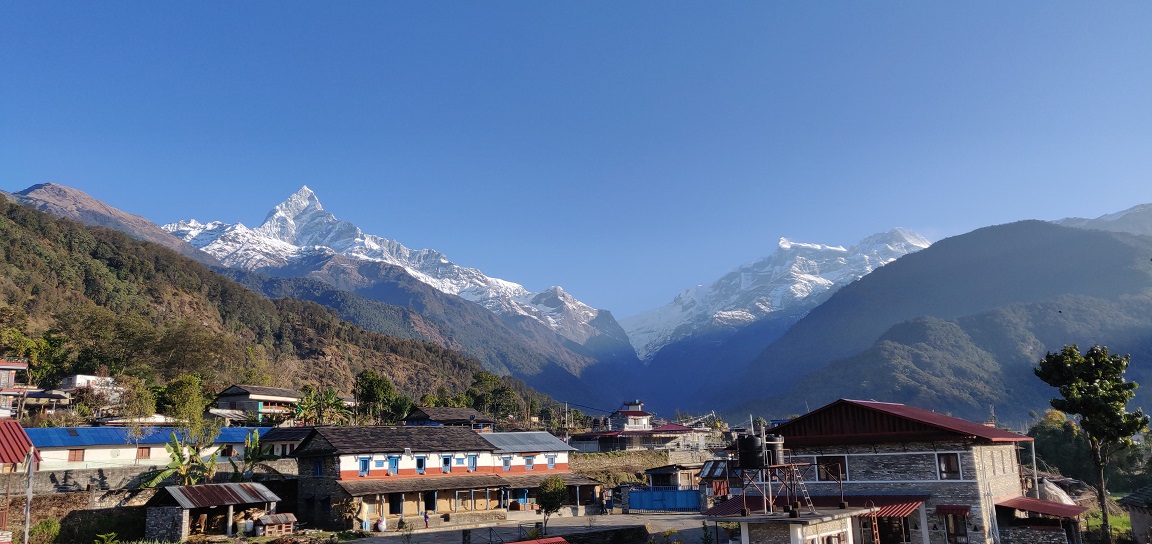
When I was first carried there as a baby in 1969, there was no Project and no road. The walk took four hours and involved crossing the foaming Seti river on a swaying bridge made of three bamboo poles. I was under three when my Dad got me to walk the whole way, requiring multiple rests at tea shops and several extra hours. I don’t remember that occasion, but I do remember many later trips when he kept me and my older brother, Mark, going with stories: Aesop’s fables, Bible tales, the history of Nepal.
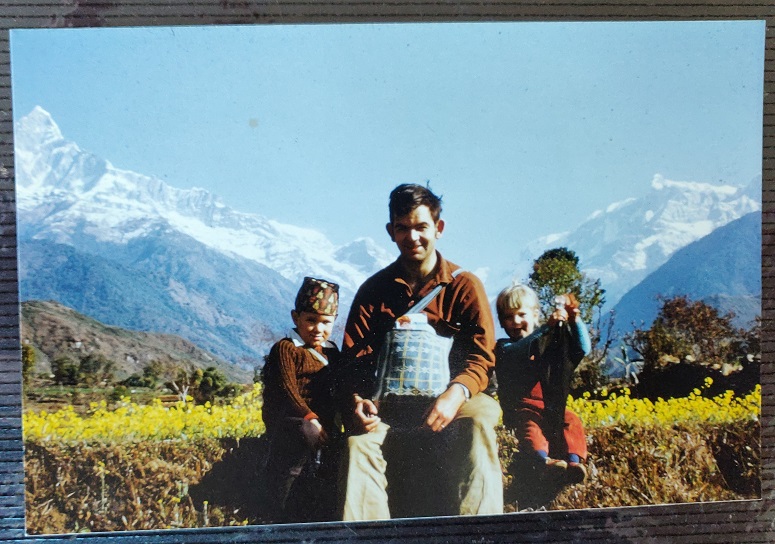
Mark, Warren & Merryn
My parents were working in linguistics and literacy among the Gurungs, who are one of over 100 ethnic groups in Nepal and one of the four groups that can join the Gurkhas. Their language – which they call Tamukyui – is from the Tibeto-Burman family and had never been written down. My parents worked with them over the years to choose a script and to represent their language in it; the Gurungs chose Devanagari, used for Nepali and Hindi, because they learn it in school.
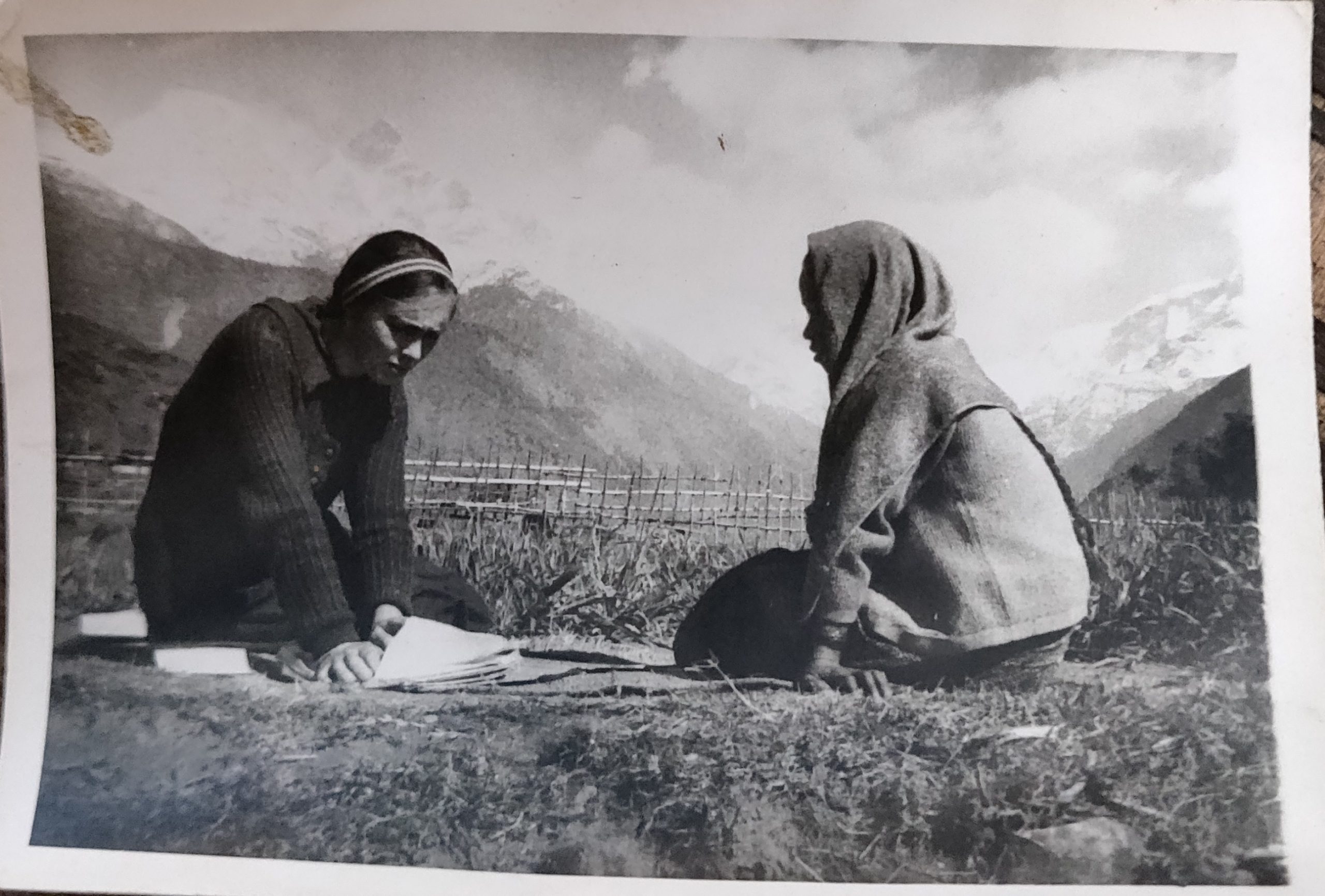
Jessie and Amjoh
We lived in the village for several months at a stretch over a period of 9 years as my parents learned the language and culture, taking copious recordings and notes. Back then, there was no electricity and all water had to be carried on backs from a source higher up the plateau. We had the only kerosene pressure lamp in the community, which meant our home was packed every night with visitors eager to flick through the National Geographic magazines and the View Master slides. (Congratulations to anyone old enough to remember what that is!)
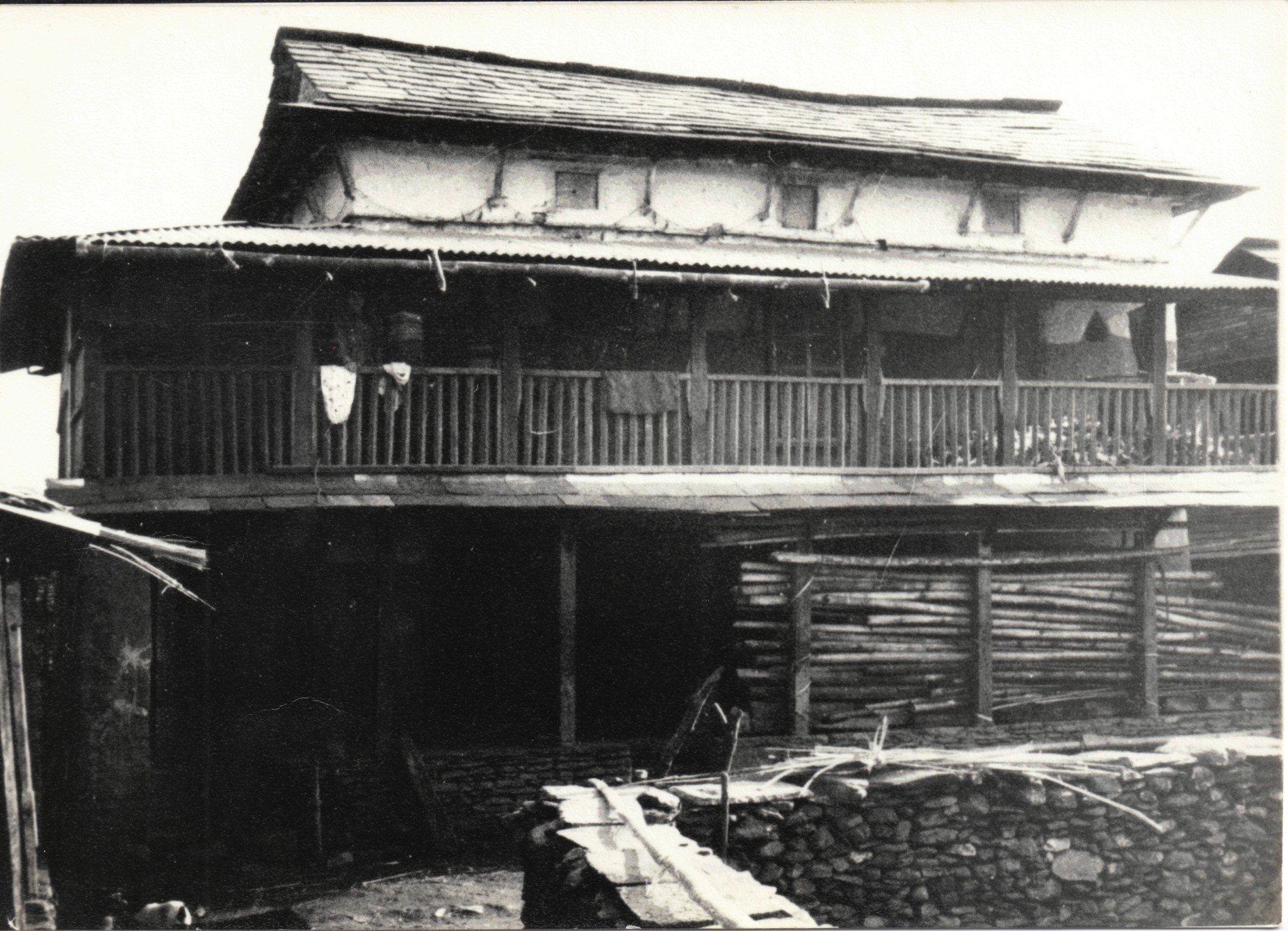
Our home was the middle floor of a house that the landlord had especially constructed to be high enough for my Dad, but like all village dwellings, had only wooden shutters and no glass in the windows. The buffalos and goats lived on the ground floor below us, while the rats had the penthouse, scuttling among the baskets of grains and corncobs under the slate roof. We had one room divided into sleeping and living areas by a sheet of orange hessian, with a half-panelled lean-to at the end that served as ‘office’. Our ‘bathroom’ was a round plastic basin and the ‘toilet’ was a pit in the neighbouring field, surrounded by bamboo matting. My father’s Time magazines were torn into squares for loo roll, though it was a bit too shiny for the job and made for a frustrating reading experience.
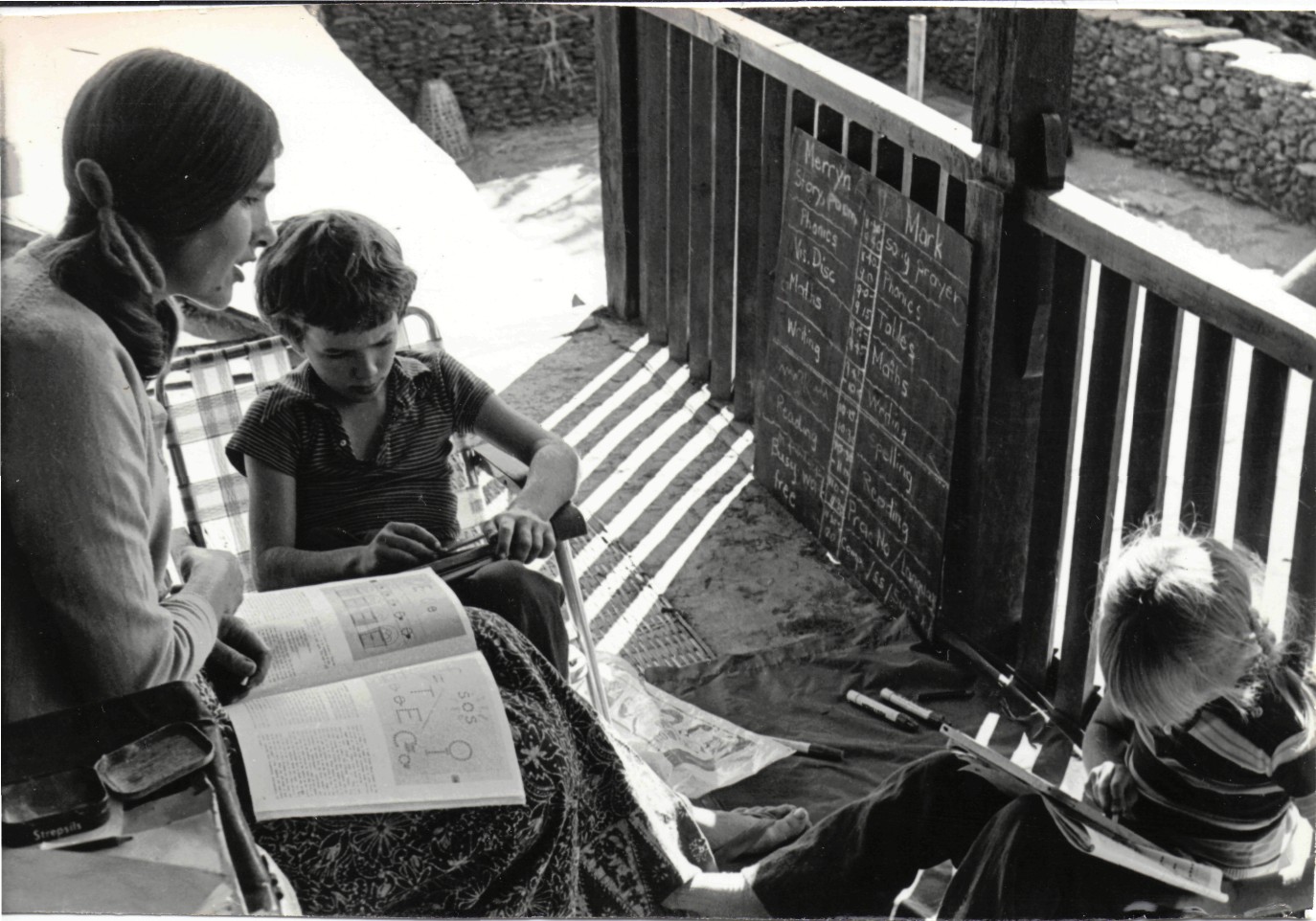
My mother home-schooled us at one end of the front verandah, while a growing number of village folk queued patiently at the other, waiting for her to tend their injuries and ailments. Watching her dispense pills in folded paper packets and daub Gentian Violet on cuts, I always assumed she was a nurse. It was years before I realised she was actually a teacher and relied on the legendary text Where There is No Doctor to help the community and keep us alive.
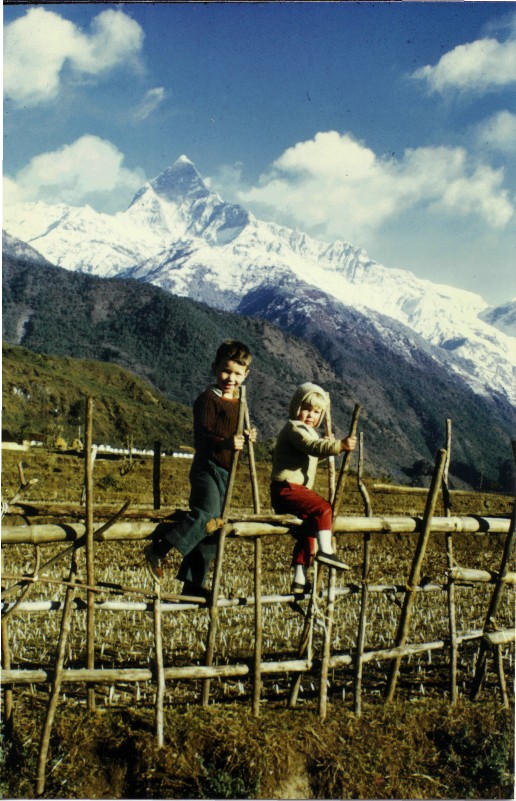
Like other village kids, Mark and I took a turn of perching on the high bamboo fences to scare off the monkeys from the crops and joined the procession to a central field for the slaughter and butchering of a buffalo. The meat was so tough that even pressure-cooking rendered it barely edible. Animals were everywhere, as was their life and death, their ritual sacrifice and place on the menu. I skipped across the stone-paved yard past flustered chickens who turned up in curry a few hours later, chopped into squares with feet and comb included. We always had a cat to ward off the rats, but my favourite animals were the baby goats, who had silky coats and velvet ears and never fought off my cuddles.
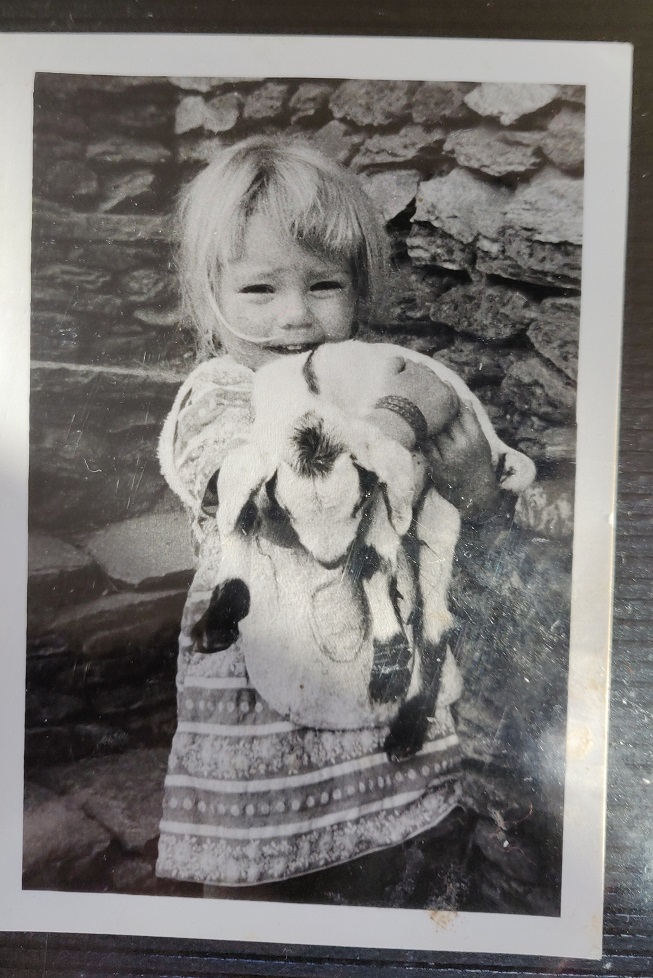
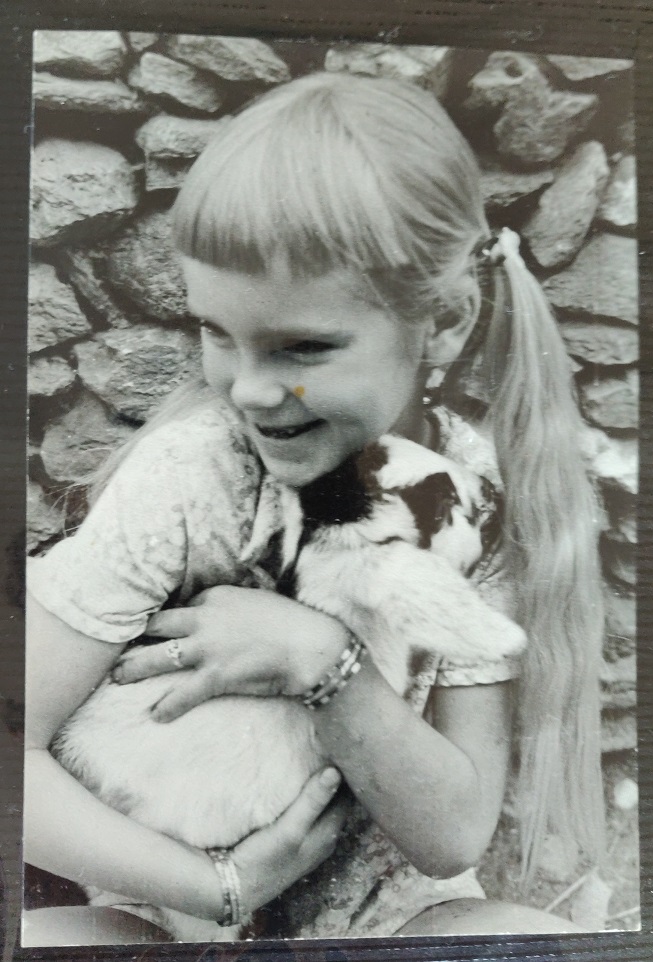
Our school lessons only lasted a few hours each morning and the rest of the time we were free to roam with our village friends. Playtime was often a blend of their games with our toys. Our parents were careful to keep our possessions minimal in the village, but Mark’s trainset was a great hit as was his wooden gun. Long and thrilling hunts ensued, where one kid was the deer and the rest of us galloped off past bamboo clumps and over stream beds in hot pursuit. The finale was to gather the dry stubble from the corn fields and build a small fire, pretending we were roasting and eating the venison.
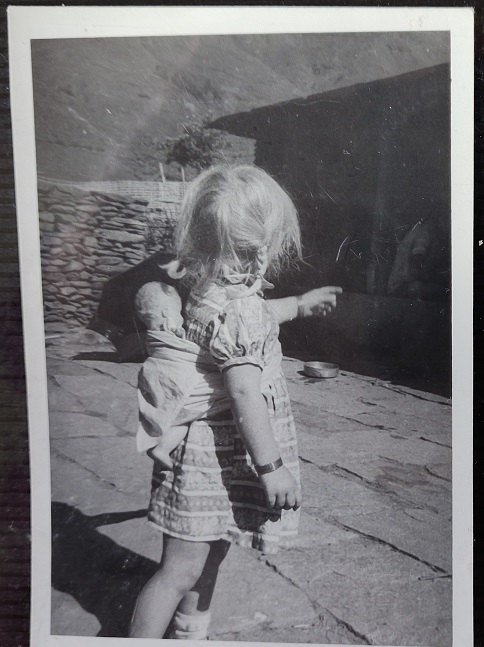
My own treasure was my doll, whom I carried around on my back and laid in a bamboo basket like village babies. I’d slept in one myself, suspended from the rafters above my parents’ bed, where they could give me a swing if I cried in the night. Tragically, I left my doll in the ‘office’ one night and found her the next morning with half her face eaten away by rats. (Heaven knows what the cat was up to.) I was distraught, but loved her all the more fiercely, wrapping scarves over her head and keeping her close. Around that time, my mother taught us to knit and Mark and I produced a series of misshapen squares. Unbeknownst to me, Mum knitted some extras, sewed them together and backed them with flannelette to make a quilt for my doll. It was my Christmas present that year in the village, and though the doll has long since vanished (hopefully to a place without rats), I still have the blanket.
Now 82 and 79, my parents, are finishing up their work with the Gurung project, and when they said it would be their last trip to Nepal, I said I wanted to be there. Mark pitched in eagerly and so it was that last week, the four of us set off for Ghachok. Just before leaving home in Scotland, I pulled out my childhood photo album, snapped some pictures on my phone and tucked the blanket into my bag.
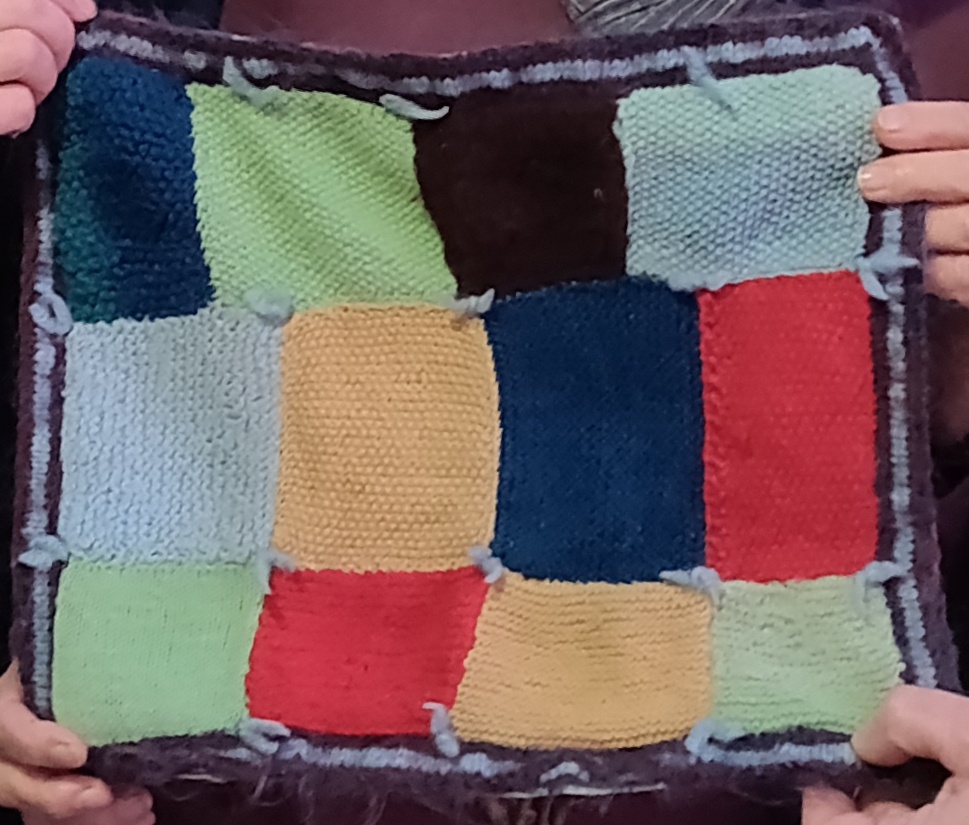
The story of what happened next is in the coming post. See you there!
A long time ago, I wanted to be an actress. (Or an acTOR, as I called myself at the time. ‘Actresses’ were either decorative fluff or the screen idols of a bygone era – not the serious performers we female drama students took ourselves to be.) So finishing up my Uni course in Melbourne I duly bought a book called something like ‘How to Make it as an Actor’ (no such guide for actresses) and underlined the key points. An early step was to get a stack of high quality head shots printed for sending out to all those eager agents and directors itching to cast you.

Maggie Diaz Self-portrait 1960s
My friend and fellow drama student, Gwendolen De Lacey, recommended a photographer called Maggie Diaz. Hailing from New York and Chicago originally, Maggie was eccentric, gifted and tragically under-recognised. It’s only through years of tireless work by Gwen, that her work has gained the acclaim it deserves, resulting in several exhibitions and an annual Maggie Diaz prize for a woman photographer. Maggie died at age 91 in 2016, so I am glad to have those early acting shots taken by her.

Maggie & Gwen by Trudy Schuringa @Trudy Kelder Photography
I well remember the shoot at her sparse weatherboard house in Balaclava. With her ragged New York- and-cigarette drawl, she insisted I was an ‘actress’ not an ‘actor’ and took me through my paces. I started with a bare face and an old shirt, then progressed through increasing amounts of make-up and more ‘actressy’ hair-dos, though never quite reaching the glamorous heights of the 1930s goddesses. (More’s the pity).
I loved the way the camera was an extension of her bony fingers and sharp eyes, and the way she talked to me, one moment making me feel like Lauren Bacall, the next chiding me for too much ‘dying swan’. It made me laugh, which was good for the pictures. But she also had an unsettling way of looking right through me: ‘The right side of your face is more angular and determined; the left side softer. Must be the two forces in you, huh?’ She was right, on both counts.
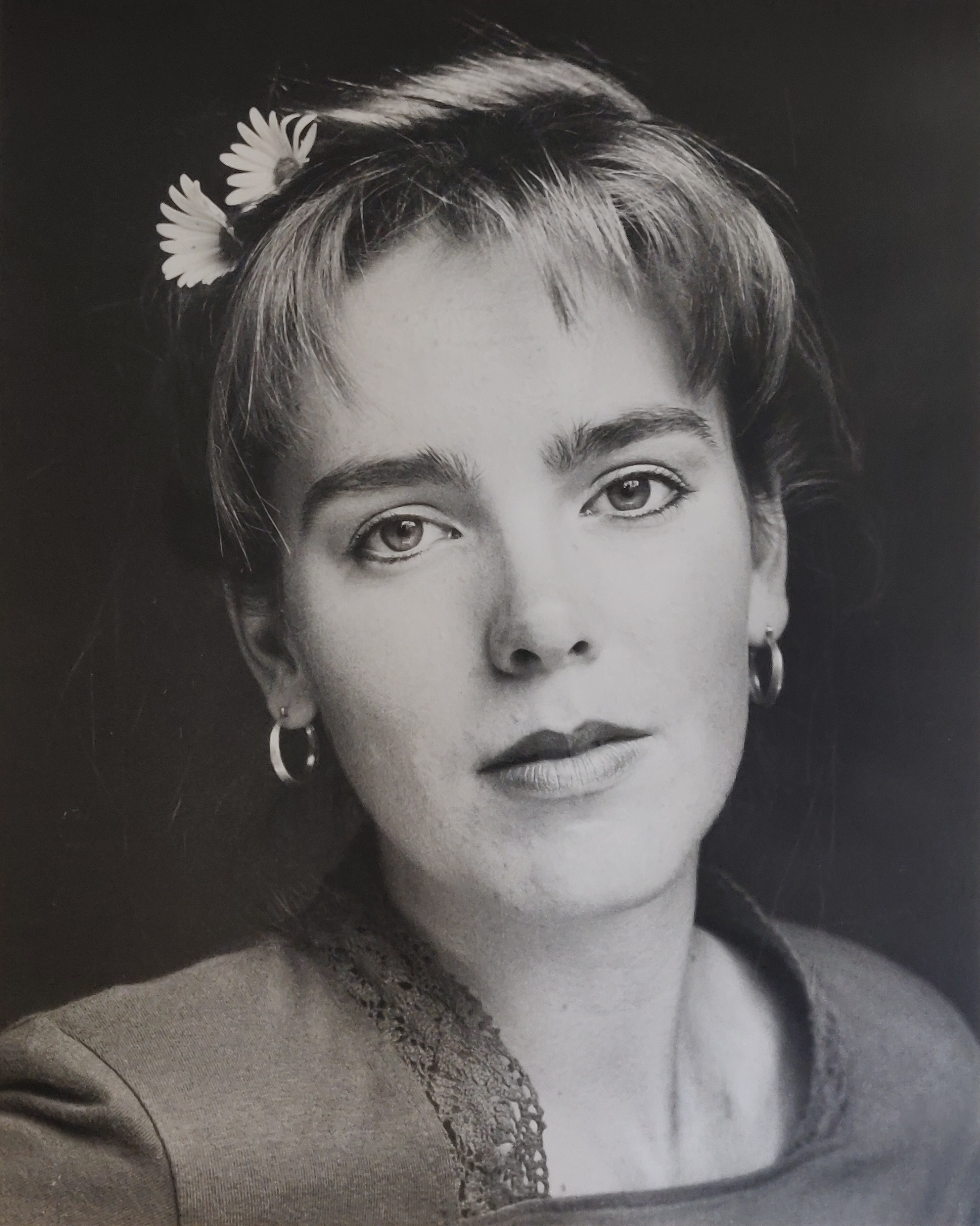
Photo by Maggie Diaz 1993
After the shoot, she sent me the proofs, and my house-mate Janet helped me choose two for printing. ‘This really looks like you,’ she said, pointing to one where I’ve got daisies tucked into a high bun. Really? That shot was from the end of the day, with the most make-up and Maggie getting arty with her garden flowers. But, following Janet’s urging, I picked it as a more formal shot. By contrast, the one I liked best was from the start of the day: no make-up, no messing about, just me.

Photo by Maggie Diaz 1993
Thanks to Gwen’s work, one of the daisy shots found its way into the Diaz archive at the State Library of Victoria.
Looking back, I remember one piece of advice in ‘How to Make it as an Actor’. The author warned not to get too many prints and to make sure you sent them out promptly. He told the cautionary tale of his friend who was still using excess shots many years later as notes for the milkman. If only I’d paid heed.
Shortly after ordering several hundred prints, I moved to Scotland and got distracted and got married. (One of my better diversions.) When life settled down, I sent out a few dozen pictures to various directors and awaited the phone calls. There was one interview with Borderline Theatre Company that led to a series of Saturday afternoon drama workshops for kids – a mere three hour journey each way – but no auditions. My one role came in a production at Glasgow’s Ramshorn Theatre, but I don’t think I’d even sent them a photo.
A few months later, my husband and I set off to work in Nepal for five years and the acting dream died on the vine. It’s probably just as well. I had already written my first play and knew I was more interested in expressing my own ideas than being a mouth piece for somebody else’s. The performer in me still rises whenever I give a reading and maybe one day I’ll write myself back onto the stage. (You have been warned.)
But even authors need head shots and over the years I’ve pressed friends and family into wielding the camera, with mixed results. Professionals definitely know what they’re doing: the most recent one was taken by the photographer at my parents’ Golden Wedding Anniversary in Australia. But I realised late last year that it was nearly five years old and I might start disappointing people when I turned up for events. So when the Cairngorms National Park organised photographer Stewart Grant to get press shots for the launch of our Shared Stories anthology, I seized the chance and booked him for a further hour.
Unfortunately, It was -6 degrees that day and once the group shots were done, Stewart suggested we postpone the author bit. ‘People don’t normally photograph well when they’re cold,’ he explained. ‘Stewart,’ I said, ‘I don’t normally dress up and put make-up on. It’s now or never.’
Cheerfully enough, he took us down to a spot by the River Spey near Grantown where everything was rimed with frost. Wonderfully, a small robin hopped onto a neighbouring post and it seemed a sign: this was the right place and the right time. Yes, I was freezing, especially when I took off my hat and gloves, but somehow Stewart brought an easy warmth to the shoot and the results were a delight. You can see more of them in my gallery.

Photo by Stewart Grant
So that’s me set now for the next five years! And if anyone needs notepaper for the milkman, I have about 477 black and white acting shots that would be just the thing. Choice of daisy design or plain.
From the comfort of my sofa in a warm living room, I have just booked myself onto my first ever mountain winter skills course. It is the middle of January in Scotland and having just returned from several weeks of the Australian summer, I feel plunged into darkness. Jet lag casts me onto the endless shores of the night where I lie tired but sleepless, listening to the silence that looms strange and total around the house. My parents’ old weatherboard house in Melbourne is a being of breath and bones, sighing with the see-sawing temperatures, bumping with the passage of creatures inside and out, caressed by trees. The Australian birds are raucous and the road busy.
Here in our village in the Highlands in mid-winter, even morning arrives without sound or light. I keep checking the clock to tell whether it is still some ungodly hour or time for breakfast. By day, rain washes across the landscape, clouds mass and shift with the wind and this morning we woke to a fall of wet snow that by afternoon had dribbled into the mud. None of this inspires me to go mountaineering. Nor does the whole-body misery of bubbling cold, sinusitis and jet lag.
But I want to write a book about the Cairngorms in all their moods, so I need to get up there and broaden my experience. Although I’ve walked in snowy hills many times, it’s always been with more experienced walkers and not long treks or demanding conditions. Late last year, therefore, I became a member of Mountaineering Scotland and this year I need to go on one of their highly recommended Winter Skills courses. The problem is they’re all booked up.
Until a few days ago when an email arrived offering a space on a one-day course this Wednesday – three days’ time. My heart sinks. I should be excited by the opportunity, but I’m feeling rotten and the last thing I want to do is spend nine hours in freezing conditions throwing myself down snow slopes for ice axe practice. Besides, the combination of the festive season, heat in Australia and this virus means I’m not exactly at peak fitness. But I know this might be my last chance this winter, so I gird my loins and book, noting that – at this late stage – no refund will be possible on cancellation.
Reading the kit list, I then note I will need to make a trip into town the following day for proper winter boots, crampons, ice axe and seriously waterproof trousers. (My current ones are budget brand, have lost their seam tapes and are about as effective as a pair of plastic bags.) But ouch. The cost of all that gear may wipe out any author earnings for the book. Wondering how many warm layers to wear, I check the Scottish mountain weather forecast for the day of the course. Here are extracted highlights:
HOW WINDY?
Southwesterly 60-80mph; risk gusts towards 100mph on high tops.
EFFECT OF WIND ON YOU?
Atrocious conditions across the hills with any mobility tortuous; severe wind chill.
That sentence goes through me like a 100mph gust of freezing wind. No, no, no. This is not me. I’m a happy-go-lucky hillwalker, not a polar explorer pitting myself against the elements and prepared to get frostbite, hypothermia and snot crystals hanging from my nose. And it’s not that sort of book I’m writing, anyway: the adventure epic of agony and conquest, the heroic survival memoir pushing the limits of bravery and belief. Who needs a mountaineering disaster? I’m touching the void of my existential crisis right here on the couch.
I go to bed feeling not just unwell, but frankly terrified. Little wonder I barely sleep.
The following afternoon, we head into Aviemore. If there’s one thing this town excels at, it’s outdoor shops, and we do the rounds. My husband Alistair is an experienced hill-walker in all weathers and advises me on winter walking boots, the pros and cons of stiffer soles or a more flexible fit, the lacing techniques. I’m struggling to get my head past the price tag. And that weather forecast. It’s only 2 o’clock in the afternoon, but already the darkness is gathering in the wind-blown skirts of rain. A friend who works in one of the shop learns I’m doing the course this Wednesday and winces. My stomach twists.
The news calls it Storm Brendan. It’s always bad news when the weather has a name.
I’m shown a series of ice axes and Alistair and the staff cheerfully demonstrate the necessary grip to arrest your fall and discuss the pros and cons of leashes. Pro: you don’t lose it. Con: if you fall without getting a grip, the thing is bouncing around and can hit you in the head. The good news is that Mountaineering Scotland will issue us with helmets. The bad news is that my head is already throbbing.
I haul waterproof trousers over my jeans and hubby points out best features for keeping rain, snow and wind out. I silently note that, even in the sale, these are more expensive than any dress I’ve ever bought. We end up in Tiso’s where I plea for time out in the cafe. With tears dripping into my hot chocolate I confess my anxieties. “Do I need to do this? Do I need to buy all this stuff?” It all just seems so scary and expensive.
Alistair is gentle. “No, you don’t have to do the Winter Skills course on Wednesday.” I almost howl with relief. “But yes, if you want to explore the Scottish hills in winter, you need to be safe. For that, you need proper equipment and better skills. You do need this stuff and it will last for years. And there are other opportunities to get the training, so don’t worry.”
Come Wednesday morning I can’t resist another sneaky peak at the mountain weather forecast. It still has those devastating predictions of 100mph gusts and ‘atrocious conditions’ but now includes these lovely lines:
HEADLINE FOR CAIRNGORMS NP AND MONADHLIATH
Stormy winds. Snow & whiteout, focused W Cairngorms NP
HOW COLD? (AT 900M)
-2 or -3C. Wind chill on higher terrain close to -20C.
So I’m sitting snugly – and smugly – at my kitchen table watching the garden trees whipping about and contemplating nothing more adventurous than a dog walk. But I am wearing-in a pair of spanking new leather winter boots that are warm and strong and quietly reassuring me that together, we’re going to move mountains.
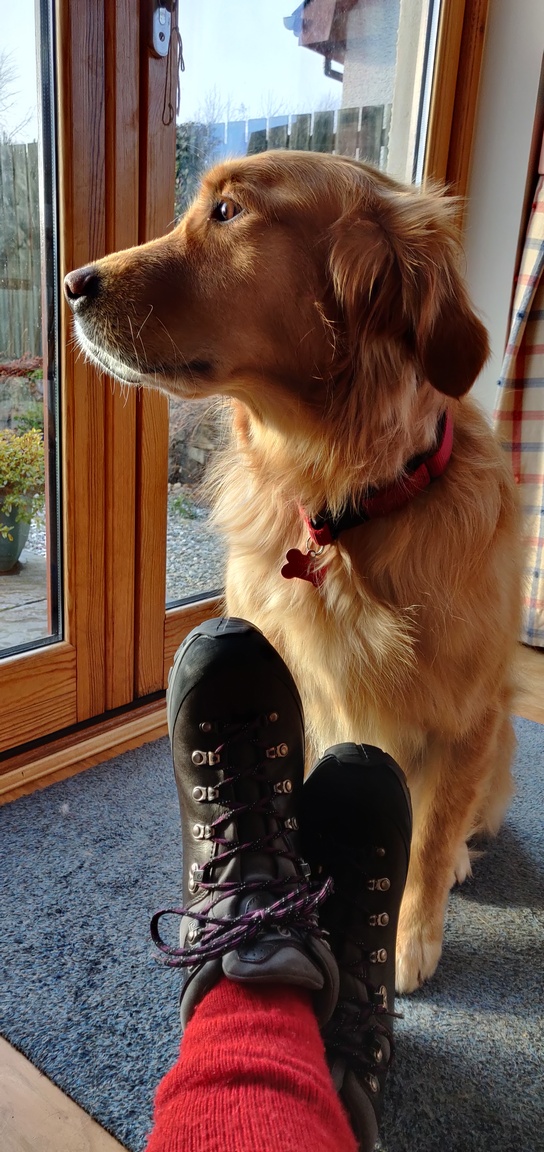
Sileas, our Golden, yearning to get me out there
In February I invited you to come with me on a journey into the Cairngorms. Thank you for your company! 2019 has certainly been a significant year: being Writer in Residence for the Cairngorms National Park has been my dream job and I feel incredibly fortunate to have had the opportunity.
It’s hard to sum up the experience, but I had five minutes to do just that at our celebration event last month, so I’d like to share those reflections with you now. (There’s also a link at the bottom to a fun slide show of the year, if you want to skip the book and go straight to the movie.)
Shared Stories: A Year in the Cairngorms in five minutes, five words, all beginning with C…
The territory of the project has, of course, been the Cairngorms, in the widest sense of the word: the mountains and foothills, glens and straths, the forests and waterways, villages and towns – the whole of the National Park. Personally, I explored much new territory, driving over 3000 miles and walking several new routes into the mountains, though I know I’m still barely scratching the surface. I learnt to allow longer to get to workshops because I kept stopping to take pictures or to have a wee wander. Time and again, I witnessed the power of people responding to this extra-ordinary landscape.

Kingussie High pupils looking across to the Cairngorms
The purpose of Shared Stories has been connecting people with nature and my second word is Community. At every workshop, different kinds of folk came together to share their experiences of the Cairngorms in both conversation and writing. There were school kids, retirees, rangers, outdoor instructors, crofters, artists, guides, educators and tourists – nearly 500 people in all. There was depth of feeling expressed, real interest and exchange, great encouragement of one another and a lot of laughter.
But the community gathered around this project has extended far beyond those who attended workshops. We had writing sent in from across Scotland and even around the world as people have borne witness to how special the Cairngorms are; that writing has been included in our anthology, shared online and read enthusiastically by countless people everywhere. It is a project that has captured the imagination of many.

Glen Esk Workshop
And that leads to my next word: Creativity. There is already a great deal of good work in the Park connecting people with nature, and long may it continue. What was distinctive about Shared Stories was to make that connection through art; to take time; to pay attention; to tune the senses – and then using the power of the imagination and language – to fashion creative responses. Through creativity we discover and express deeper parts of ourselves and our relationships to those around us and our world. We experience nature with our whole being; we sing back to it.
My fourth word is Culture. At the creative intersection of people and place, culture arises. There is a rich tradition of Scottish and Gaelic heritage here, as expressed through some of the writing, as well the musicians and singers who played at our celebration event. It’s heartening to see how that culture is not just history, but a living and transforming culture of today and tomorrow. Additionally, one of the highlights of the project for me has also been illuminating the cultural diversity of this place, particularly through engaging with many visitors and encouraging the use of other languages in the writing of Cairngorms Lyrics. I will always remember the workshop where a Bulgarian woman spoke passionately about how much she loves this place, and how she’s never felt so at home anywhere else.

Girl at Forest Fest at the Highland Folk Museum, Newtonmore
My last word is Chronos – time. The project has explored the ages, with work that contemplates mountains formed millions of years ago to the birth of a new leaf. It has involved toddlers scribbling capercaillie pictures in Carrbridge to a lady in her 80s sending a Doric poem about the River Dee. But it has explored another dimension of time, too, which is simply the importance of taking time in nature. Everywhere I’ve gone, people have acknowledged how much it means to them. The pupil evaluations in schools repeatedly said how much they loved the time outside and wished there was more of it. Busy adults reported how restorative it was to take time – to give, find, steal – time to fall still in the natural world.
Many – young and old – also spoke of how rewarding it was to take the time to write. One child gave me a note at the end of a workshop that said: “Thank you for taking the time to come to our school.” The pleasure, I assured her, was mine. I owe a huge debt of thanks to the Park and our other funders, The Woodland Trust and Creative Scotland, for making that time possible. May they continue to support artists working in these ways.
And so, it is with much thankfulness that my time as Writer in Residence of the Cairngorms National Park comes to a close. There was a considerable team of people at the Park who helped make the project happen and I am deeply grateful to them all, especially Alan, Anna, Sian, Karen, Cat, Adam, Mike, Alison, Grant, Will, Kate, Nancy, Emma, Lucy, several Jackies (several spellings) and many more, I’m sure. (I’m sorry for missing anyone!) Most of all, my thanks to everyone who joined in, whether by attending workshops, sending writing, reading and sharing the work, reading this blog or simply by extending encouragement. That means YOU!

Cat Campbell, one of the great team at the Park
But, I’m very pleased to say, my ‘traffic of love’ with the Cairngorms is far from over. I still live here, still explore, still write; and there will be further projects with the Park for next year: the secondary school workshops will be rolled out into primary schools and I will be developing interpretation for The Speyside Way.
AND… after a long, long wait and much discouragement there is some Very Exciting Book News on the horizon, so watch this space!
I will continue posting about my writing life here in the Cairngorms in Writing the Way – about once a month – so do stay on board if you’re keen to follow the journey. (But I will entirely understand if you’d like to bow out now.) You can also (or instead) sign up to receive my newsletter here, which comes out three times a year with a round-up of publication and event news, photos and some terrible jokes.
Finally, I would like to leave you with this short slide show capturing images and quotes from Shared Stories: A Year in the Cairngorms, with music by Sam Appleby.
That’s it folks! May you know joy in this season of celebration, and hope as the new year dawns. See you in 2020.
Merryn

Last week I described my first outing with the Health Walk Group in Glen Tanar. As Writer in Residence for the Cairngorms National Park, I’ve had the pleasure of working with many kinds of people of all ages right across this vast and varied landscape. Some of them have eagerly signed up to attend a writing workshop; others, like school classes, are just lumbered with me. (Though with sometimes surprising results.) And then there are the folk like the Glen Tanar ones, who already have a deep and joyous relationship with their natural environment and no need to write about it. They did, however, graciously welcome me to come along.
My walk with them the first week was cloaked in mist and the swirling stories of the Glen’s history – natural and human. We shared delight in the place and one another’s company, both outdoors and in the warmth of the Boat Inn; and though we didn’t write anything down, the conversations were rich. It’s always been an important principle of the project that we encourage responses to the Cairngorms environment in both spoken and written form. As a local friend observed to me, talking rapturously about this landscape in which he grew up, “I don’t write, Merryn, but I can talk for Scotland!”

Talking is definitely welcome. Which is why I was very happy at the end of my first meeting with the Glen Tanar group. Even though they’d been clear they didn’t want to write, they had been generous in sharing their stories of this beautiful place. I was very much looking forward to seeing them the following week.
I’d barely got home, however, when an email dropped into my inbox from one of the group: Anna. Using several Scots nature words, she’d crafted a Cairngorms Lyric!
Glen Tanar walked in muggle
Autumn 🍂 colours, heron.
Injured puddock walked safely to linky edge.
muggle = drizzling rain; puddock = frog; linky = flat & grassy
I was delighted. Then the next day, another email arrived from Margaret:
“Thanks for joining us on the walk yesterday. I really enjoyed the session afterwards at The Boat Inn.
I’ve always loved reading but have never felt the urge to write for pleasure. However, as we were walking round the loch I felt that I should, perhaps, make the effort to come up with something short and simple and produced this.
Yellow, gold, rust and brown
Autumn’s leaves drift down, heralding Winter’s chill.

This morning, I decided to have a go at a Cairngorms Lyric. This is the result.
Like a sentinel, tall and still,
the silent heron waits by the lochan’s glassy waters.
I’ve just looked online and found that an old Scots name for the heron is “Lang Sandy” so another version could be:
Like a sentinel, tall and still,
Lang Sandy waits silently by the lochan’s glassy waters.
I doubt I’ll set the heather on fire with these but I’ve enjoyed doing it. Feel free to discard or share as you see fit.”

Glen Tanar Loch
Let me tell, you, these beautiful offerings definitely set my heather on fire! I couldn’t stop grinning – and definitely couldn’t wait to get back to them all. “What are you like?” I said, as we gathered in the car park the next Friday. “The group that doesn’t want to write sends me wonderful poems straight away!” We all laughed.
Our walk that day, this time with Ranger Eric, was bathed in autumn sun, every leaf and frosted twig shining. As we went, we stopped at different points to focus on one sense at a time, smelling the earthy leaf mould underfoot and listening to the rushing Tanar and the high piping of birds. At an old bridge, we pulled off our gloves to explore the textures around us: rusting metal, granite, tree bark, slick wet ice, moss that is normally spongy but now frozen hard as rock.

At the high point of the trail where the view opens towards Mount Keen, we stood in brilliant light, taking in all we could see. Fragile drifts of mist rose from the dark forests, echoing the strands of cloud in the sky, where the blue shifted from intense on the horizon to pale above.
“Look!” said Donald, pointing with his stick. All around us, the long grasses were rimed with sparkling frost, and on each blade, droplets of melting ice glowed like jewels. “See the colours!” He said. And it was true, the longer we looked, the more we noticed flashes of rainbow hues as tiny beads of water caught the sun. “There’s a red one!” someone cried. “Oh look at the brightness of that green!”
When we stop to pay attention, there is no end to the world’s miracles.

Rowan berries, Glen Tanar gardens
Back at the Boat Inn, Anna and Margaret succumbed to my persuasion and shared their poems, to great appreciation from the group. And then – wonder of wonders! – Aileen pulled a scrap of paper from her pocket and confessed she’d scribbled some Cairngorms Lyrics, too. (And for those who don’t know Doric, the translation is below.)
It’s nae the pine I’ll min’
Bit the flash o’ the dipper in the burn.
(It’s not the pine I’ll remember
But the flash of the dipper in the stream.)
I kent the mannie fa’s grannie
planted the linden tree.
That’s foo aul’ I am.
(I knew the man whose grannie
planted the linden tree.
That’s how old I am.)
Well, as you can imagine, I was thrilled. The non-writers of Glen Tanar had penned some beautiful poems and, I’ll wager, were as surprised and delighted as I was. Long may they wander, wonder and – now and again – even write.

Though the Glen Tanar Health Walk group love where they walk and were very happy to have me join them, it was made clear that they did not want to do any writing.
I said, ok, I could certainly work on that understanding. In fact, most of my engagement with the Health Walk groups for the Shared Stories project has not involved a ‘writing workshop’ as such. Each group is different and rather than impose an unwelcome activity, I’ve tried to come alongside them and enrich their weekly outing in ways that respond to their interests. My times with the Grantown, Aviemore and Kingussie groups are described here.
My first visit to Glen Tanar was a typically cold, grey and drizzly November day. It’s nearly two hours’ drive for me and burrowing through thick cloud on the rollercoaster Snow Roads, I did wonder if it was worth the time and effort just to trudge along with a group who maybe didn’t really want me there. In the car park of the Glen Tanar Charitable Trust, I watched them emerge from their vehicles adjusting their plumage of waterproof jackets, trousers, gaiters, boots, hats, scarves, gloves and sticks. No outing in the Cairngorms is just ‘a walk in the park’!

Glen Tanar Health Walk Group
But they were brimming with smiles and laughter and greeted me warmly, Glynis offering me chocolates from the bag she passes round every week. I thanked them for including me and assured them there were no writing activities and the last thing I wanted to do was to spoil their walk. More smiles and laughter, maybe even a little relief.
Glen Tanar is on the eastern side of the Cairngorm mountains where the Tanar Water flows into the River Dee. Once the lands of the Marquis of Huntly, the estate was bought in 1865 by Manchester banker and MP, William Cunliffe Brooks. Since 1905, it has been owned by four generations of the Coats family, who now run it as a diverse Highland estate for field sports, holiday accommodation and weddings.
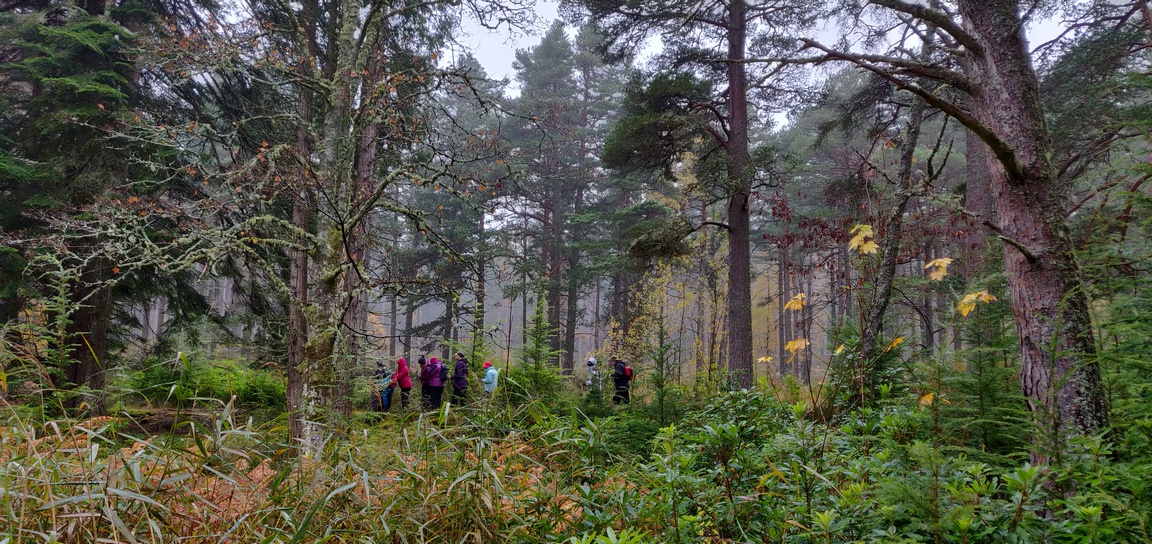
Because of Scotland’s access laws, anyone is free to roam on private land (respecting certain restrictions) and the Charitable Trust actively encourages people to explore and enjoy Glen Tanar, in particular its National Nature Reserve. The Health Walk here has been doing exactly that every Friday, come rain, hail or shine, for many years, usually in the company of a Trust ranger. And it’s easy to see why.
The landscaped gardens were designed for Sir Cunliffe Brooks at the end of the 19th century and include a series of connected ponds and 200 different tree species. Now somewhat overgrown, a creeping wildness is overtaking the Victorian fancy, original paths and flowerbeds lost under the competing tangle of native and introduced plants. On that misty, late Autumn day, the place was breathing its stories, pungent with the cycles of growth and decay.

One lady showed me a giant stump from which 15 new saplings had sprouted, mostly different kinds of tree. We stopped to look at an abandoned summer house, its wood quietly rotting as a fairy-tale stone well stood sentinel nearby. The group pointed out the tendrils of leaves from the very rare twinflower, and at a lochan fringed with reeds, we watched a heron in its perfect stillness.

“Don’t step on the frog!” someone said.
“It’s a toad, it’s a toad!” Ranger Mike was rolling his eyes. The group laughed. Apparently this happens regularly.
“When I was wee,” a senior lady murmured to me, “we just called it a puddock.”
Afterwards we retired to the warmth of The Boat Inn, where the coffee was fragrant and the scones served up like a Bake Off Showstopper. Every Health Walk ends with this gathering for beverages and a blether, and the two halves of the expedition are equally enjoyed. The Glen Tanar group sat around one large table and I asked if they’d like to play Talk in the Park. It’s a simple activity where each person in turn chooses a card, reads out the conversation prompt on it and then shares with the group. Not everyone has to take a card, of course, but as soon as someone starts, most folk want a go and, inevitably, everyone is involved in listening and pitching into the conversation.
One of the cards read: Talk about a person who is a frequent companion in your nature experiences. Aileen’s face creased into smiles, her eyes shining, as she talked about the wonderful person who had gone with her on nearly every outdoor adventure for countless years. “And that’s him, there!” She grinned, pointing across the table at her husband. “Oh that’s a relief,” he said, cheekily. “Was wondering who she was talking about.”

When I gave out a sheet of Scots words for nature, former school teacher Mary launched into a spontaneous and splendid recitation of the fabulous poem The Puddock by John M Caie. Cheers and applause all round and no arguments about whether it was a frog or a toad.
“Now,” I said at the end, passing round the Cairngorms Lyric handout, “I know you folks aren’t interested in the writing, but this is just to show you some of the things that have been happening across the Park. Just for your interest, you know. Just… well, just in case…”
And, as they say in all the best internet click bait, you’ll never believe what happened next.

(But you will have to wait till next week to find out…)
Hooray! It’s National Poetry Day today!
For my five years at Kingussie High School library, this was always one of the highlights of my year, when we had poetry readings at lunchtime with drinks and biscuits. There was always a heart-thrilling mix of poems, including in other languages and, last year, in song.

National Poetry Day is a wonderful, country-wide celebration of poems classic and contemporary; a chance to return to an old favourite and discover new gems; an encouragement to sharpen your pencil and have a go yourself.
If that sounds too difficult and you’re struggling for ideas, why not try a Cairngorms Lyric? They’re only 15 words long and even if you’ve never been to this beautiful part of Scotland, you can still write one. If you do, please share it with the hashtag #CairngormsLyric and let’s see how many we can have ringing round the internet!

Here’s one of mine, the first of a series of ten called Calling the Mountains which I will read at Ness Book Fest tomorrow (Friday 4th October) and will be published in our Shared Stories: A Year in the Cairngorms anthology coming out in November:
Ben MacDuie – Beinn MacDuibh
 The Mountain of the Son of Duff

High King of Thunder
 Old Grey Man
 Chief of the Range
 Head of the Clan
Another fun and non-threatening way of coming up with poetry is to do it with others. I don’t believe poems are meant to be solitary pursuits; they grow out of our lives together and are shared back into the world. They can also be created in community.

One of my workshops for the Shared Stories: A Year in the Cairngorms project was with the tremendous folks who volunteer across the Park as Health Walk leaders. In the morning we followed HighLife Highland ranger, Saranne Bish, around Anagach woods, where she told us so many fascinating things about the forest and sent us seeking out all its colours. Here’s a wee video of it made by Sian Jamieson from the Park team: Anagach Walk

In the afternoon, I led a workshop on how Health Walk groups might explore different creative responses through words, whether investigating place names, using Talk Cards or writing. One activity was to get everyone to complete the sentence ‘On today’s walk…’ on a post-it note. I gathered these in, arranged them in an appealing order and – voila – a Group Poem was born! Reading it out to everyone at the end of the workshop brought surprise and delight at how easy it was to create and how rewarding to hear.

On Today’s Walk

 Group Poem created at Cairngorms National Park Health Walk Leaders’ Training Day
11th September 2019

 On today’s walk
 we met, we talked, we stopped, we observed

 life on a dead tree

 On today’s walk
 we chatted with new people
 we stopped a few times to look around
 the sun shone
 and the wind blew the cobwebs away!

 On today’s walk
 we looked at the spectrum of colours

 the chatter flowed
 the senses were stirred

 On today’s walk
 we collected a range of scraps
 of colour in nature,
 looked at lichen
 through a magnifier

 we sensed the soft decay of autumn

 we found the mushrooms for tea

 On today’s walk
 there was no rain

 the invisible snail left a clue
 a visible, silvery trail

 On today’s walk
 we did talk, talk, talk
Why not try it with your own group, whether on a family holiday, with work colleagues (see here for how CEO Grant Moir did something very creative for the Park staff away-day) or in a club or hobby group? Whatever you do, please take a moment on National Poetry Day to stop for a moment and savour a poem – reading or writing. Use the comments below to tell me your all-time favourites!