


It was quiet when I arrived at the edge of Anagach woods, sunlight filtering down through giant trees, a soft breeze shifting the leaves. Gradually, people began to appear, some striding purposefully down the track, others making their way slowly with two sticks. Most were retirement age, all were local folk who gather every week for the Grantown Health Walk, one of about 15 that take place in locations across the Cairngorms National Park.
Health Walks are short, safe, social, local, low level and guided by a trained leader, all intended to help people be more active and connected, to one-another as well as nature. I was there to bring another dimension to their outing through the Shared Stories project by inviting creative responses to the natural world.
The Grantown group is large and splits into two strands, determined by pace. The first week I went with the slow walk, who were happy to stop every now and then to focus on a sense, breathing in the woodsy smells or inspecting the patterns of bark. These women wait for one another and share time with a wide embrace.

The second week I joined what walk leader, David, calls ‘The GGrantown SAS’. In keeping with his military background, he sets a brisk pace and the dozen or more walkers revel in the energy and the many routes he has found. I didn’t ask them to stop and meditate on the aromas, but took the opportunity – while puffing alongside – to hear their experiences of the outdoors. Most of them spoke of childhoods unfettered by adult supervision with whole days spent roaming, scrambling, fishing and foraging.
Back in the Royal Legion where they always finish with coffee and biscuits, I introduced the Cairngorms Lyric and offered conversation starter cards: “Where in the Park do you feel most at one with nature?” “What is your favourite wildlife of the Park?”

At that last one, David and his wife looked at each other. “I was afraid of heights,” Beata said, “and couldn’t go up a hill. He gradually got me there.” It started with small slopes and she always had to go down backwards, unable to face the view down, but finally, on the third attempt, she made it to the top of Meall a Bhuachaille and hasn’t looked back.
“Now don’t write too many good things about the Park,” one man warned. “We’ve got enough tourists as it is!” The conversation traversed the familiar contested territory of what the Park is for. I suggested expressing their views in poetry. Smiles and raised eyebrows, but on my second week at Grantown, a woman shyly gave me a Cairngorms Lyric and another emailed me several, set into her photos of the Health Walks.

With the Aviemore group, we explored the low slopes beyond Badaguish where the broome was massed with gold and Scots pine regenerating. They showed me the remains of the old crofting township of Beglan, now just overgrown stones in broken rectangles. Some in that group have walked all the Cairngorms and remember ski-ing in the early days. One gentleman persuaded me to get down cheek to cheek with a tiny burn to video its splash and song.

The following week we walked in the cool damp of Glenmore forest, where we talked about overcoming the fear of swimming. One woman was recovering from a hip operation and another was 93 and deaf. It rained, but she kept smiling.

In Kingussie, the group is more mixed. The retirees are joined by folk from Caberfeidh Horizons, a social enterprise for adults with a learning disability, mental health issues, addiction problems or long term unemployed. On my first day with them, we walked up the river Gynack, following its route through stone pools and gorges, pausing on a bridge to listen to its many notes. Resting under trees, we identified birdsong and all the colours of green.
The next week took us past the community allotments, across fields strewn with wildflowers and under giant beeches. In the café afterwards, we used the conversation cards and heard stories of getting lost in the mountains and finding friendship with a horse. I shared my poems built from the words they had come up with the week before, and one of the walkers gave me his own Cairngorms Lyric. The feeling amongst these folk was gentle and supportive, a place of acceptance and quiet joy together, both in the beautiful outdoors and the welcome of a café.

In November I will be joining another Health Walk Group in the Park and in September will be sharing at a training day for the Health Walk leaders, all volunteers who give generously of their time and care to make these walks possible. It has been a gift for me to come alongside these groups and to witness how good it is when nature, walking and a therapeutic community come together.
“Everybody needs beauty as well as bread, places to play in and pray in, where nature may heal and give strength to body and soul.” John Muir
At the start of this year, I decided to embrace my term as Writer in Residence for the Cairngorms National Park as a kind of pilgrimage. Certainly, I would be covering a lot of ground delivering the project, and that has proved true, and fascinating. More significantly, I knew I would be on a personal journey, discovering new thinking about this distinctive landscape and its people, new territory as a writer, and new learning – I hoped – about myself.
Feeling, by mid-year, a bit lost and run down, I realised it was time to undertake a physical pilgrimage. Sometimes it is only through moving the body that we shift the spirit. In my last post I wrote about my place of inner and outer chaos and needing – quite literally – to walk away; about the dream to climb Angel’s Peak in the Cairngorms and about why that mountain, of all mountains, was important.

Here is the story.
We leave the car near the ruins and rambling crofts of Tullochgrue above Aviemore, rope up Sileas, the golden retriever, and shoulder our packs. I haven’t done a camping trek in two years and it feels heavy. The afternoon sky is patchy sun and cloud as the trail takes us through the Caledonian forest of Rothiemurchus; it is deep with Scots pine and mixed with the many greens of silver birch, aspen, and rowan. Blaeberry and heather carpet the woodland floor and the Allt Dhruidh burn chortles swift and shallow through the dappled light. I could lie down here and know peace.
As the trees thin and the path rises, we emerge onto rocky moor with the dark chasm of the Lairig Ghru up ahead, cloud massing on its tops. ‘Lairig’ is Gaelic for pass, but the origins of ‘Ghru’ are debated. Formed some 400 million years ago, this triangular cleft through the middle of the highest Cairngorms was once a route for cattle drovers and smugglers. Today we meet only walkers coming the opposite direction from Deeside and a mountain biker bombing down the track. With his long red hair and beard streaming from under his helmet he looks like an indomitable Gaul. I feel anything but, my heavy pack and boots making my gait clumsy and causing a sharp twang in the hip. Growing up in the Himalayas, I used to be a mountain goat; can I regain my hill feet as well as my head?

The rocky trail is lined with grasses, mosses, bog cotton and wildflowers, from buttercup yellow to the zingy purples of heather and vetch. Meadow pipits rise from the banks with their swift wing beat and bouncy flight, cheeping urgently and we keep Sileas on her lead. Gradually, the path reveals the red shades of the Cairngorm granite: dusky roses, peaches and wines. Though the rock turns grey with exposure, any fresh cut reveals its blood and it’s no wonder the Gaelic name for this range is Am Monadh Ruadh, the russet-coloured hills. The water spilling down from the mountain is so clear it makes the stream bed shine like polished copper, though higher up, it disappears and reappears among the rocks. Further in, the Lairig Ghru dims with mist, the steep scree giving way to the jagged cliffs of Lurcher’s Crag.
It’s nearly 7 when we arrive at the high point of the pass where the Pools of Dee are ice cold and give no sign of their waters flowing in or out. The bank of stones above the second pool and the swirling cloud give a sense of the world vanishing beyond. We pitch camp and cook in a blowing smirr, crawling early into our thermals and down bags. Unfamiliarity has made Sileas hyper-vigilant and she lies out for hours in the rain, staring around, until Alistair eventually tugs her under the bell. All night my sleep is routed by the scant darkness, the tent rattling, and the aching of my hips on the hard ground. I breathe wet dog and socks.

We wait out the rain and it is mid-morning when we pick our way down the boulder fall, the valley unfurling below in the gathering sunshine. The view stretches beyond the buttress of Devil’s Point to the smoky hills south of the Dee. To the west, the twin summits of Cairn Toul and Angel’s Peak are still wreathed in cloud, challenging me to reach them.
As the Garbh Choire opens to our right, we ford the burn that becomes the Dee and strike out across the bog. Small green frogs leap in front of us and the way is dotted with flowers, delicate and exquisite in this wind-battered place. The peaks gradually clear and we can see the rim of the high bowl between them that holds An Lochain Uaine – the green pool – and the waterfall that threads down from it, over dark rock. But we can see no path, for there is none.

We ford Allt a’ Garbh-Choire and push up the slope, finding a way among the stones, sometimes needing hands. Despite that, it’s easier going than yesterday as I don’t have a pack and my body is slowly remembering the footholds of youth. Cresting the rim I go even faster, almost running now across the boulder field until I see the lochan.
Yes. It’s here. It’s real.

My novel and my characters are imagined, but something about being in the actual place that is pivotal for them makes them seem real, too, as if they are not just in my mind, but alive and present. It’s almost as though I might meet them here and I feel like crying. I also feel silly. And elated. The pool keeps changing colour with the clouds, one moment blue, another gun metal grey, rarely, the green for which it is named. In my book, Sorley swims, and though I love outdoor swimming and harboured a fantasy of taking a dip, the cold wind and my cowardice soon snuff that notion.
Over our lunch of oatcakes and soup, we scan the north ridge of Angel’s Peak through binoculars. It was our planned route – because Sorley takes it – but we decide the steep scramble is unsafe for the dog and start up Cairn Toul instead, traversing above the lochan to an easier route. From there it’s still a hard, slow slog and my body’s memory of youth fades. I hear a text ping. Wouldn’t it be amazing if, arriving at the geographic and emotional climax of my novel, I get the news of a publisher? I laugh even before I check. I know it won’t be, and it isn’t.

And, right now, that’s okay. By the time we get to the top of Angel’s Peak, the sun has conquered the sky and the world is falling away below us. Though the wind almost throws me off my feet, I am overjoyed because I am here. Stretching in every direction, the Cairngorms are billowing round tents of stone, rising in waves and walls of granite, falling in cliffs and corries, bathing in light. Snow clings in deep crevices; burns are seams of silver in the grey and green; cloud shadows glide like sea galleons and mythical beasts across the slopes. Right below us, An Lochan Uaine lies dark and fathomless.

I don’t know if I will return to swim there just as I don’t know what will happen with the book, but I do know I am changed. In these mountains I have been washed by rain, shot through with light, blown to bits by wind and hung out to dry. The mountain has shaken me hard enough to make my bones rattle and my head break its locks; it has beaten me like a rug and cast the devils to the dust; it has seared its image on the wall of my mind.
But like Jacob wrestling with the Angel and wounded at the hip, I demand my blessing. As I walk the many hours home, I am remade. The mountain returns the pieces of me one by one in the ptarmigan’s croak and the taste of a clear burn; it restores me in the petals of a wild orchid and the gaze of deer; it reveals my lost path in ancient rock and lights my way in sun.
It restores my soul.

The Writer has not been in Residence in the Cairngorms this week but gallivanting down through the capital cities on a Grand Tour. The Pilgrim has digressed. It all began on Monday in Edinburgh with a day of meetings with the Society of Authors in Scotland team, joined by our SoA CEO (don’t you love acronyms!) and our Development Manager. There’s an exciting new plan ahead for supporting authors in Scotland, so watch this space.
On the way to the meetings I couldn’t resist taking this snap of the Romanes & Paterson tea-room on Princes’ Street. In the summer of 1992, while on the iconic Aussie year-out-round-the-world-trip, I worked as a waitress here for three weeks. Eating discounted cream cakes every day, I bought my first kilt in the shop downstairs and fell deeper in love with this country and my new boyfriend. The kilt no longer fits, but the boyfriend is now husband and Scotland home.

That night I was supposed to be hopping onto the Caledonian Sleeper with him in Kingussie, bound for London, but because of the Edinburgh meetings, thought I would simply join him when the train came through at midnight. Nothing simple about it. The train doesn’t officially take on passengers at that hour, but thanks to the kindness of staff on the train and at Waverley, they spirited me on board at 12.30, gave me a drink and eventually reunited me with hubby when the Inverness carriages were shunted on at 1.45 am!
This wasn’t great for beauty sleep for the Grand Day Out of the following day: a Garden Party at Buckingham Palace. We did grab a snooze at the home of our lovely friends in London, who have strong Cairngorms connections and always look after us well. My role in the SoA was the occasion for the invite to the Palace and the trigger for scouring charity shops and friends’ wardrobes for a hat!

Getting off the bus at Hyde Park there was no missing the long queue of other palace-goers in full plumage like a flock of migrating birds, twittering and giggling. The day was gloriously sunny, though as an Aussie brought up in South Asia I can’t concur with the journalist who described the 21 degrees as ‘blistering heat’! We arrived through the grand front entrance and on arrival in the gardens were herded into waiting areas by the Queen’s body guard with their rolled umbrellas, who looked very dapper in top hat and tails but not quite equipped for a security crisis.

After a long wait, the Yeoman of the Guard appeared, looking like characters from Alice in Wonderland and equally ill-equipped, and after a longer wait, a posse of royals: Her Majesty the Queen, Will & Kate, and a handful of others. (I confess I don’t really know my Eugenies from my Beatrices.) Whoever it was, they were a long way off, so I rapidly decided our chances of royal hob-nobbing were minimal but our chances of snacks without a long queue had never been better, so we broke ranks and headed for the tea tent. Fortunately, we were not pursued by guards of any costume, the tea tent was cool and quiet and the cakes delicious.

We wandered around the lake and gardens, posing for and taking photos, smelling flowers and meeting so many interesting people: a senior couple who had been in the Scout movement since childhood, a retired mayor, German embassy staff, two beautiful young South African women studying here. Overall, it proved to be a fun and incredibly friendly event, with hundreds of people milling about the gardens, chatting, laughing, enjoying the military bands, slipping off high heels to go barefoot on the lawns and thoroughly enjoying a small share of royal pageantry. Definitely a Grand Day Out!

The next day, Alistair got the train home and I moved into The British Library for the day – what better refuge for a writer! I started with the wonderful ‘Make Your Mark’ exhibition about the history of writing, which included such treasures as a Mughal painting of the royal scribe working cross-legged on the floor, and then tried to find a place to make my own marks. There are plentiful places provided free to the public, but every table with a socket was occupied so I ended up, in venerable Mughal tradition, on the floor. Just as well I had an Asian upbringing.

Thursday saw me heading to the new offices of the Society of Authors to see progress on the renovation works. Despite builders, dust and construction materials everywhere, the staff seemed remarkably serene. I take my hat off to them for their forbearance through a long and exhausting process, especially our tireless CEO, Nicola Solomon. She joined us for the Management Committee meeting that afternoon that was held at the beautiful premises of the Art Workers Guild.


After the meeting and a convivial drink with a few others at a local pub, I caught a bus to Sloane Square. At least that’s where I thought I was going, until I realised it was going in the opposite direction. Several bus and tube journeys later (confusion courtesy of Google maps and maybe that pre-dinner wine) I puffed into the Royal Court Theatre just in time to watch White Pearl, a brilliant, darkly funny play about race attitudes among Asians.

Friday morning, eschewing alcohol and apps in favour of breakfast and a paper tube map, I still managed to ride a train in the wrong direction and ended up puffing into Kings Cross station feeling hot and bothered and very ready to get back to the country. Thankfully, I had a seat, a table, a socket and wi-fi, so should have been powering through the work. If only it hadn’t been for the fascinating conversation with the guy beside me who has a law degree but works as a performer singing Motown hits. He talked about his experience of being black in Britain, teaching his daughter to ride a bike and the final hours with his late grand-father.

I am glad to be home now, but thankful for this busy, colourful week, for each vision and encounter, even the inconvenient ones, for that was where I found kindness. Life is rich and full of treasures, whether in the collections at the British Library or the tunes of a busker, and each person, whether royal or railway staff, holds a world of stories.
One of my great hopes for this year as Writer in Residence at the Cairngorms National Park was to dedicate more time to my poetry. What time? What poetry? Maybe I was the only person surprised to discover that the role (and writing about it in this blog and other publications) has kept me so busy that there has been little time to wander lonely as a cloud penning verse. This may be of public benefit, but even if my poetry proves of no value to anyone else, I dearly wanted to develop my practice.

And that’s the key word. Practice. Because every time I sit down to write a poem these days what emerges doesn’t sound anything like a poem. It sounds like drivel. Or doggerel. Or doggy-do (to which I have dedicated an entire blog post, should you wish to escape now before accidentally treading in one of my poems.) Perhaps I should stick to expounding the Dog Fouling Act but my soul was rather hoping for higher things.
Hoping, I’ve discovered, doesn’t write poetry. Practice does. I did know that (after all, I preach it at every writing workshop I ever lead). But I also know it because I used to do it. Regularly. I have notebooks, folders and computer files full of poems since childhood, written on everything from napkins to the back of refund vouchers when I worked at a department store checkout as an 18 year-old. (Much more passion than practice at that stage.)

But two things have happened: one is that I have fallen out of practice. The time demands and sheer slog of writing three novels, four plays and numerous stories in the past ten years has only left crumbs under the table for poetry. But the second thing is not committing to the process of re-writing. Most of my poems are dashed off, first-draft impressions – like an artist’s sketch or the hum of an early tune – and while some hold promise, most need work. And there’s the rub. Work is hard. It’s not as much fun as that initial glimmer, that tumble of words scribbled in a notebook.

So, feeling this year of residency galloping by without much poetry from me, I’ve committed to practice. Yesterday, while sitting by the Spey leading a Shared Stories workshop with pupils from Kingussie High School, I wrote alongside them, trying to capture words for the sand martins zinging low across the river. Back home I fished out a description of watching birds at Loch Insh from a few days before, because martins were there, too. And then I flipped back through other scraps and scribbles from my many visits to the Loch, and started to work on those words. What follows here is the series of short poems that emerged. They represent just one evening of effort, so I don’t know if they are finished (how does one know?) and I don’t even know if they are separate poems or a whole, but I do know that crafting them has fired again my love of writing poetry and my determination to practice. (And it’s lifted my soul above that dog dirt, too.)

Loch Insh Birds
a mallard glides through the rushes
velvet green head, pearl white throat
stately as a royal boat
martins zig and zag
zooming, skimming, whipping round
up and down with zipping sound
the osprey strides the air
beating wings against wind
gaining ground, winning the dare
a phalanx of oystercatchers
in perfect formation flight
Red Arrows in black and white
somewhere, a hidden curlew cries
bubbling, whistling, lonely prayer
rising to the skies

Of all the bird books and field guides lying around my house, the one that is most precious is not an heirloom, or expensive, or even the most comprehensive. It’s the one that was given to me by my friend, the wildlife guide and passionate birder, Mark Denman. The book is dotted with his notes on yellow post-its, testimony to both his knowledge and kindness, and he gave it to me five years ago. Our two families with young sons had been friends for some time and we knew that Mark was not only an exceptionally gifted violinist, but also a Speyside Wildlife guide with a prodigious knowledge of butterflies and birds; in fact, birds were one of the major reasons he, Susan and the boys had moved up from London. When Mark discovered I was writing a novel set in the area and wanted to learn more about the birdlife, he kindly offered to take me round for a day.

That was in May, five years ago, and my husband, Alistair, and I set off with Mark for Loch Insh, where he trained his telescope on the osprey nest on the protected island just off the shore. As we watched the female perch protectively in her nest and the male lift off, showing the flash of white belly and underwing, Mark told us their astonishing story.
The birds winter in Senegal, West Africa, and every year the female returns first to the same nest. Other birds might fight for it, resulting in spectacular aerial battles, but once the victorious female is established, the next contest is for the winning mate. Her previous partner will arrive soon, but sometimes one or two other males will turn up and compete for her favour, all demonstrating their prowess through the delivery of fresh fish. It’s more than a romantic gesture, as osprey are the only birds of prey that almost exclusively hunt and eat fish, having sharp eyes that can spot them underwater, even in rain and mist, and reversible talons that help them grip.
Once the eggs have hatched, the female also fishes and by late summer, she takes off first on the journey back to Africa. A few weeks later, the male follows her and finally the chicks – usually one or two – make the journey alone, arriving in the same part of Senegal.

“We don’t know how they know the route or the destination,” Mark said, “and maybe it’s meant to be a mystery. Some things are beyond our understanding.”
Then he pointed out a pair of whooper swans on the water, who fly non-stop over one-and-a-half days to Iceland. He told us about the tiny willow warblers who come all the way from sub-Saharan Africa to bless our spring with their cascading song, and the field-loving oyster catchers, curlews, snipe and lapwing who winter on the coasts and spend summer on Insh Marshes.
My notes from that day include efforts to capture the bird calls. The common sandpiper goes ‘beep beep beep’ and ‘diddle iddle iddle’. Mark, with his perfect pitch, could imitate many of the calls precisely and in his post-its, he sometimes corrected the rendering in the book. Better than that, in the guide he passed on to his close friend and colleague, Duncan MacDonald (my guide up the Feshie) he wrote the calls in musical notation.

On to Loch Morlich, we watched the sand martins and swallows in their fast, skittish flight over the water; the first migrants back from Africa, they are the heralds of spring. On Cairngorm mountain above the loch, Mark pointed out the three iconic birds of the range: the snow bunting, that breeds in the Arctic circle; the ptarmigan, a brown grouse that turns pure white with the snow; and the dotterel, whose Gaelic name amadan-mòintich means “fool of the moors” perhaps because, despite historic persecution, it is uncommonly fearless of people. Mark’s post-it note reads, “Ridiculously tame! Walk towards you!”

At Broomhill Bridge, we watched the charming dipper, that bobs up and down on its river rock and walks right under the water in search of food. It was a joyous first sighting for us, and despite his life of bird-watching, Mark never lost the sense of pleasure these creatures bring, however common, nor his patience in sharing them with others.
After a heartening lunch in one of Grantown’s many excellent cafes, he took us to some nearby woods. In the filtered sunlight of the giant Scots pines, standing among blaeberry bushes and moss, we listened to the fragmented chorus of bird song. Mark helped us see jays, wrens, tree creepers and the unusual crossbill, named for its beak that can pull the seeds out of pine cones. The forest was alive with finches, siskins and tits, including the exquisite crested tit, whose only home in the UK is the northern pine forests of Scotland.

These woods also harbour one of the Cairngorms’ most charismatic species, the capercaillie. The largest of the grouse family, this elusive bird is famous for its elaborate mating ritual, the lek, but is critically endangered. The caper were like a secret treasure to Mark, who’d searched for them many times, but only seen them after he’d moved to the area, as if the birds had demanded the utmost commitment before revealing themselves. To him, they were like surviving relics of the past, a final link to a lost landscape, and he felt enormous pride and privilege to have encountered them. Like other guides here who know the caper and their hidden territories – a kind of secretive priesthood – he called them by name. “Shall we go and see Arnie?”

Unsurprisingly, we did not see Arnie or any of his cohort that day and Mark would never have violated their nesting sites. May is peak breeding season, the most vulnerable time for the birds, whose decline is caused mainly by disturbance. If you want the capercaillie to survive, please be wise. Mark was fiercely protective of them and passionate in his work to help others appreciate wildlife without threatening it. Indeed, passion is a perfect word for Mark, who did nothing by halves, but had a burning intensity for the great loves of his life: butterflies and birds; Crystal Palace football club; music; golf; his family.
In April four years ago, while guiding a Speyside Wildlife trip to Arizona, he was diagnosed with a brain tumour. The treatment and weakening down his left side meant he had to stop work immediately, and within weeks he could no longer play the violin. In April three years ago, the Denman family joined us for Easter Sunday lunch. By then, Mark was in a wheelchair, and though he shone for us that day with his usual stories and humour, we knew there were times of utter darkness. Over the two years of illness, his family endured the agony of seeing his body fail, his personality change and his brilliance drain away. Some things are beyond our understanding.
But there were shafts of light. His close guiding friend, Simon, took him on a longed-for birding trip to Costa Rica; Duncan and other friends joined Susan pushing him in his wheelchair in a mad dash up a forest track to catch sight of a rare bird. A Siberian Accentor, it almost never comes to the UK but Mark saw it. He also lived to witness the believer’s baptism of one of his sons in Loch Insh and afterwards told me he knew his own soul was in Christ. In April two years ago, he died. At his burial in the small graveyard beside Insh Church, the newly-returned osprey pair rose up and soared above us. It was a farewell and guard of honour; it spoke of Mark:
“in his riding
Of the rolling level underneath him steady air, and striding
High there, how he rung upon the rein of a wimpling wing
In his ecstasy!”
- The Windhover, Gerard Manley Hopkins
This April, two weeks ago, the osprey have returned again to Loch Insh and as I watch them in their wild beauty, the sunlight of Africa still in their wings, I know that somewhere in this mystery and glory, Mark lives.

When I arrive at Speyside High School the welcome from Lesley Williamson, Head of English is warm, though a little surprised. She confesses with a giggle that they’d somehow got me down as Mervyn and were expecting a man. And a beard. I apologise for any disappointment and acknowledge I have an unusual name and answer to anything beginning with M. I’ve had ‘Mervyn’ before, every variation of ‘Mary’ and even ‘Melon’. (I kid you not.) But never sported a beard. Evidently a much-loved accessory of Scottish nature writers, especially the mountain-going males, it’s never really suited me.
Fortunately, the S1 pupils that file in after the bell seem to have forgotten the advertised gender of today’s visitor or have made a seamless adaptation; they certainly don’t look puzzled. But they do look excited. This can be a little noisy, though is far preferable in my view to the look of dead-eyed boredom they will no doubt perfect in a couple of years. This bunch are about 12 and still too young to know they’re not supposed to show their enthusiasm.

We play ‘Take a Stand’, where I get them to place themselves along a line depending on how much they enjoy being outdoors. A wee lad whom we’ll call Bobby presses himself against the door that indicates the far end of the ‘love outdoors’ spectrum. When it comes to the question about how much they enjoy writing, he runs across the hall to the opposite door, shoots right through it and on down to the end of the corridor to a fire escape, where he might have escaped were it not for a teacher high-tailing it after him. He gets the intended laughs from his peers, though I move swiftly on.
There’s an animated discussion between another teacher and the kids about the ideal location for our outdoor activity and, with a couple of athletic lads as guides, we set off for the Linn Falls. On the way I discover one girl’s love of the outdoors includes dressage while another’s love of words has seen her filling diaries from before she could write – which she dictated to her mother. I also discover that the Linn Falls might have been ideal for a Duke of Edinburgh expedition but if we’re all to be home before the weekend, let alone get any writing done, we might need to think again. I wonder if Bobby was behind the plan.

At a grassy lane on the edge of fields, I suggest we’ve stumbled on the perfect spot, and we agree to settle – tents and provisions no longer required. The class spread out, sitting on jackets on the damp grass, or perched on gates or, in the case of one, in a tree, and I am thankful for the presence of supportive teachers and no over-zealous Health and Safety Officers. We go through a guided sense awareness activity, closing eyes and focusing on breathing and the sense of smell. Of course there are remarks and snickers from Bobby and friends about feet and farts, but I ignore these too and commend the good focus of the majority. And most of them are amazingly still and quiet.

Gradually, as we work through each sense and take time to tune in to the natural world, it is astonishing how much is revealed. A burn tumbling down a stone channel brings a soft, continuous plashing; there are bird calls nearby and far off; the hedgerows hold deep scents if we get close enough to breathe them in; the breeze is cool but gentle on our skin. We are lucky: it was forecast to be drizzle but we’re lolling in sunshine with a hint of spring warmth in the air. After taking time to concentrate on observing and feeling, I get them to jot down as many words as possible for each sense.

For taste, however, I outlaw eating anything; (even I have my Health and Safety limits, though it would seem Bobby – who is eyeing up the sheep droppings – does not). Instead I encourage them to imagine an animal that might pass this way. What would it eat? What would its food taste like? A couple of boys ponder the culinary habits of a bird and decide on a worm for lunch. They write: squidgy, squirming, soft, squishy. The very words that leap to mind when I emerge in my swimsuit for the first time after winter, but I don’t mention this.

Back inside I ask if anyone used Scots or Gaelic words and after initial head shaking, we discover that, unawares, they have. Words like ‘burn’, ‘glen’ and ‘wee’ are so common here that it’s easy to forget their origin. We look at the leaflet ‘Place-Names of the Cairngorms National Park’ which explains the language roots of names in the Park, including Pictish, Gaelic and Scots. I also pass out a sheet of words selected from Amanda Thomson’s wondrous publication, A Scots Dictionary of Nature. These bring a lot of laughs: imaky-amaky means ant, gulliewillie is a quagmire covered in grass and whutterick-fuffing is a gathering of weasels.

I then explain our new poetic form, The Cairngorms Lyric, and set them off using the word hoards they created outdoors and the Scots and Gaelic words from the handouts, to create their own. Feverish writing ensues. Not a child kicks back or rolls their eyes or does nothing. Not even Bobby. Because Bobby, as it happens, is inventing faster than anyone, scribbling, giggling and bursting out of his skin to show me his work. When it comes to the end and I ask if anyone would like to read aloud, there are many eager hands, but none waving as madly as his, and though there are many poems that delight and enchant, none make me grin so much as his.
Aye – bin a braw day fu’ ae surprises for Mervyn the Beardless Writer.
(Look out for Cairngorms Lyrics from Speyside High in future posts.)
This week’s post is not pretty. It doesn’t feature wildlife guides, dignified gentlemen in evening light or gorgeous children. Sorry to disappoint, but there are no photos of sweeping mountain views or snowy glens, either, and categorically no waxing lyrical about the scenery. In fact, the whole thing, from start to finish, is shit. Pardon the language. I’m not joking or using a figure of speech, I’m being quite literal. Because, friends, fellow-walkers – and I’m looking especially at us dog-walkers – we need to talk about shit. Our dogs’ shit. By extension, OUR shit.
Anyone who knows me at all will know that I rarely say words more rude than ‘bother’. (Okay, my family may beg to differ, but in public, I mean. In a blog post, especially.) But this situation demands that we call a spade a spade; or, more to the point, shit ‘shit’. Whatever euphemisms you favour – ‘crap’, ‘poo’, ‘pucky’ – just don’t cut it because they don’t carry the requisite degree of disgust. And disgust is the word, folks. Disgust is the feeling I get when I look to the west and see dog owners have left their shit for the rest of us.

Yes, I am a dog owner. Followers of Writing the Way will remember the charming Sileas from last week and friends locally will know her from enthusiastic greetings and the occasional missing sausage. Clearly, I’m not against domesticated canines or their owners and I’ve certainly failed on a lot of dog-rearing basics, like obedience. (And stick-throwing as well, which, I’m told, is a no-no.) But what infuriates me is the way some of our breed cheerfully let their pets shit all over the place and don’t clear it up. It’s foul for everyone and puts the whole dog-owning crowd in a bad light. It’s also illegal. Avid readers may like to savour the finer points of the THE DOG FOULING (SCOTLAND) ACT 2003, but at 5652 words with 18 sections and 43 subsections I wouldn’t recommend it. But I can offer an easy summary: Clean up after your dog.

Everybody knows that, don’t they? So why doesn’t everybody do it? It’s another example of the callous littering I talked about two weeks ago. And I’ll tell you what’s worse than the people who turn a blind eye to their dog’s shit, it’s the ones who carefully scoop it into little plastic bags and leave it beside the path or dangling on trees in touching mementoes of Fluffy’s presence. Oh, I know, I know. We’re going to pick it up on our way back. But there are two problems with this approach:
Problem 1) We don’t. I walked up a hill last Sunday and saw shit bags lying at the foot of a way marker post as I headed out at 11.30. They were still there when I got back six hours later and it was getting dark and I was pretty sure no conscientious owners were racing back for them at that point.

And that brings me to Problem 2) Even if we really DO scrupulously retrieve every single plastic deposit on our return journey, why should everyone else have to see the wretched things in the interim? The shit bags that sat there for six hours were in Glenmore, one of the most celebrated stretches of ancient Caledonian pine forest in the UK, home to red squirrels, pine marten and the elusive capercaillie. How dare we, as dog owners, endanger this wildlife and ruin the beauty for others? Ok, I said there wouldn’t be pretty pictures, but now I have to show you this one of Glenmore forest so you know just how awful it is to have it sullied.

But what really struck me was the presence of three different bags (and, by the end of the day, banana peels, too). As you can see, it’s a simple post with a coloured stripe at the top. Nowhere does it say “Dump your shit here.” There is nothing to suggest it doubles as a rubbish bin because, clearly, there’s no bin. But as soon as one idiot plonks their bag there (must be the derivation of the word ‘plonker’), somehow others feel permission to follow suit, all choosing to see the words ‘Waste Disposal Station’ where there are none. Precisely who do they think is going to come along and clear it up?
In the Glenmore case it was me. As a dog owner and lover of this place I just can’t bear it. As I’ve done many times before, I gathered it all up and took it home. But I probably shouldn’t tell you that, in case, like the way marker post, I am re-purposed and you don’t see Writer in Residence but Waste-Disposer in Residence. Well, let me tell you this, my writing may sometimes be crap, but dog owners: if we don’t get our shit together there’ll be a lot worse from me!
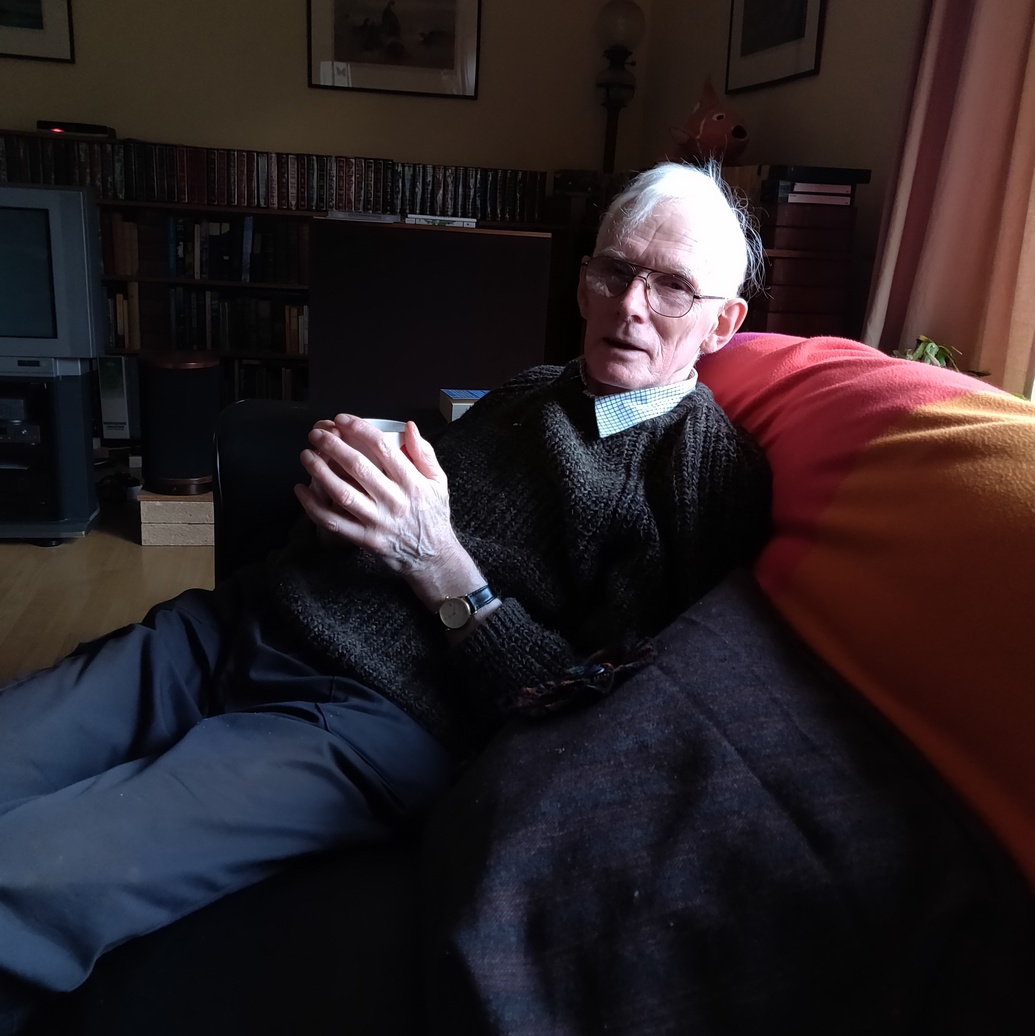
The view from Goldenacre looks out across Loch Insh to the Feshie hills beyond. John Anderson, who is nearly 80, serves me tea and Victoria sponge beneath the window as he tells me the story of his family. He has discovered an unexpected connection between us, which is why he asked me over. I went to boarding school in the hill-station of Mussoorie in North India and the school – Woodstock, named for a Sir Walter Scott novel – was in the Raj-era cantonment of Landour. John’s mother had been born in India while her doctor father, David Wilson Scotland, was a Lieutenant Colonel in the Indian Medical Service. He shows me a sepia postcard sent from Glasgow to the Scotlands at ‘Church View, Mussoorie, India’ and another addressed to their home back in Colinton, Edinburgh, where they had named the house, ‘Landour’. He knows nothing more about their time in the hill station, but I speculate that Dr Scotland may have served in the British army sanatorium established in Landour in 1827.


Mussoorie, India 1860s
It’s a small world. A particularly small world in the village of Kincraig where both John and I live, though I am a relative newcomer, having been here for a mere twelve years. He has been in the area on and off through his youth and for the twenty years since retirement, but laughingly tells me he’ll never be considered ‘local’. When he was born in 1939, his parents were tenant farmers at Banchor Mains, 10 miles south-west of here by Newtonmore, and they moved from there through Lochiel, Loch Rannoch, Invereshie and Strathmashie, graduating at Loch Rannoch from tenancy to landowning.
Years later, when sheep from the local estate were ravaging the Goldenacre garden, John contacted the shepherd, who was the late Donnie Ross, legendary in these parts for his outspoken views on crofting, the environment and anything else to do with land management, but also for treating others with respect. He sent one of his strapping sons to deal with the sheep, but the young man also saw fit to berate the ‘English incomers’ for always complaining. John did not argue, but when the son reported to his father, Donnie told him, in no uncertain terms, “John Anderson’s father gave all his tenants at Strathmashie the right to buy. You go straight back down and apologise.” He did.

John himself never followed in the landowning or farming walk of life, to his father’s disappointment, but did study agriculture in London and joined what was then the Edinburgh and East of Scotland Agricultural College, now part of Scottish Rural College. His chief role was monitoring farm incomes in South East Scotland and covering the fortunes of the potato sector for which he was perhaps better known, having contributed a monthly commentary on it for 23 years without missing a single edition. He challenges me to match that writing record, which shames me into scuttling straight home afterwards to type up my notes.
John’s story, like so many in this area, is one of deep history with the land. I ask him how he feels about it. “I’ve lived in beautiful places all my life,” he says. “At Fassiefern House we had a view of Ben Nevis. But I never climbed it then. People ask me why, but when you had sheep and hill cattle, you only went up the hills if you had to.” When I ask his views about tensions between farming and conservation interests he says, “It’s complicated.” And that’s about the simplest way of putting it. What is clear is John’s own quiet dedication to caring for the landscape as he goes out regularly clearing litter from the village. “I fill a wheelie bin a month from one kilometre of road – can you believe it? Why? Why do people do it?” “Laziness,” I suggest. “Some people just don’t care and can’t be bothered.”

The view from Goldenacre
We agree it reflects a loss of connection. A loss of connection with the land, with the animals who are dependent upon it and with the people who call it home. Ultimately, littering also seems to me a loss of connection with a deeper part of ourselves; a part that dwells fully present in our environment, that does not experience it as just a backdrop, or a playground, or indeed a workplace, but as much a part of us as our breath and bones.
The light from the window dies softly in John’s living room, where my feet rest on a one-hundred year old rug from India. (The Asian in me has left my shoes at the door.) Long and lean as a stork, with hair as white as the scant snow on the Feshie hills, John holds his mug in gnarled hands as he tells me of a walk with his late wife, Frances. “We climbed to the pictish fort of Dun da Lahm above Laggan and we could hear the stags roaring in the woods below and the echoes of it across the valley. And she turned to me and said, ‘This would be a good place. You can lay me to rest here.’”

He looks up and smiles, a pattern of light and shadows on his face, and I know why I have come. It is not so much to talk about historic links to India or the local land, but to share time and presence on this passing day; to experience something at the root of what our environment and people so badly need: connection.
Here is an invitation: come with me on a journey into the Cairngorms.
Perhaps, like me, you live here; perhaps, like I once was, you are a visitor. In some senses they are the same. Next to the deep time of the mountains, our sojourns here, whether a lifetime or a holiday, are but a flicker. And yet, however brief – and even if we have never come – we make our mark.
These ranges and valleys, with their forests, rivers, moors and marshes, may be ancient, but they are not invincible. They live. And the collective effect of all of us who have shared their life for thousands of years has shaped and changed them, just as they change us. They and we live together.
And we belong here. In the same way as the capercaillie and the stag, the mountain willow and the scots pine, people belong in this place. Why not? People are not aliens or machines imported to this planet from elsewhere, and nor do I believe the world would be a better place without us. People are of the earth; as much a part of nature as the rocks and trees and creatures.
But too often we have forgotten it. Too often we live on it rather than within it, not noticing how much the damage to the earth is damage to us, or how much the thriving of the earth is our own thriving.
So I am learning to take notice; to find and feel my belonging to the natural world around and its belonging to me. That is the journey of a lifetime, but 2019 is unique as I am privileged to be Writer-in-Residence for the Cairngorms National Park. I am already a writer (since childhood) and already a resident (since 2006) so what does this role mean? It means time alongside other folk sharing our experiences of this special place together, whether in workshops, story-telling sessions or reading each other’s work. It also means time for me to write with a particular focus on our life here alongside nature.
I don’t know yet what I will write or what form it will take. My plan is not to have a plan, but to explore the territory, both physically and creatively. That feels at once exciting and frightening, because I don’t know where it will lead or what I will have to show for myself by the end. But it also feels right. This year is a kind of pilgrimage; it has a goal but no fixed destination. It is a journey into the living landscape and a pledge to listen to it; a traveling in stillness as well as motion; a commitment to presence. As Nan Shepherd wrote in the first page of The Living Mountain, her iconic hymn to the Cairngorms, “it is to know its essential nature that I am seeking here.”
And so I invite you on this journey of seeking. You can join in the workshops and your own writing by following the news at Cairngorms National Park; and you can follow my pilgrimage through this blog on my website. However you live in and love this place, I hope you will share your story.