


Friends and faithful readers of Writing the Way, I cannot tell you how happy I am to share this news with you. Below is today’s press release from Scottish independent publisher, *Polygon:
FACT AND FICTION: TWO-BOOK DEAL FOR MERRYN GLOVER’S CAIRNGORMS
Polygon, an imprint of Birlinn Limited, has signed Merryn Glover to a two-book deal for a novel and a non-fiction work each set in the Cairngorm mountains. Glover was the first writer in residence at the Cairngorms National Park and has won Creative Scotland support for both projects.
Polygon has bought World All Language rights from Cathryn Summerhayes at Curtis Brown and will publish novel Of Stone and Sky in Spring 2021 and The Hidden Fires: A Cairngorms Journey with Nan Shepherd in 2022.
Of Stone and Sky is a multi-generational family story set in the Scottish Highlands. After shepherd Colvin Munro disappears, a mysterious trail of his twelve possessions leads into the Cairngorm mountains. His foster sister Mo and prodigal brother Sorley are driven to discover the forces that led to his disappearance. Spanning almost a century, the novel is a paean to the bonds between people, their land and way of life. A profound mystery, a political manifesto and a passionate story of love, the novel is shot through with wisdom and humour.
The Hidden Fires is Glover’s response to Nan Shepherd’s The Living Mountain. Drawing from her upbringing in the Himalayas and gradual adaptation to Scotland’s hills, she contrasts her own Cairngorm experiences with Shepherd’s. Exploring the same landscapes and themes of the classic work, she challenges herself and the reader to new understandings of this mountain range and its significance in contemporary Scotland.
Edward Crossan, Editor at Polygon, said: ‘I am thrilled that we are publishing Merryn Glover, an exceptional writer. Her moving and profound novel, Of Stone and Sky, was commissioned on the strength of its compelling narrative and elegant prose. Her non-fiction work, The Hidden Fires, which uses The Living Mountain as its guiding light, is a poetic piece of nature writing, a fitting tribute to Nan Shepherd, and is so vital now, more than ever.’
Glover is the author of A House Called Askival (Freight, 2014), four radio plays for BBC Radio 4 and BBC Radio Scotland and numerous short stories. She was born in Kathmandu and grew up in Nepal, India and Pakistan. Australian by citizenship, she lives in the Highlands and has called Scotland home for over 25 years.
Glover said, “I am honoured and excited to be published by Polygon, a proud, independent Scottish publisher and the perfect home for these books, so rooted in Scotland. I am also delighted that Polygon matches the international vision and wide reach that is so important in my work”

- Polygon Books is an imprint of Birlinn Limited, Scotland’s largest independent publisher. It publishes literary fiction, poetry, and books on popular culture from award-winning writers such as Liz Lochhead, Norman MacCaig, Jenni Fagan, Stuart Cosgrove, and the author of The No. 1 Ladies’ Detective Agency, Alexander McCall Smith. Polygon was originally established by students of Edinburgh University, including a young Gordon Brown, in the late 1960s. It became part of Birlinn Limited in 2002. In 2018, Polygon was the home of the Centenary Edition of the Novels of Muriel Spark.
- Press release on Polygon’s site here.
Living by the Spey, most of my walks into the Cairngorms are from the north-western side, such as the one to Angel’s Peak last year. I’ve always wanted to venture in from the Deeside on the south-east, walking up to Loch Etchachan and Ben MacDuie, so on a recent weekend we drove round the top of the mountains to begin a three-day camping trek from the Linn of Dee near Bramar. We were blessed with endless sunshine, but the unusually still air meant we were also cursed by Scotland’s smallest and most infuriating fiends: the midges! Apart from their invasions morning and evening, it was a trip of radiant light and colour, of long days and far views, of rushing water, birdsong and quiet. I’ll let the photos tell the story.


We got to Braemar by 5.30 that evening, extremely thankful for hot showers, a pub meal and a huge soft bed. But even more thankful for three days walking, swimming, sleeping, looking and listening in the Cairngorms.
“However much I walk on them, these hills hold astonishment for me.”
Nan Shepherd, The Living Mountain
It’s the Cairngorms Nature at Home Big 10 Days! This WAS going to be the Cairngorms Nature Big Weekend and I WAS going to be over with the rangers in The Cabrach in Morayshire leading a family story-making session. Hopefully, all of that can still happen next year, but in the meantime the folks at Cairngorms Nature have organised a fantastic programme of virtual events from 15th to 24th May. That means people all around the world can enjoy this exceptional place while staying safely at home.
To mark the event, I’m sharing a nature poem each day on Instagram and Twitter. The ten together make up a series called The High Tongue, printed below, which were my contribution to our Shared Stories anthology last year. Exploring the names of ten of the Cairngorm mountains, each title begins with the anglicised version, followed by the Gaelic spelling (if different) and then the translation, which is explored in the rest of the poem. They are all Cairngorms Lyrics. This is a new poetic form I invented last year as Writer in Residence for the Park and you can read all about it here. (For pronunciation of the Gaelic names, look out for a recording I’ll post soon of me reading them all.)
Ben MacDuie – Beinn MacDuibh
The Mountain of the Son of Duff

High King of Thunder
Old Grey Man
Chief of the Range
Head of the Clan


Cairn Gorm – An Càrn Gorm
The Blue Mountain

Rainbow height:

blaeberry
bog         brown
red         deer
snow        white
blackbird
dog         violet
moss        green
bright

The view from the top of Cairngorm
Carn Ealer - Carn an Fhidhleir
Mountain of the Fiddler

She plays the rock
with the bow of the wind
for the stars to dance


Cairn Toul – Càrn an t-Sabhail
The Barn Shaped Mountain

Storehouse of stone

Boulders shouldering like beasts
in this dark byre

Hail drumming the watershed

Cairn Toul
Ben Vuirich – Beinn a’ Bhùirich
Mountain of the Roaring

Once the haunt of wolves
       howling at night

             now just their ghosts
                             in failing light


Coire an t-Sneachda – Coirie an t-Sneachdaidh
Corrie of the Snow

Bowl of white light
black rock       wind run        ice hold
hollow of the mountain’s hand

Coire an t-Sneachda
Beinn a’ Bhuird
The Mountain of the Table

Giants gather in clouds of black
for a bite and a blether,
bit of craic.


Ben A’an – Beinn Athfhinn
Mountain of the River A’an

in a cleft of silence
hidden loch       secret river
   name breathed out
      like a sigh

Loch Avon
Braeriach – Am Bràigh Riabhach
The Brindled Upland

freckled speckled wind rippled
  shape shifting fallen sky
dark    light    shadow     bright
              land up high


Am Monadh Ruadh
The Red Mountains

Range of russet hills
forged in fire at first sunrise
old rust rock
glowing still

Am Monadh Ruadh
It’s the Cairngorms Nature at Home Big 10 Days! This WAS going to be the Cairngorms Nature Big Weekend and I WAS going to be over with the rangers in The Cabrach in Morayshire leading a family story-making session. Hopefully, all of that can still happen next year, but in the meantime the folks at Cairngorms Nature have organised a fantastic programme of virtual events from 15th to 24th May. That means people all around the world can enjoy this exceptional place while staying safely at home.
To mark the event, I’m sharing a nature poem each day on Instagram and Twitter. The ten together make up a series called The High Tongue, printed below, which were my contribution to our Shared Stories anthology last year. Exploring the names of ten of the Cairngorm mountains, each title begins with the anglicised version, followed by the Gaelic spelling (if different) and then the translation, which is explored in the rest of the poem. They are all Cairngorms Lyrics. This is a new poetic form I invented last year as Writer in Residence for the Park and you can read all about it here. (For pronunciation of the Gaelic names, look out for a recording I’ll post soon of me reading them all.)
Ben MacDuie – Beinn MacDuibh
The Mountain of the Son of Duff

High King of Thunder
Old Grey Man
Chief of the Range
Head of the Clan


Cairn Gorm – An Càrn Gorm
The Blue Mountain

Rainbow height:

blaeberry
bog         brown
red         deer
snow        white
blackbird
dog         violet
moss        green
bright
The view from the top of Cairngorm
Carn Ealer - Carn an Fhidhleir
Mountain of the Fiddler

She plays the rock
with the bow of the wind
for the stars to dance


Cairn Toul – Càrn an t-Sabhail
The Barn Shaped Mountain

Storehouse of stone

Boulders shouldering like beasts
in this dark byre

Hail drumming the watershed
Cairn Toul
Ben Vuirich – Beinn a’ Bhùirich
Mountain of the Roaring

Once the haunt of wolves
       howling at night

             now just their ghosts
                             in failing light


Coire an t-Sneachda – Coirie an t-Sneachdaidh
Corrie of the Snow

Bowl of white light
black rock       wind run        ice hold
hollow of the mountain’s hand
Coire an t-Sneachda
Beinn a’ Bhuird
The Mountain of the Table

Giants gather in clouds of black
for a bite and a blether,
bit of craic.


Ben A’an – Beinn Athfhinn
Mountain of the River A’an

in a cleft of silence
hidden loch       secret river
   name breathed out
      like a sigh
Loch Avon
Braeriach – Am Bràigh Riabhach
The Brindled Upland

freckled speckled wind rippled
  shape shifting fallen sky
dark    light    shadow     bright
              land up high


Am Monadh Ruadh
The Red Mountains

Range of russet hills
forged in fire at first sunrise
old rust rock
glowing still
Am Monadh Ruadh
Do you love maps? I find them fascinating, so when I was invited by Walk Highlands to write an article about what to do when we can’t walk very far, Map Gazing immediately sprung to mind. It’s what I did for a long time before making my pilgrimage to Angel’s Peak and what I did for a long time afterwards, to savour the journey. A map, I’ve discovered, is not just an image of the land, it is a story about it.
Read the Map Gazing article (with fantastic photos from the Walk Highlands editors) here:
My head is still in the Himalayas. Two weeks ago, I shared about my childhood in Ghachok, a village in the mountains of Nepal which is home to the Gurung people. We left it in 1976, and over the years, have made several trips back. This is the story of those returns.
The first one was in 1984 with my brother’s friends. Not much had changed then except that Mark and I were now tall enough to bang our heads on the door lintel, which felt like the end of childhood.
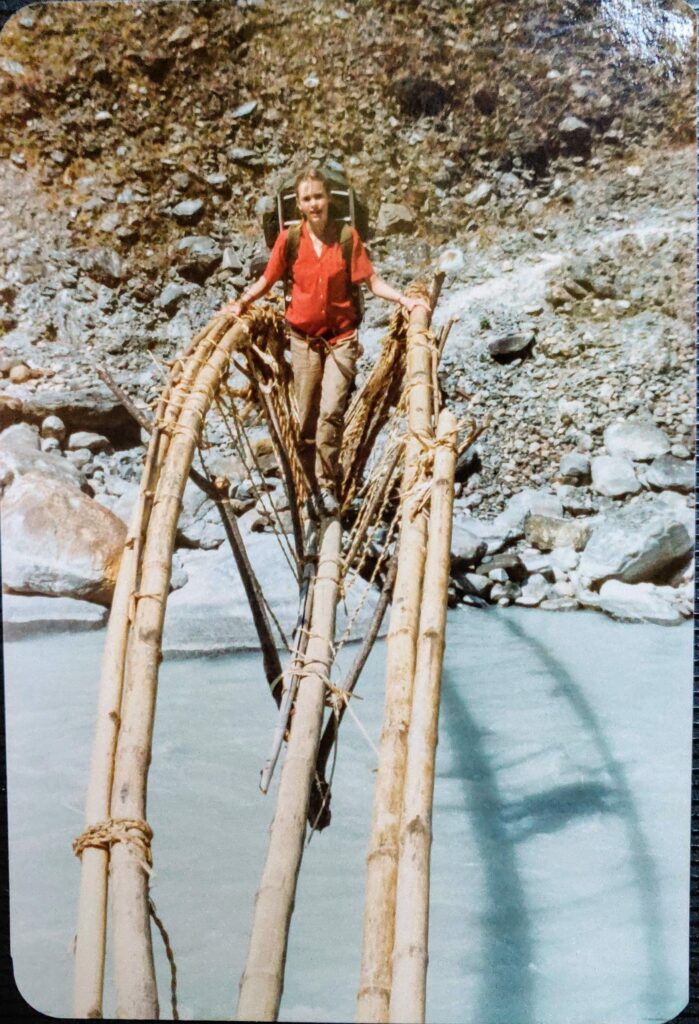
1984 on a familiar bridge
We noted on each of our visits how more of our village friends and neighbours were moving away, often to the town of Pokhara down in the valley, but equally often to places overseas. Many young men were serving the Gurkhas in far flung postings and many of the young women were married to them. On one return to Australia in 1987, we met our landlord’s daughter with her new husband in Singapore. The girl who used to tear round the village in bare feet and wild hair that she wouldn’t let anyone brush, had been transformed into a vision of beauty and grace. That entire family has now left the village.
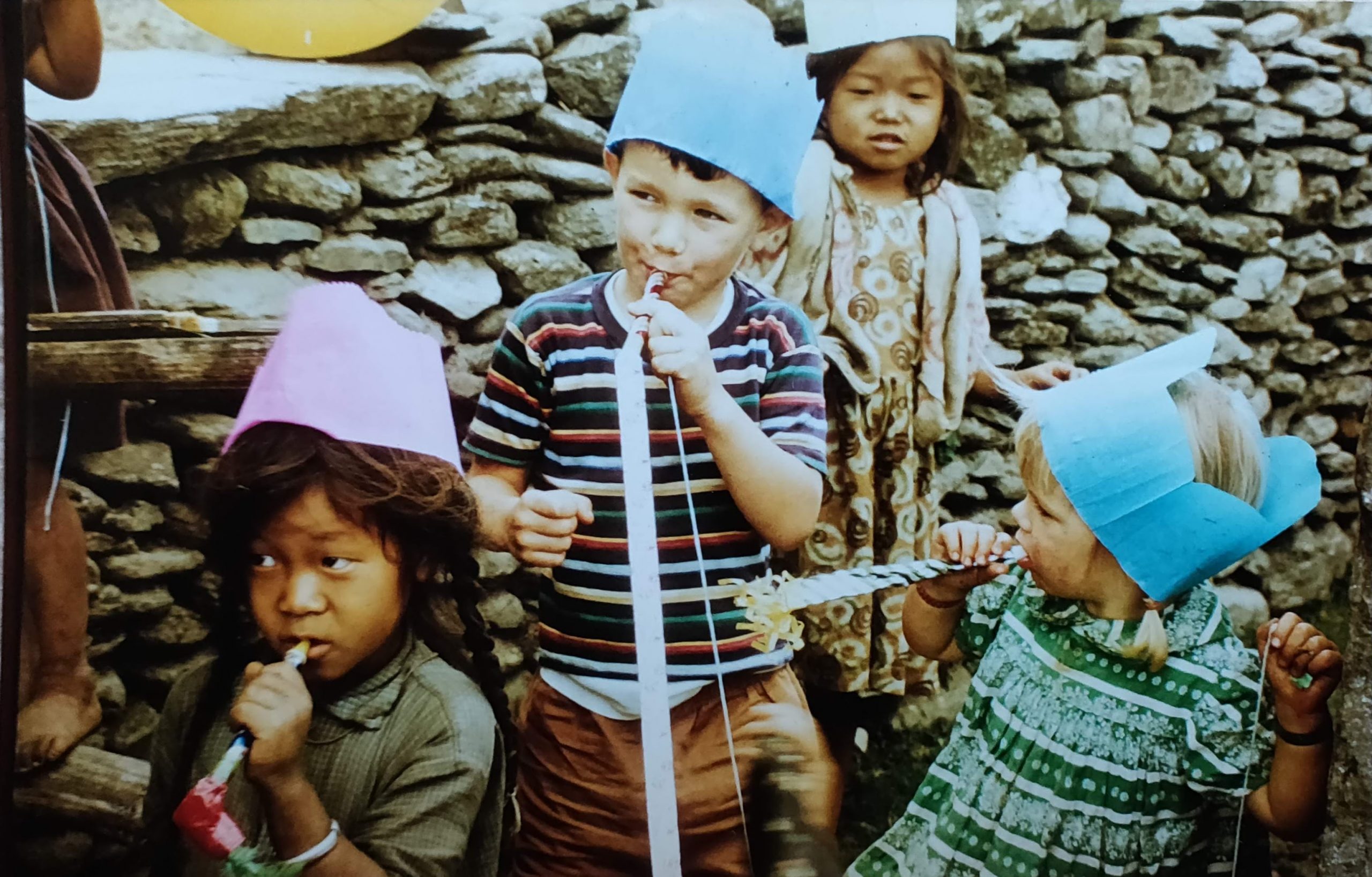
My 2nd birthday. We liked it scruffy.
In 1998, we were all working back in Nepal and with our parents, Mark and I took our growing families to see Ghachok: his wife and two wee kids, my husband and our baby, though he was just a tummy bean at the time. Our old house was vacant, so we slept in the musty room upstairs and peered out the back window at Machapuchare. The main difference by then was the establishment of the Annapurna Conservation Area Project and the replacement of goats – whose grazing habits inhibit forest re-growth – with ducks. They were great for curry but not so good for cuddles.
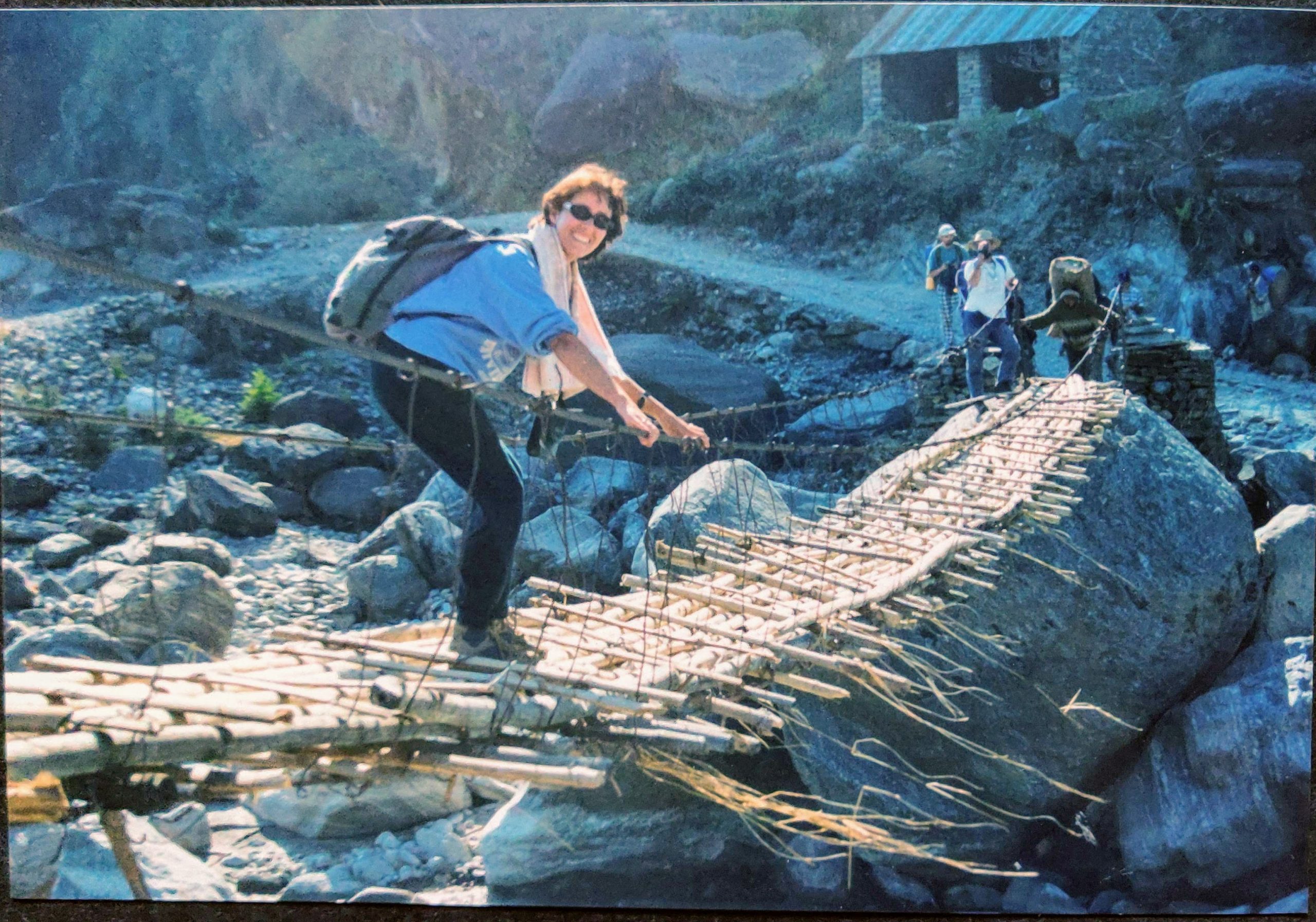
Mark’s wife, Jenika, clinging on for dear life and sanity in the Glover family
We went again in 2004 to celebrate my parents’ 40th wedding anniversary, with a few more children in tow, though my doctor husband and younger son missed out, as the latter came down with pneumonia. A pony helped the kids up the mountain and my Dad, with dodgy knees, back down. We went with a trekking company who erected tents for us at the edge of the village and it felt dislocated. Electricity poles and wires were marching up the plateau, but even more people had gone.
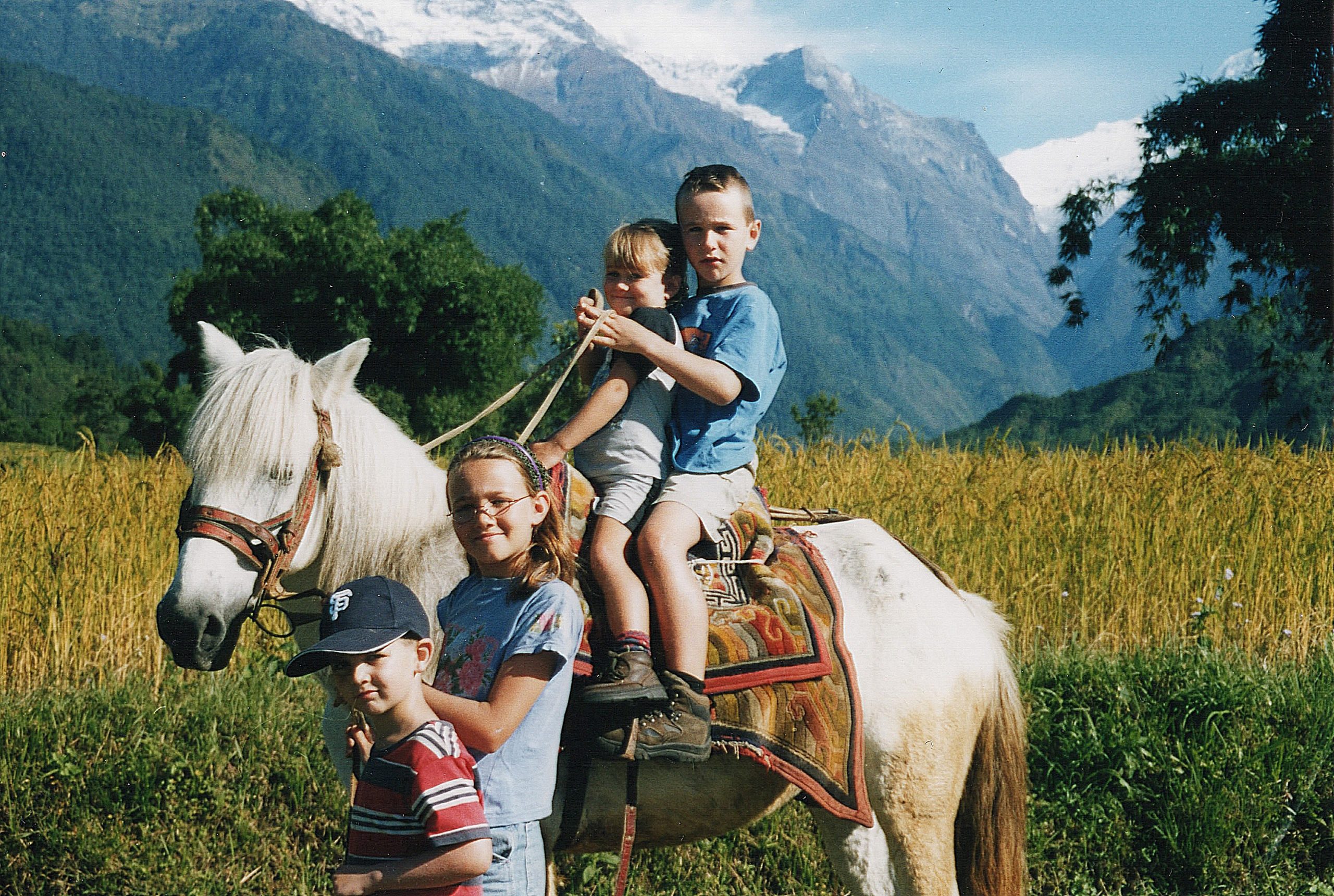
Sam, Rebekah, Sarah, Joshua and friend in Ghachok
So when I asked to go again this year, as part of my parents’ farewell from Nepal, they were ambivalent. For our sake they would go, but didn’t expect many meaningful connections. We clocked the first major difference before leaving Pokhara: there is now a road and a regular bus that took us all the way there in 90 minutes, heaving and blasting its horn up the un-metalled track, a few kids piled around the driver for good measure.
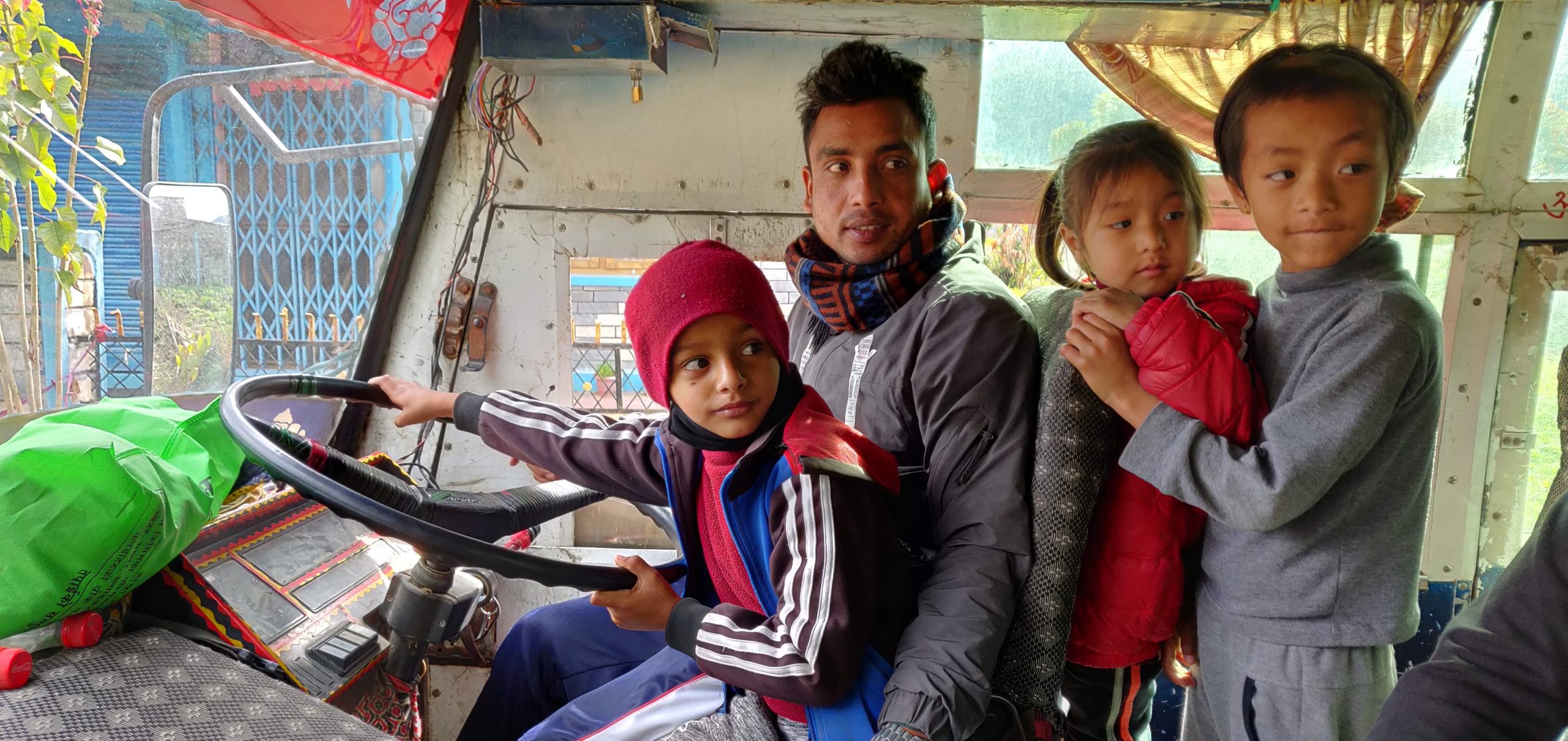
Takes a team
The second innovation was the well-appointed Machapuchare Village Inn, where a friend had booked us for the two nights. It had spotless rooms with attached western bathrooms (no Time magazines), solar heated water and mobile reception better than the Highlands of Scotland. We walked above the village to find the springs where we used to picnic, but they were lost under the new forest and the dirt cutting for an extension to the road. There was rubbish underfoot, but overhead, scarlet and golden orioles rippled through the branches.
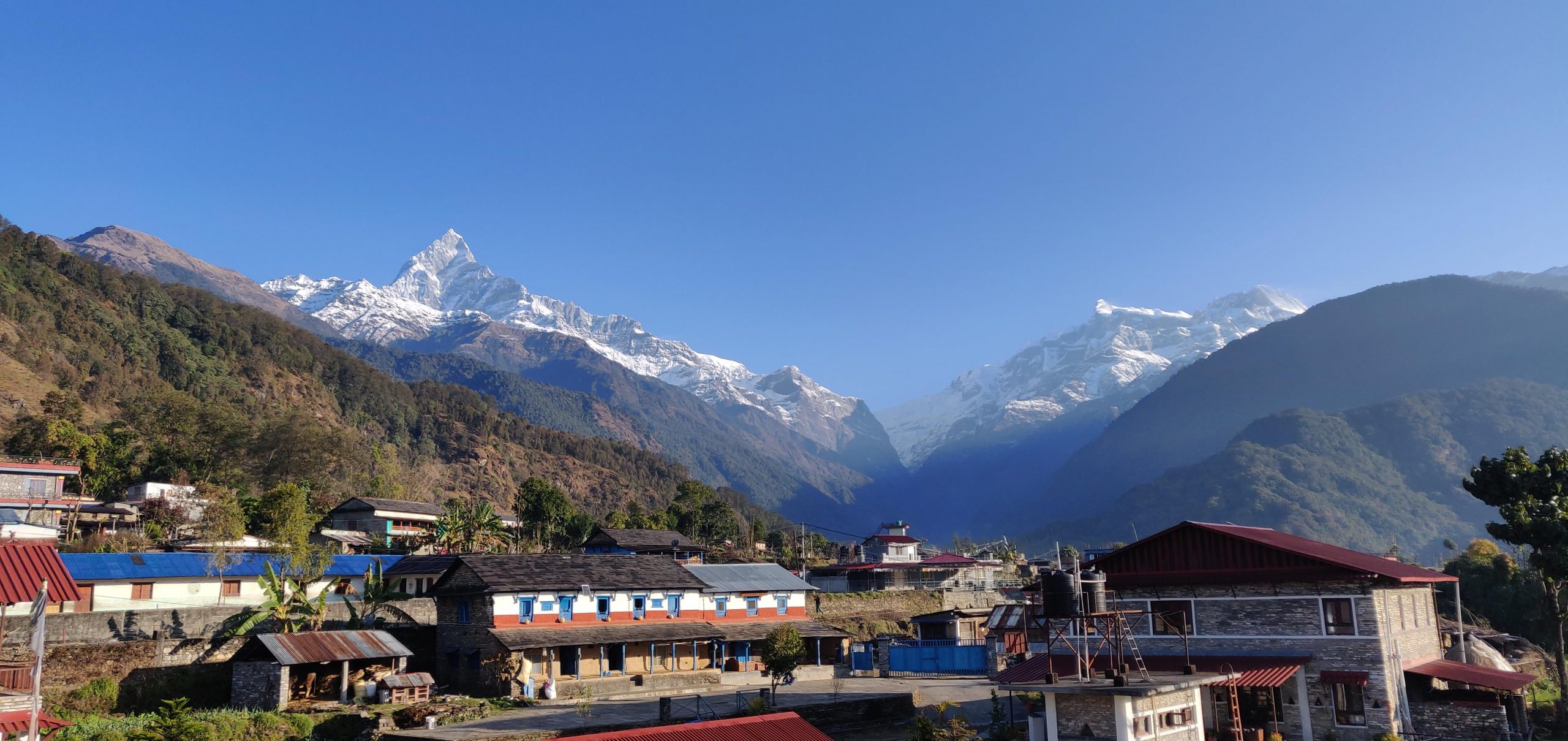
View from the Machapuchare Village Inn
Some of the terraced fields looked abandoned, while others had been cleared by machine. There was no sign of the traditional ploughman with his yoked cattle, though, interestingly, the goats were back. Perhaps they are allowed now that enough forest has taken hold. Whatever the reason, they proved as adorable and obliging as ever, one even kissing me on the lips.
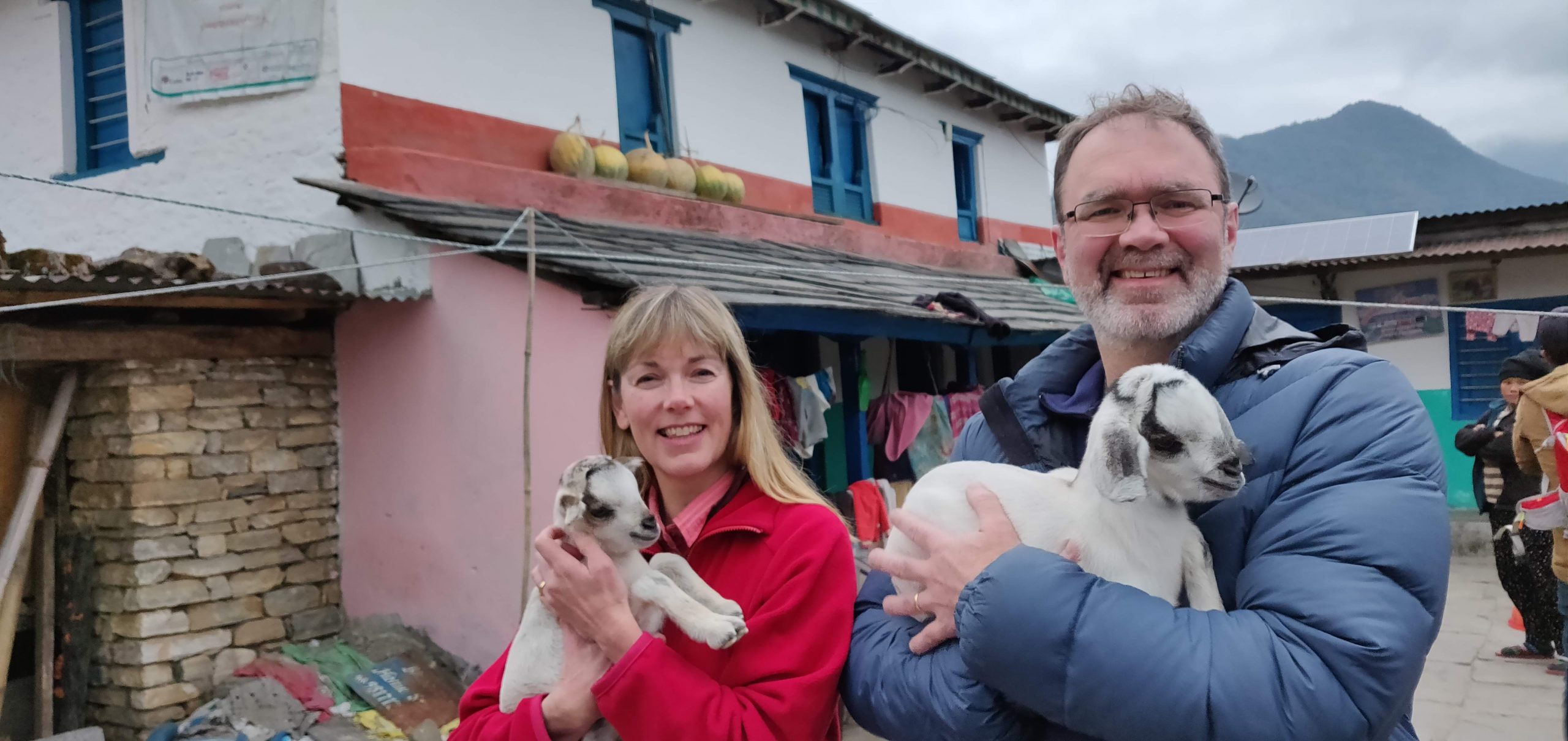
Kidding around
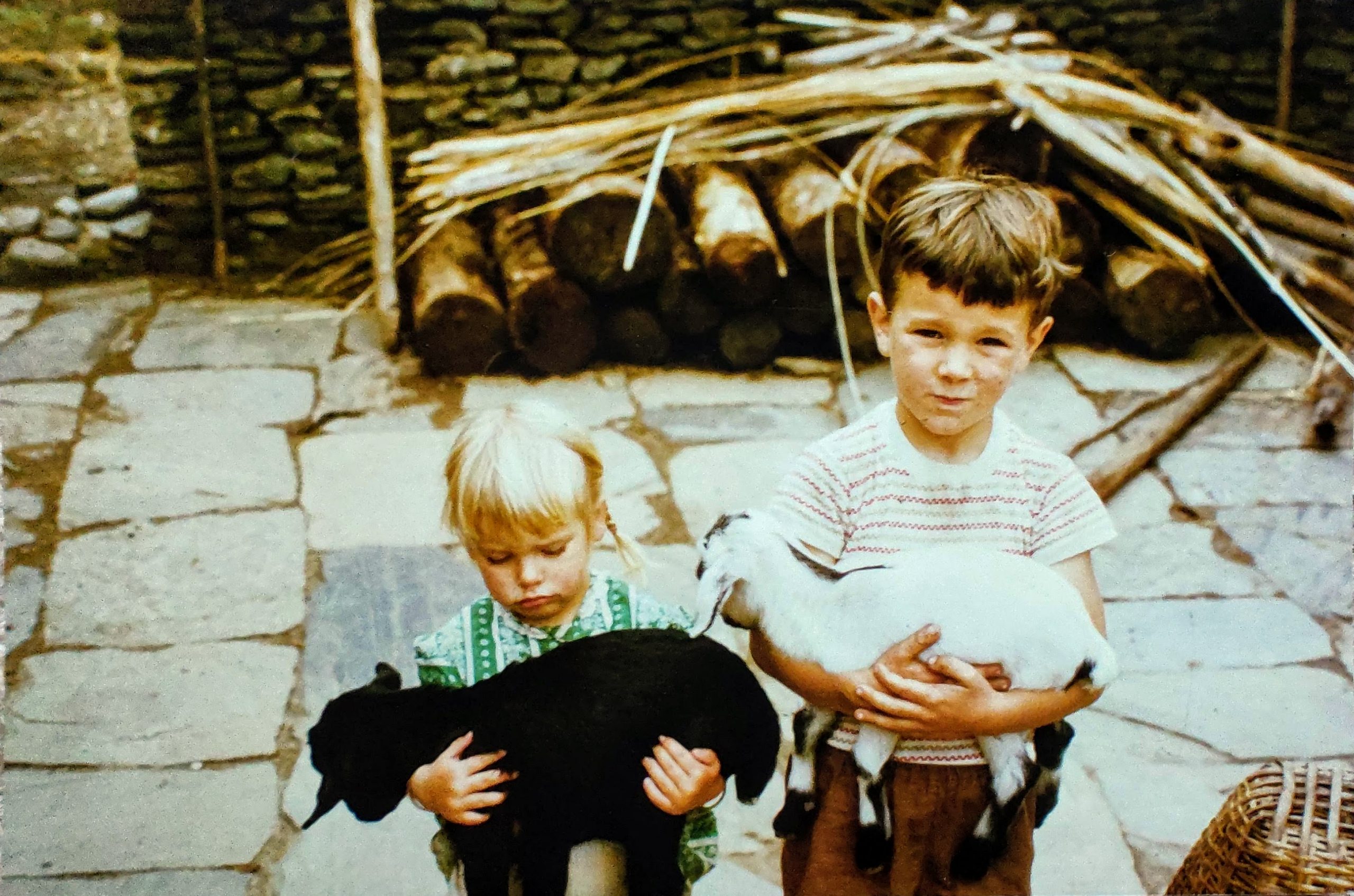
“We asked for a Barbie and a rocket.”
As we explored the village, to our surprise and delight, more and more of the old guard appeared and welcomed us with excitement: Abhwee! they cried. There was also cheerful critique in the case of my brother. Nepalis dye their hair well into old age and the men don’t grow beards, so Mark’s white designer stubble threw them. “Oh you’ve grown old!” they exclaimed. Or, “You used to look good!” He took it on the chin, so to speak.
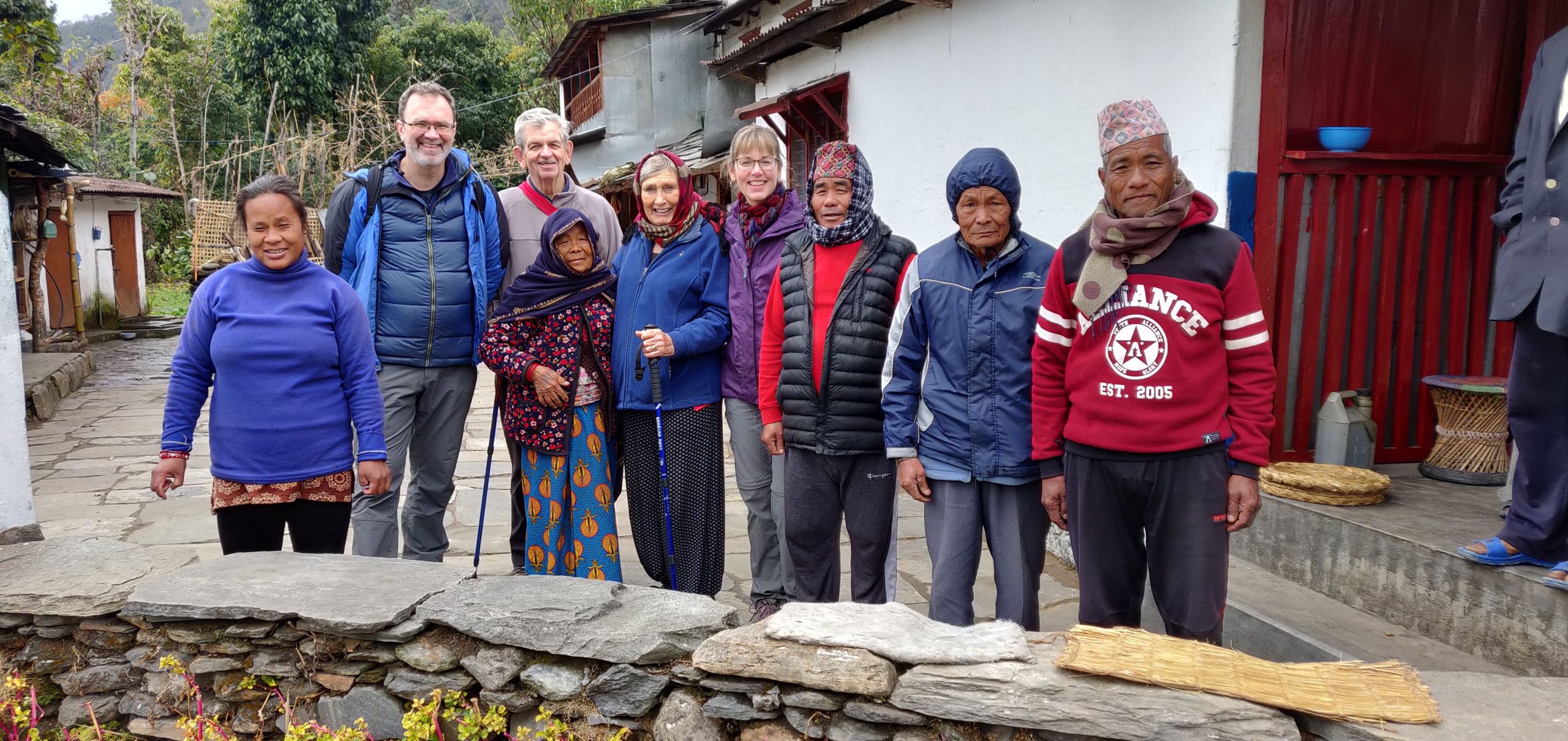
Goma-ma-aama & friends
As the oldest child, he had been named Surya (pronounced Soordzay) by the community, which means ‘sun’. The rest of the family are simply named in relation to the first-born (male or female): Surya-ma-aaba (father), Surya-ma-aama (mother), Surya-ma-nani (oldest girl). In a culture with close ties across extended families, there are distinct kinship terms covering most relationships: father’s eldest brother’s wife; cousin-sister on the mother’s side; youngest son; even younger youngest son (when a surprise turns up). Although everyone gets an official legal name, it is rarely used in childhood, and means there are multiple ‘nanis’ and ‘tagus’ scampering around the village; it also reflects the importance of the place within the family over the identity of the individual.
Mark was 7 months old when my parents arrived in the village and were given a vacant hovel to rent. Abandoned because it was allegedly haunted, their capacity to survive its maleficence perhaps changed its fortunes, as it has been in use ever since. As a baby, Mark spent many happy hours on a potty out the front waving to passers-by, so we took a commemorative photo on the same spot, though without the full re-enactment.
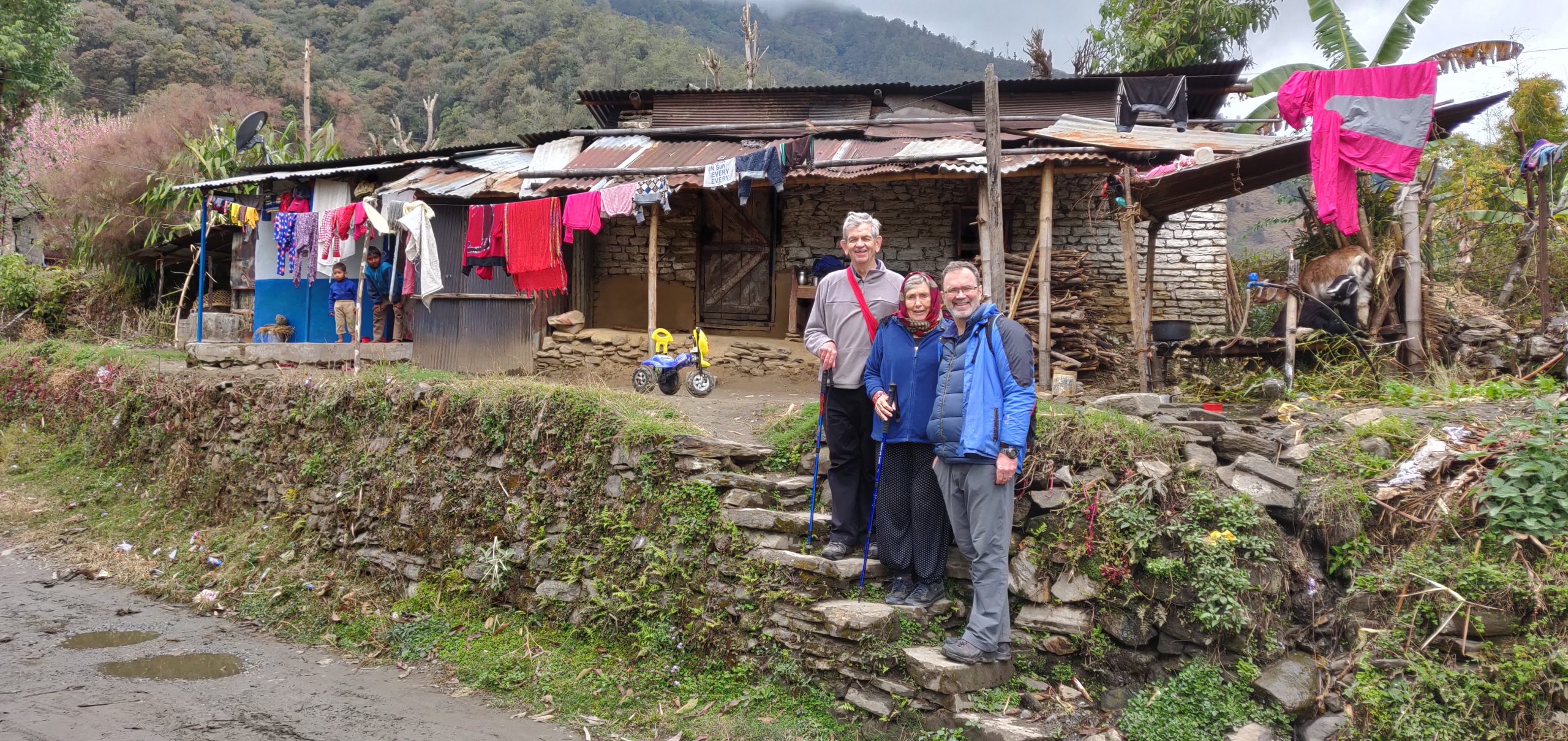
The haunted house
We returned to a second house where we had stayed (too young for my memory) finding the elderly owners now crippled by stroke. Sitting in their dark kitchen/living/bedroom, with him half-paralysed and her hobbling, we talked as their daughter-in-law made tea over a fire-pit in the earthen floor, a method unchanged in fifty years. Then she went outside and took a video call on her smart phone.
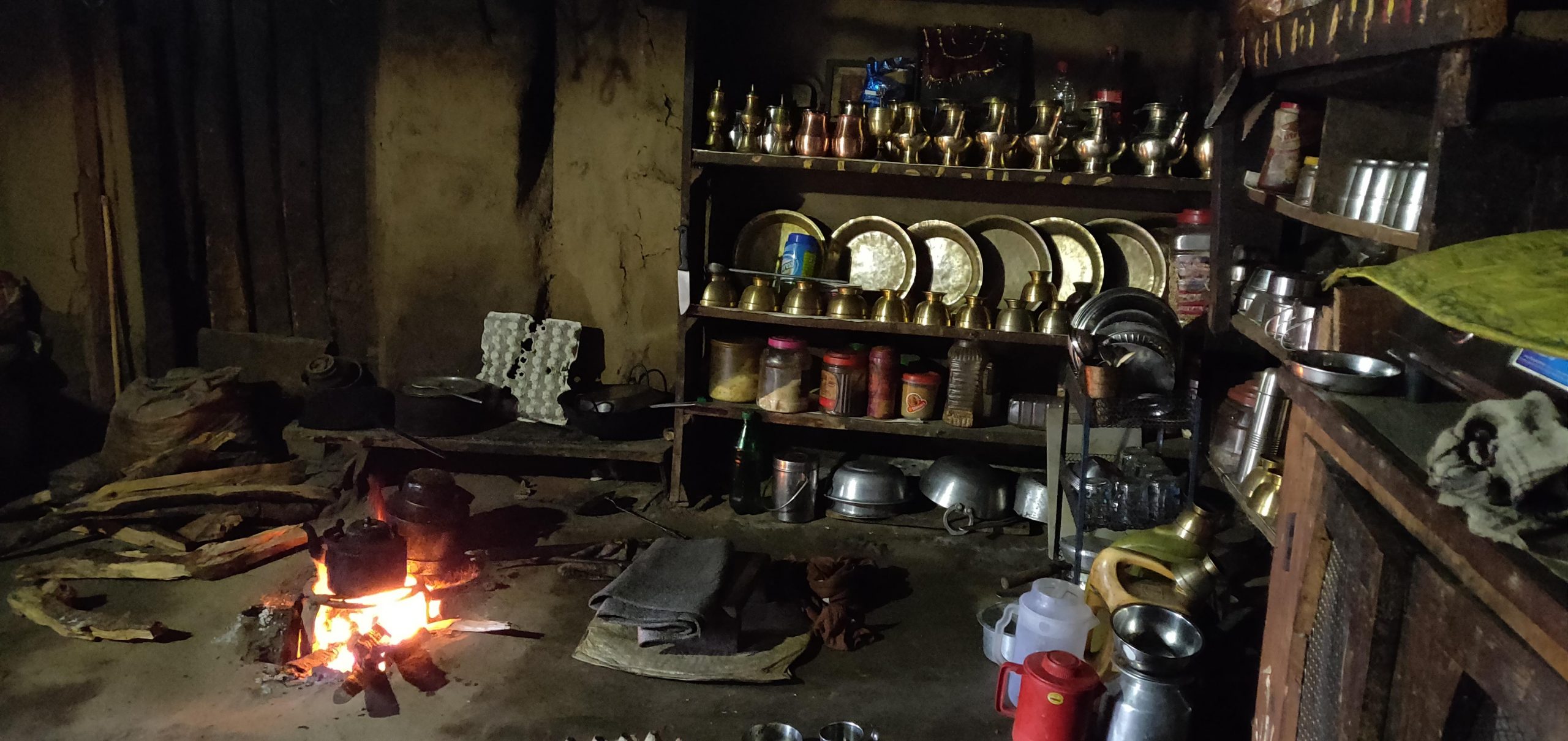
Back at the house where we had spent most of our time, we climbed the wooden log ladder to the verandah that had been school and dispensary. It was covered in corn cobs and the door to our living space was locked. Peering through, I saw the light from the northern window fall into a dusty cavern of corn husks and old bamboo mats. The ceiling was gone and the wooden beams gave way to slated darkness. It was hard to imagine the bright home that had been filled every night with people and the sounds of Gurung chatter, songs and even dancing.
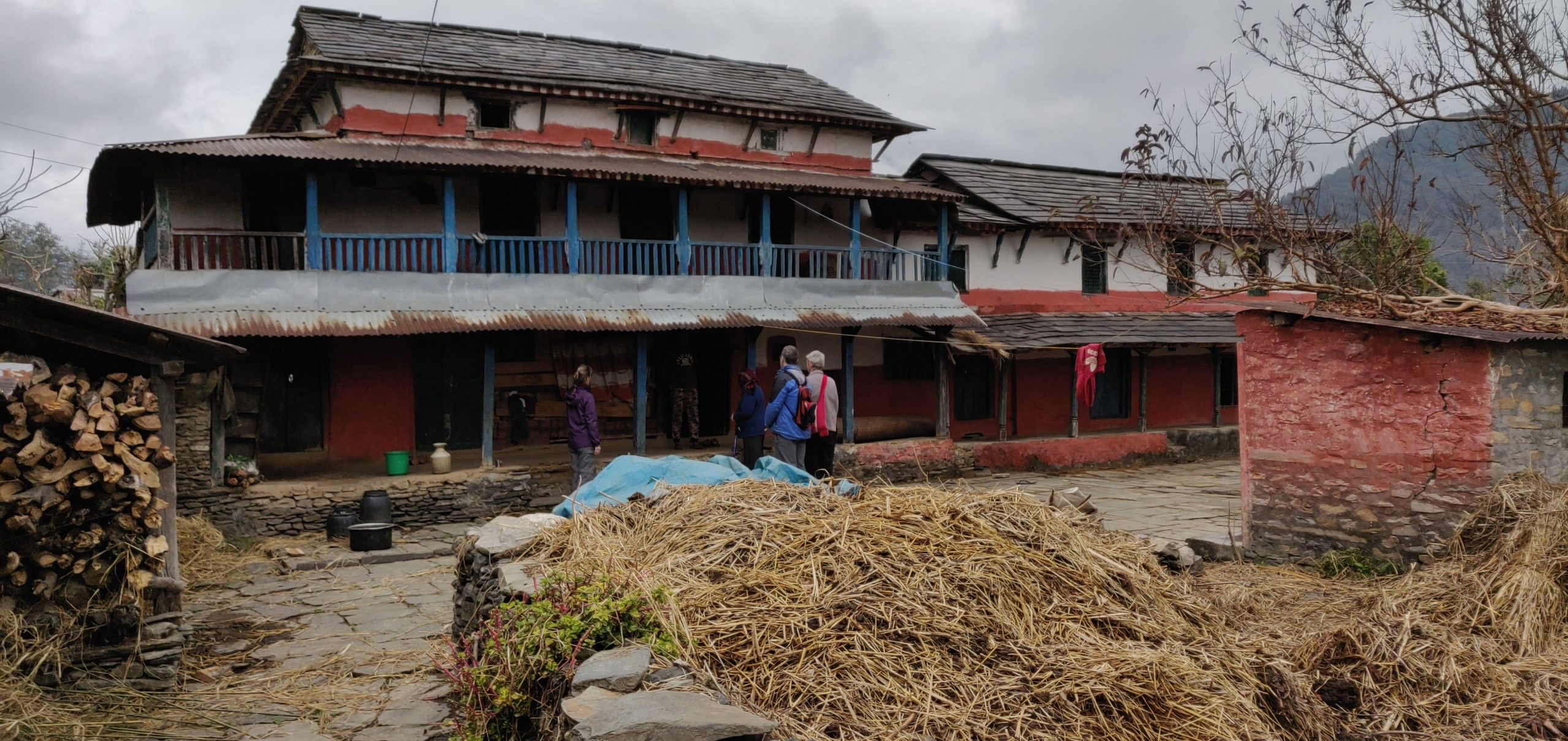
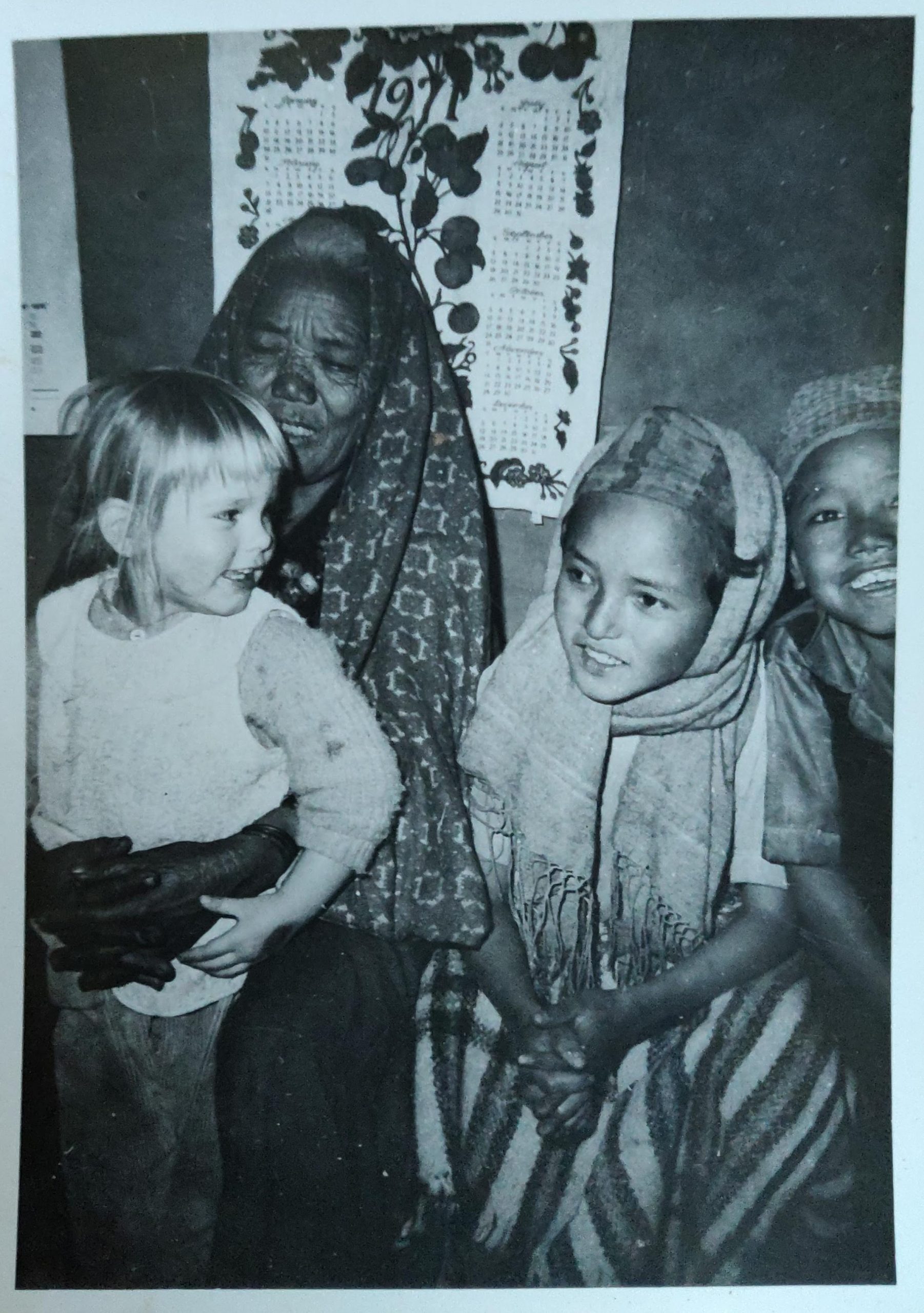
One of the evening gatherings
But as we walked the old trails, more and more of those people remembered and found us again. One was Bara Hakim, a man with speech and learning disabilities whose nickname meant ‘Big Boss’ because he very ably commanded all around him. Then there was Goma-ma-aama whose son had been our playmate, and the widow of Purna, the porter who had delivered our mail and supplies. Another was Bobar Singh, the son of our neighbours up the path who had been desperately poor. It was reassuring to see he was dignified and well educated, though, like many, he has no work.
He insisted on guiding us around to Lasti Shon, a waterfall that had been a favourite picnic spot. Although the water is snow melt and icy cold, I have swum there on every visit and this occasion was no different.
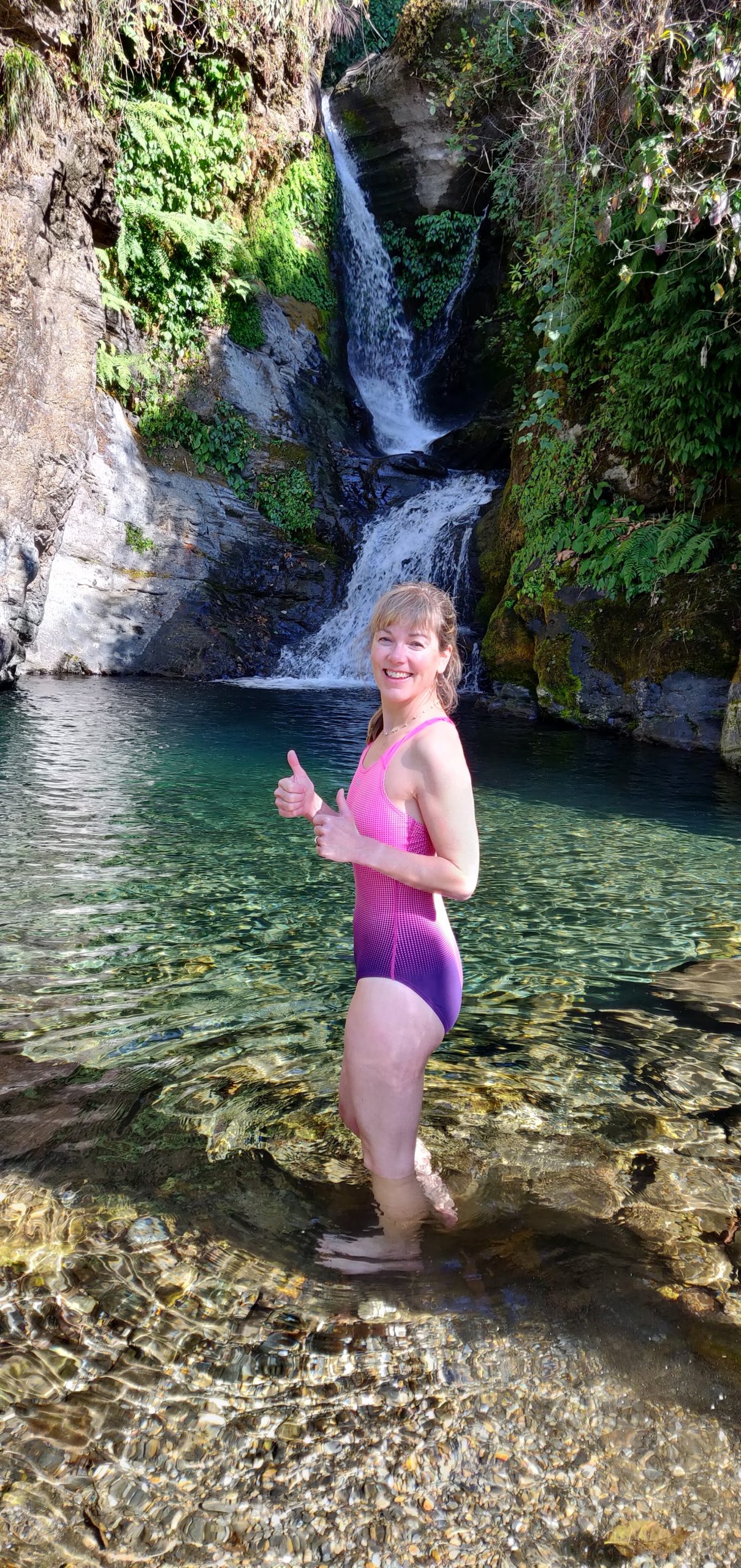
Wild swimming in the Annapurnas
Returning via the plateau rim, hundreds of feet above the Seti river gorge, we were stopped in our tracks by the sight of eagles riding the thermals. They took off from the cliffs below and passed us, their vast wingspans just feet away, before rising above, a dozen or more wheeling in the sun.
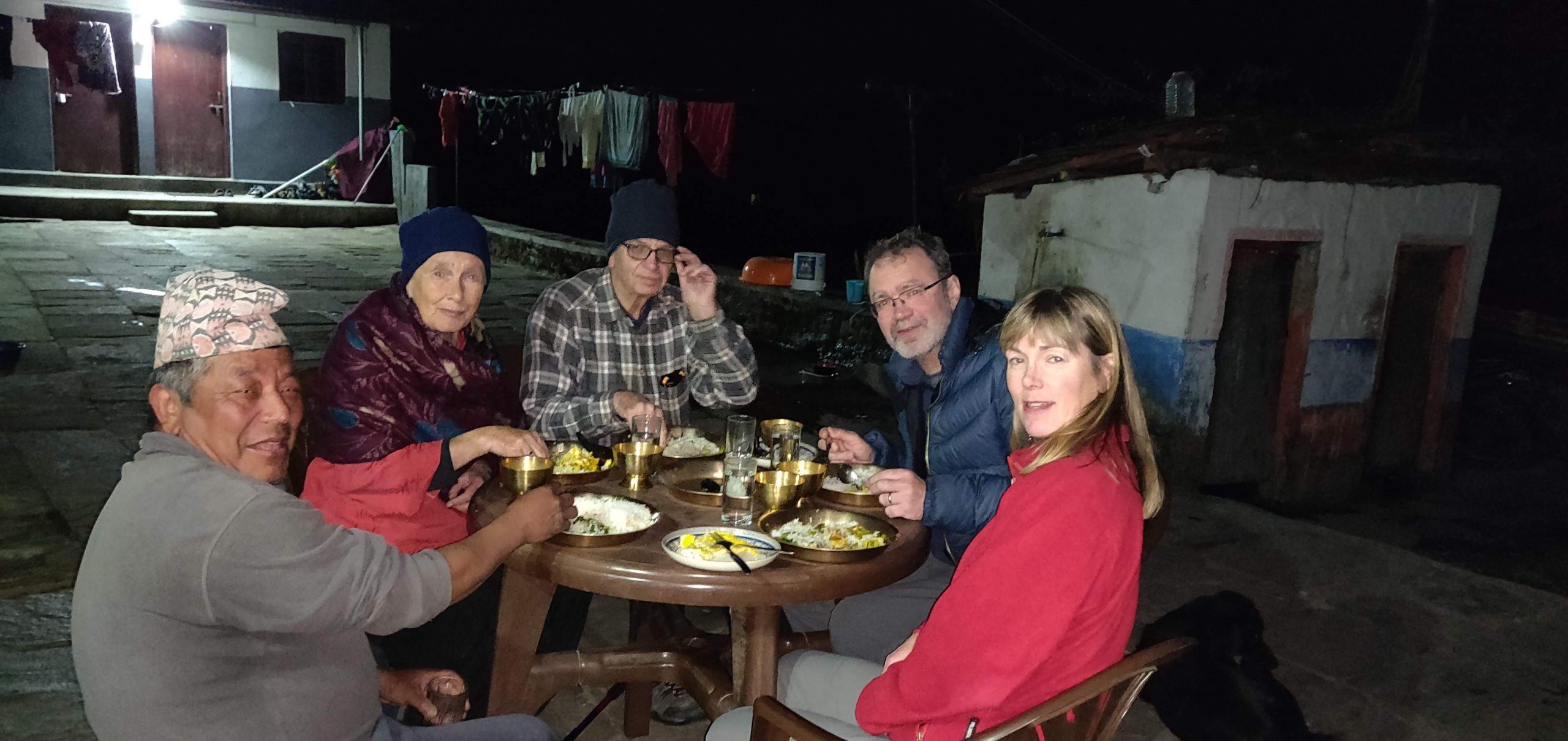
Baru Kaji’s hospitality
Another old acquaintance, Baru Kaji, got wind of our visit and insisted we eat at his home on our last night. Like many places in the village, his is now a Home Stay with support from Australian Aid and Australian Caritas. Though most village houses are still traditional with earthen floors and cattle sheds at the side, they now have external brick toilets and a courtyard tap. Many also have satellite dishes. Made entirely of organic produce from Baru Kaji’s own fields, our meal of rice, daal and curries was plentiful and delicious. One thing that hasn’t changed in Ghachok, however, is the wife preparing the food, serving everyone and then eating alone at the end. The position of women in Nepal has improved dramatically in the past fifty years, but they still have multiple challenges (of greater significance than dinner time etiquette.)
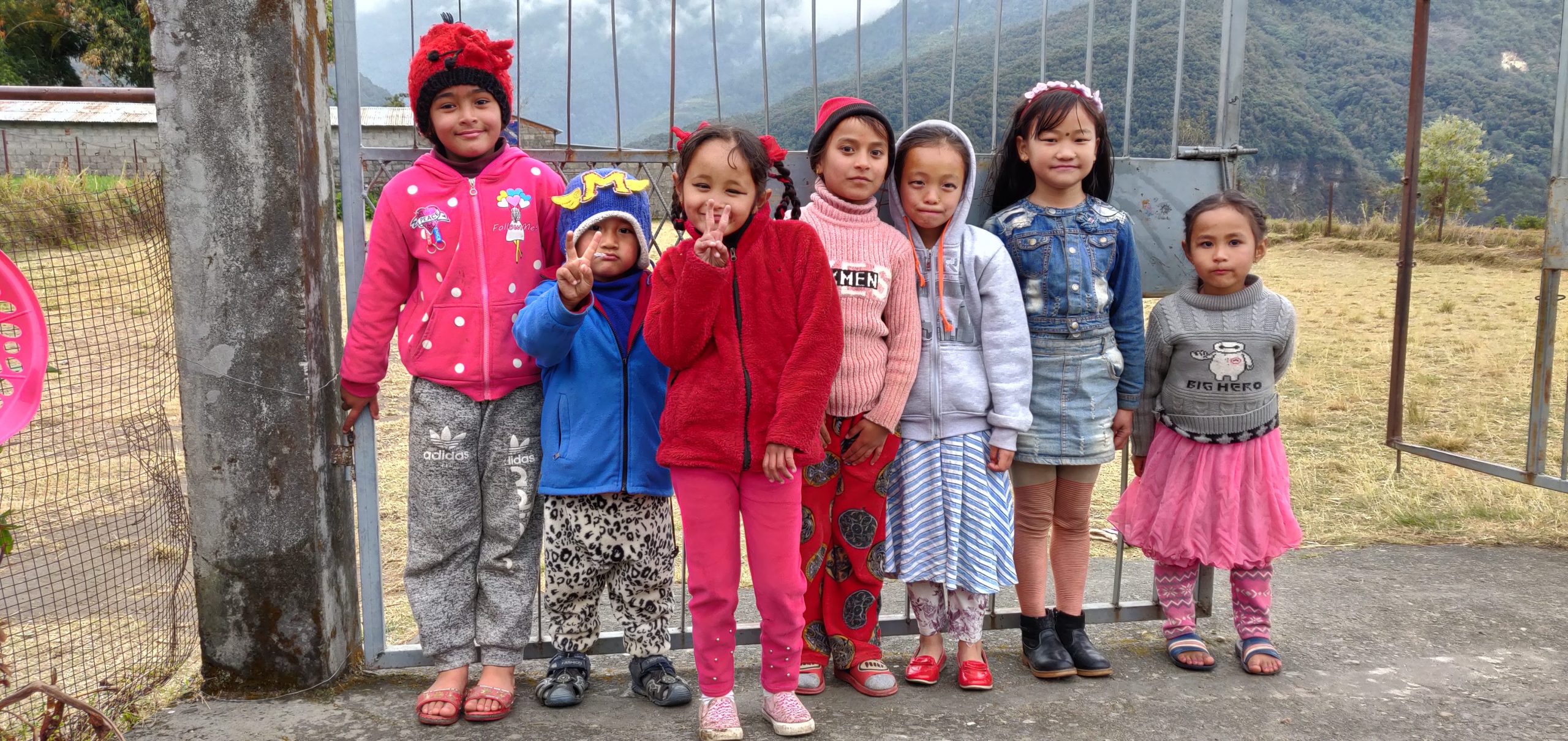
The next generation of girls showing their spark
Our mornings in the village began with clear skies and the sunrise lighting Machaphuchare behind us. The quiet was touched only by the old familiar sounds of cocks crowing and people’s voices, carried easily on the windless air. And then the bus would arrive, rumbling and blasting its way up the road, under the concrete archway and past the multi-storey, multi-coloured Buddhist gompa. (There were none here even 15 years ago.) But that breach of the peace was nothing against our final night, when Nepali pop music was broadcast across the valley till 5am in celebration of a local wedding. In one bouncy song, a young man tries to woo his girl but discovers the price of love these days includes an iphone and a flight to America. (She’s certainly not eating last!)
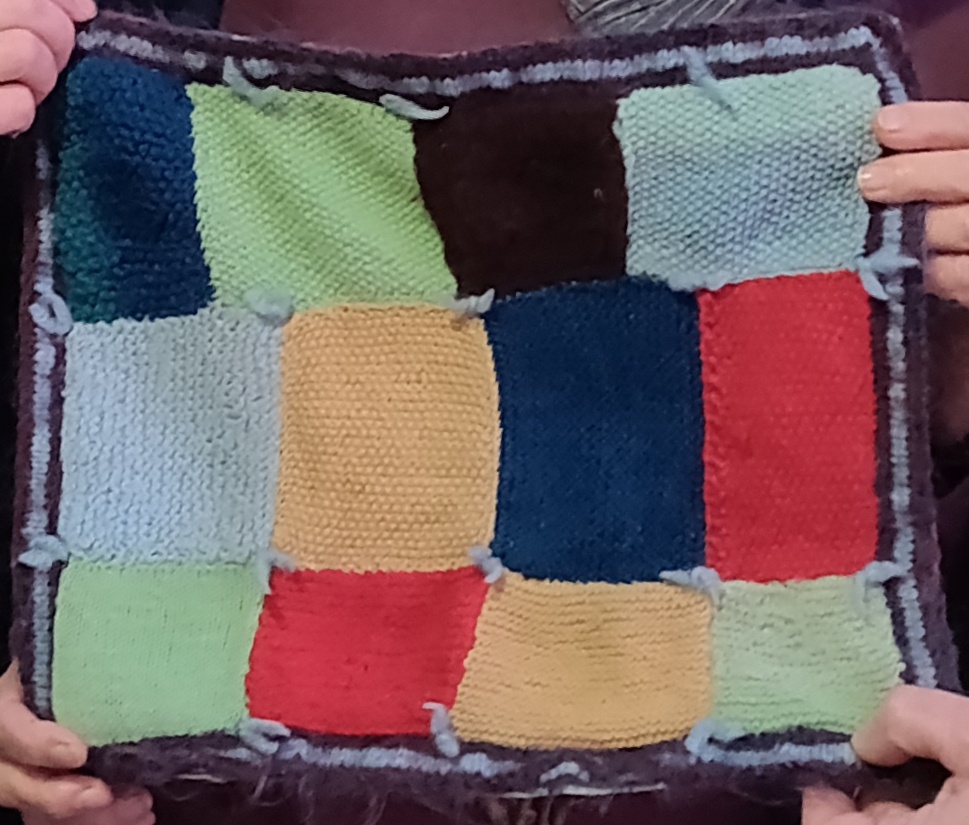
One thing remained. On the final morning, standing in the sunshine with Machapuchare behind, I got my family to close their eyes and figure out the object I placed into their hands. It didn’t take too much fumbling and false guesses before they realised it was the old knitted dolls quilt. You can watch the moment here. There was something both gentle and powerful in the coming together of those hands that had made the quilt all those years ago; a family weaving back together in stitch and story.
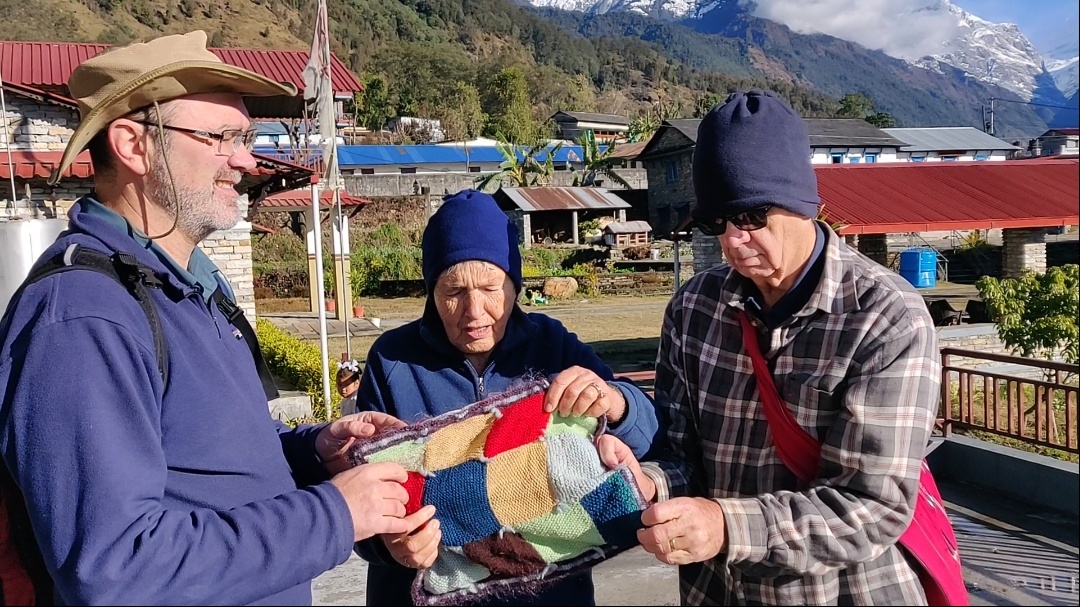
Remembering by feel
They say you can’t go home, and we were all aware of the perils of nostalgia and the reality of change. But that journey was far more than a return to the past; it was an affirmation of a family’s life together. It was a difficult life at times and we are no dream family, but it was a life fired by a purpose greater than itself. We were ordinary people in an extraordinary place and I am forever thankful. To be there again together, for the last time, was gift.
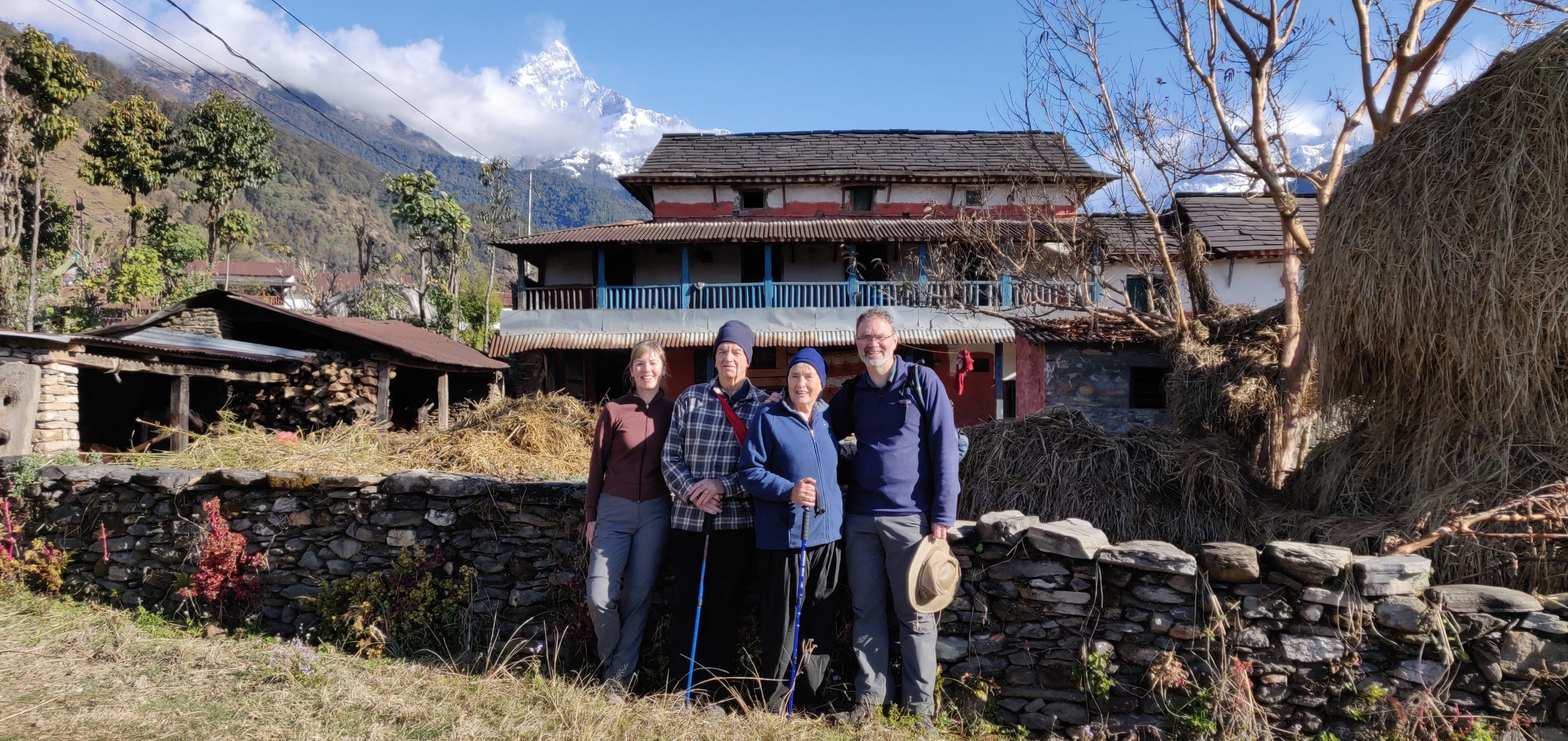
Ghachok village sprawls across a sloping plateau below Machapuchare – Fishtail Mountain – one of the most striking in Nepal. At the centre of the Annapurana range, the peak rises in a sharp triangle that has never been climbed, since a failed attempt in 1957 when it was declared sacred and out of bounds. The mountain stood like a shining guardian over much of my early childhood in the Gurung village that now falls just within the Annapurna Conservation Area Project.
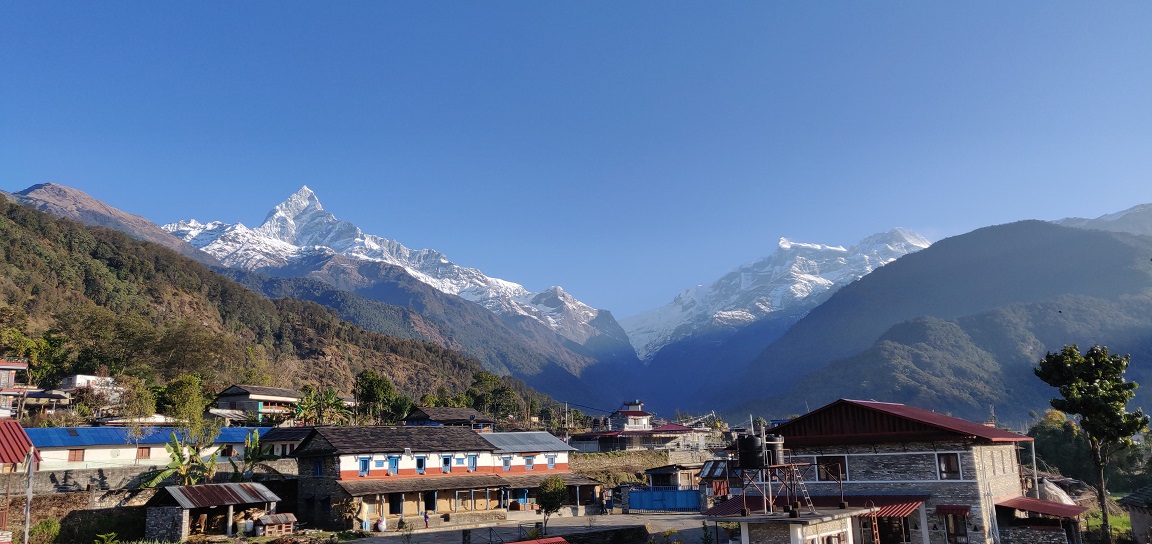
When I was first carried there as a baby in 1969, there was no Project and no road. The walk took four hours and involved crossing the foaming Seti river on a swaying bridge made of three bamboo poles. I was under three when my Dad got me to walk the whole way, requiring multiple rests at tea shops and several extra hours. I don’t remember that occasion, but I do remember many later trips when he kept me and my older brother, Mark, going with stories: Aesop’s fables, Bible tales, the history of Nepal.
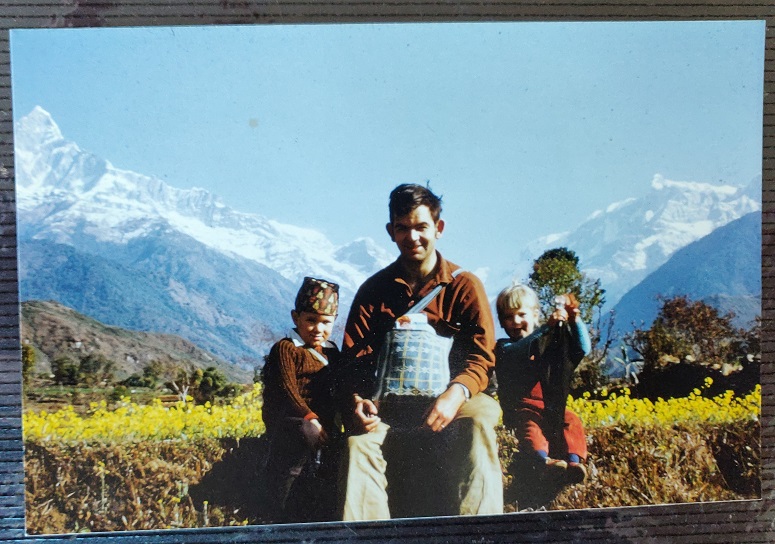
Mark, Warren & Merryn
My parents were working in linguistics and literacy among the Gurungs, who are one of over 100 ethnic groups in Nepal and one of the four groups that can join the Gurkhas. Their language – which they call Tamukyui – is from the Tibeto-Burman family and had never been written down. My parents worked with them over the years to choose a script and to represent their language in it; the Gurungs chose Devanagari, used for Nepali and Hindi, because they learn it in school.
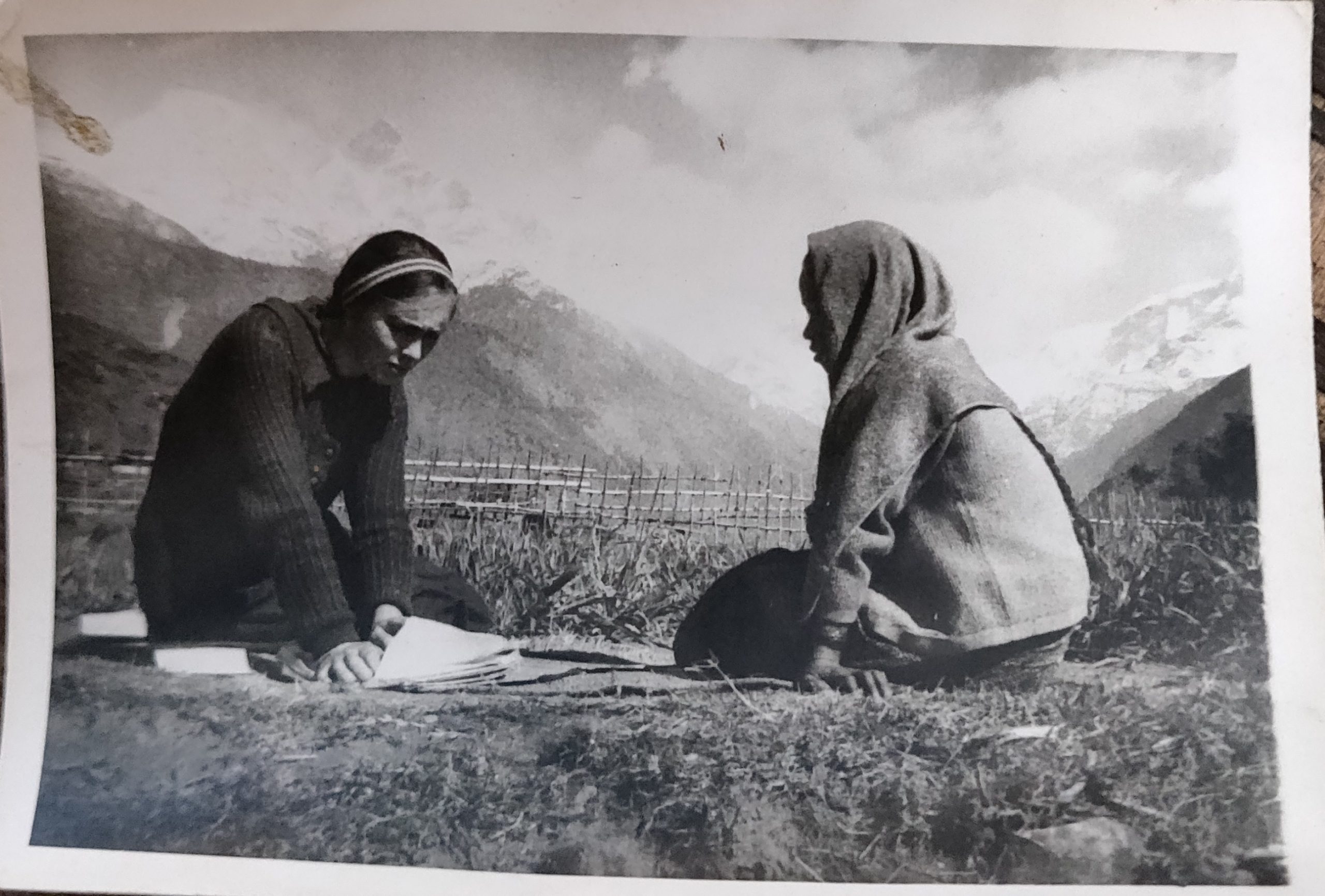
Jessie and Amjoh
We lived in the village for several months at a stretch over a period of 9 years as my parents learned the language and culture, taking copious recordings and notes. Back then, there was no electricity and all water had to be carried on backs from a source higher up the plateau. We had the only kerosene pressure lamp in the community, which meant our home was packed every night with visitors eager to flick through the National Geographic magazines and the View Master slides. (Congratulations to anyone old enough to remember what that is!)
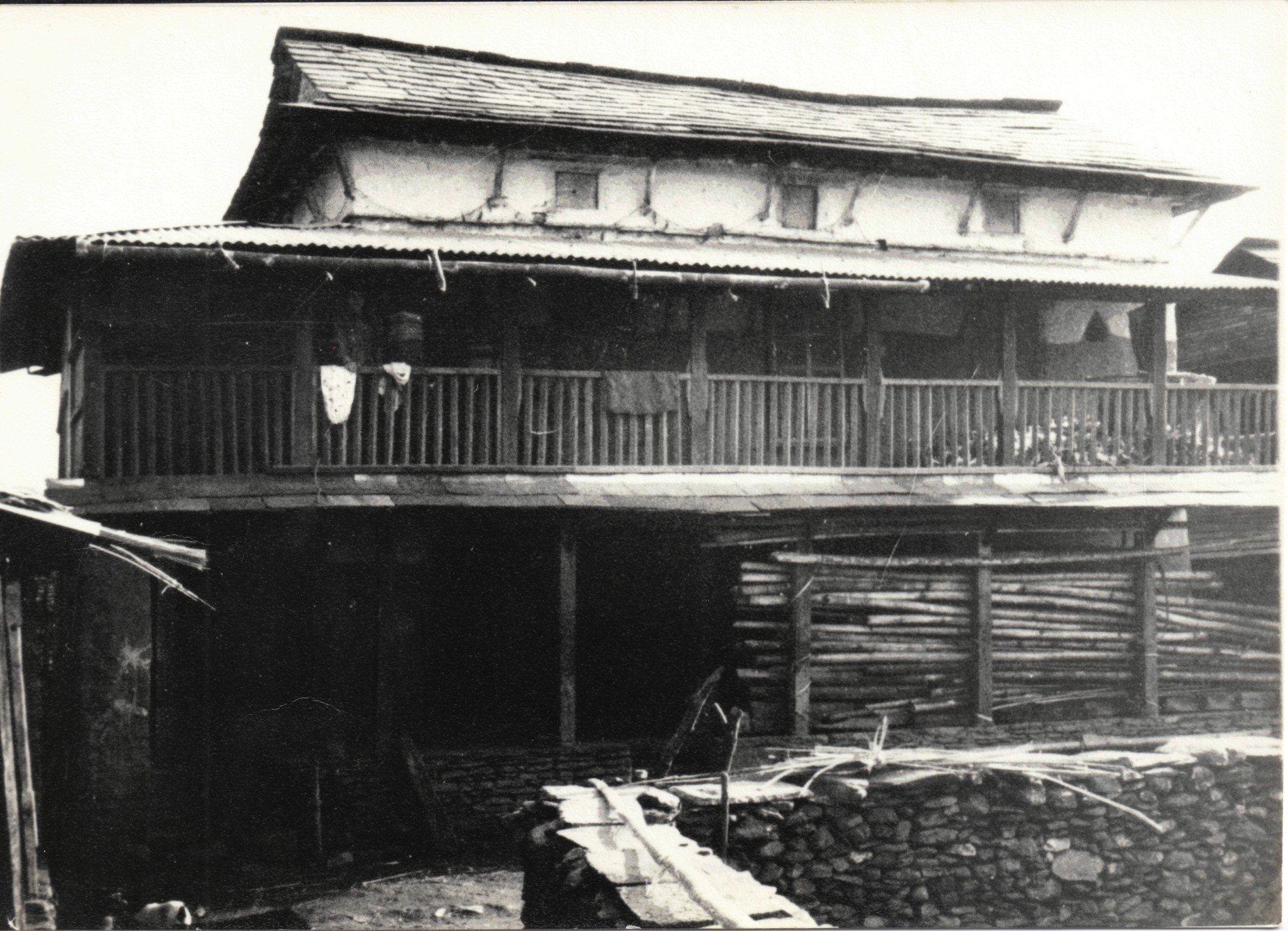
Our home was the middle floor of a house that the landlord had especially constructed to be high enough for my Dad, but like all village dwellings, had only wooden shutters and no glass in the windows. The buffalos and goats lived on the ground floor below us, while the rats had the penthouse, scuttling among the baskets of grains and corncobs under the slate roof. We had one room divided into sleeping and living areas by a sheet of orange hessian, with a half-panelled lean-to at the end that served as ‘office’. Our ‘bathroom’ was a round plastic basin and the ‘toilet’ was a pit in the neighbouring field, surrounded by bamboo matting. My father’s Time magazines were torn into squares for loo roll, though it was a bit too shiny for the job and made for a frustrating reading experience.
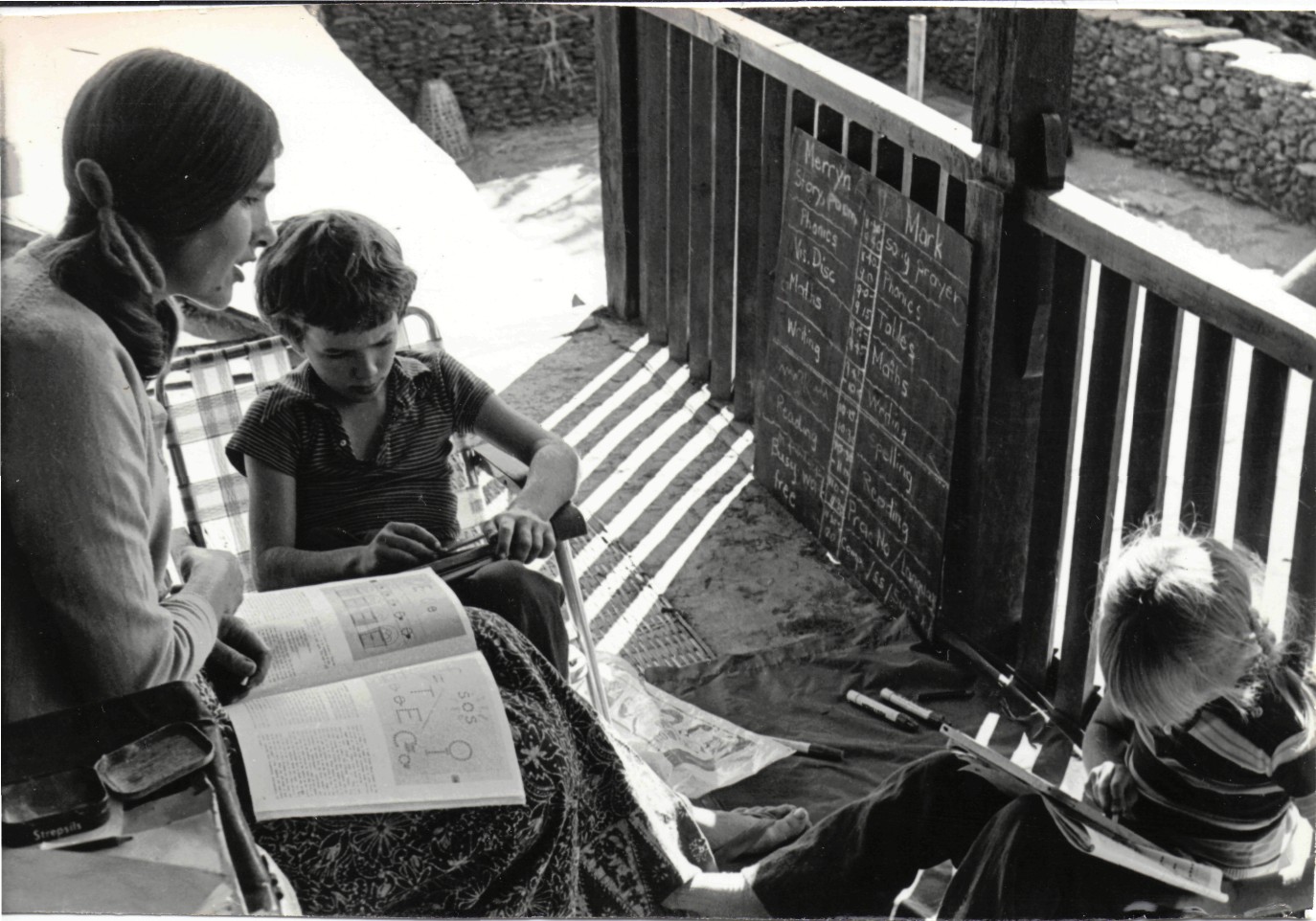
My mother home-schooled us at one end of the front verandah, while a growing number of village folk queued patiently at the other, waiting for her to tend their injuries and ailments. Watching her dispense pills in folded paper packets and daub Gentian Violet on cuts, I always assumed she was a nurse. It was years before I realised she was actually a teacher and relied on the legendary text Where There is No Doctor to help the community and keep us alive.
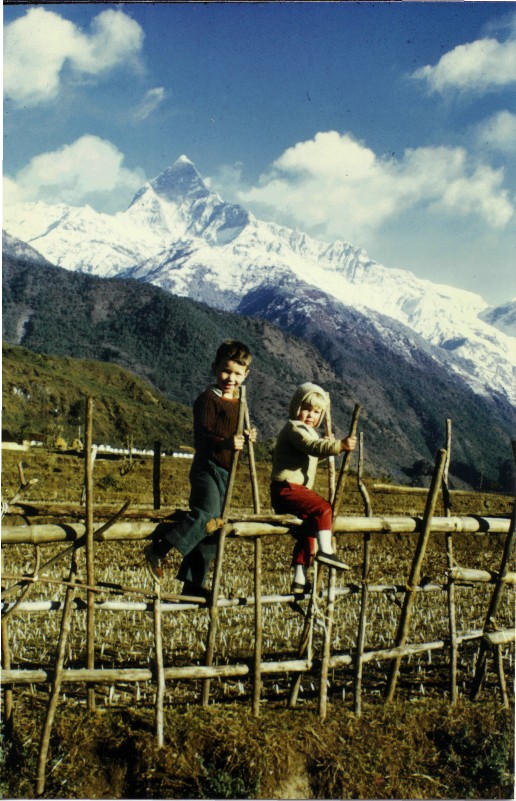
Like other village kids, Mark and I took a turn of perching on the high bamboo fences to scare off the monkeys from the crops and joined the procession to a central field for the slaughter and butchering of a buffalo. The meat was so tough that even pressure-cooking rendered it barely edible. Animals were everywhere, as was their life and death, their ritual sacrifice and place on the menu. I skipped across the stone-paved yard past flustered chickens who turned up in curry a few hours later, chopped into squares with feet and comb included. We always had a cat to ward off the rats, but my favourite animals were the baby goats, who had silky coats and velvet ears and never fought off my cuddles.
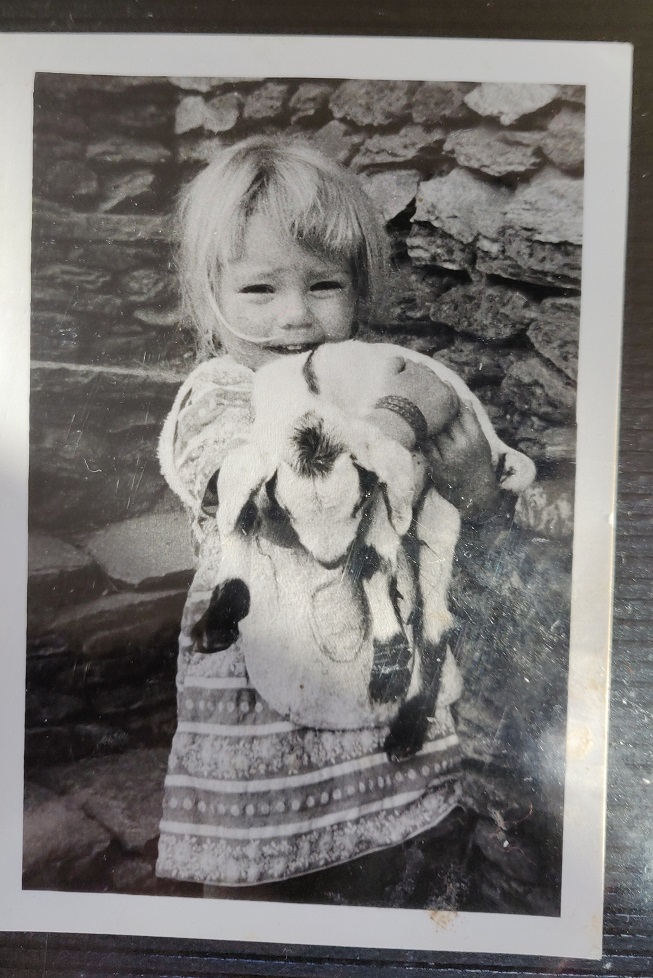
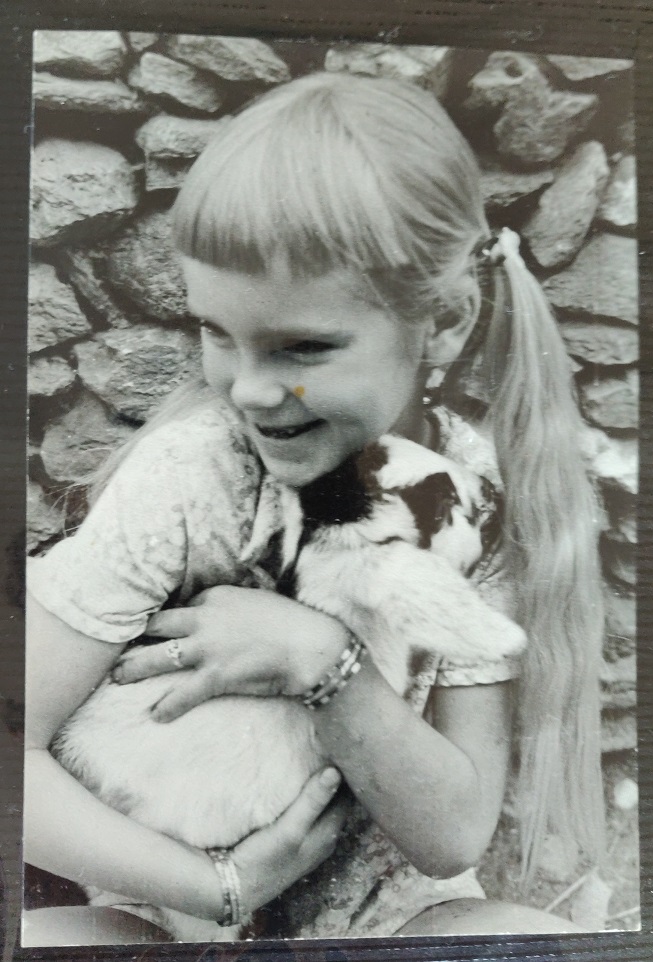
Our school lessons only lasted a few hours each morning and the rest of the time we were free to roam with our village friends. Playtime was often a blend of their games with our toys. Our parents were careful to keep our possessions minimal in the village, but Mark’s trainset was a great hit as was his wooden gun. Long and thrilling hunts ensued, where one kid was the deer and the rest of us galloped off past bamboo clumps and over stream beds in hot pursuit. The finale was to gather the dry stubble from the corn fields and build a small fire, pretending we were roasting and eating the venison.
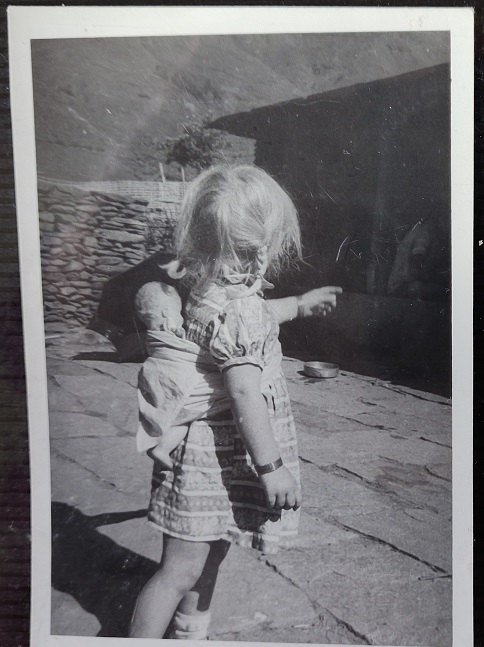
My own treasure was my doll, whom I carried around on my back and laid in a bamboo basket like village babies. I’d slept in one myself, suspended from the rafters above my parents’ bed, where they could give me a swing if I cried in the night. Tragically, I left my doll in the ‘office’ one night and found her the next morning with half her face eaten away by rats. (Heaven knows what the cat was up to.) I was distraught, but loved her all the more fiercely, wrapping scarves over her head and keeping her close. Around that time, my mother taught us to knit and Mark and I produced a series of misshapen squares. Unbeknownst to me, Mum knitted some extras, sewed them together and backed them with flannelette to make a quilt for my doll. It was my Christmas present that year in the village, and though the doll has long since vanished (hopefully to a place without rats), I still have the blanket.
Now 82 and 79, my parents, are finishing up their work with the Gurung project, and when they said it would be their last trip to Nepal, I said I wanted to be there. Mark pitched in eagerly and so it was that last week, the four of us set off for Ghachok. Just before leaving home in Scotland, I pulled out my childhood photo album, snapped some pictures on my phone and tucked the blanket into my bag.
The story of what happened next is in the coming post. See you there!
From the comfort of my sofa in a warm living room, I have just booked myself onto my first ever mountain winter skills course. It is the middle of January in Scotland and having just returned from several weeks of the Australian summer, I feel plunged into darkness. Jet lag casts me onto the endless shores of the night where I lie tired but sleepless, listening to the silence that looms strange and total around the house. My parents’ old weatherboard house in Melbourne is a being of breath and bones, sighing with the see-sawing temperatures, bumping with the passage of creatures inside and out, caressed by trees. The Australian birds are raucous and the road busy.
Here in our village in the Highlands in mid-winter, even morning arrives without sound or light. I keep checking the clock to tell whether it is still some ungodly hour or time for breakfast. By day, rain washes across the landscape, clouds mass and shift with the wind and this morning we woke to a fall of wet snow that by afternoon had dribbled into the mud. None of this inspires me to go mountaineering. Nor does the whole-body misery of bubbling cold, sinusitis and jet lag.
But I want to write a book about the Cairngorms in all their moods, so I need to get up there and broaden my experience. Although I’ve walked in snowy hills many times, it’s always been with more experienced walkers and not long treks or demanding conditions. Late last year, therefore, I became a member of Mountaineering Scotland and this year I need to go on one of their highly recommended Winter Skills courses. The problem is they’re all booked up.
Until a few days ago when an email arrived offering a space on a one-day course this Wednesday – three days’ time. My heart sinks. I should be excited by the opportunity, but I’m feeling rotten and the last thing I want to do is spend nine hours in freezing conditions throwing myself down snow slopes for ice axe practice. Besides, the combination of the festive season, heat in Australia and this virus means I’m not exactly at peak fitness. But I know this might be my last chance this winter, so I gird my loins and book, noting that – at this late stage – no refund will be possible on cancellation.
Reading the kit list, I then note I will need to make a trip into town the following day for proper winter boots, crampons, ice axe and seriously waterproof trousers. (My current ones are budget brand, have lost their seam tapes and are about as effective as a pair of plastic bags.) But ouch. The cost of all that gear may wipe out any author earnings for the book. Wondering how many warm layers to wear, I check the Scottish mountain weather forecast for the day of the course. Here are extracted highlights:
HOW WINDY?
Southwesterly 60-80mph; risk gusts towards 100mph on high tops.
EFFECT OF WIND ON YOU?
Atrocious conditions across the hills with any mobility tortuous; severe wind chill.
That sentence goes through me like a 100mph gust of freezing wind. No, no, no. This is not me. I’m a happy-go-lucky hillwalker, not a polar explorer pitting myself against the elements and prepared to get frostbite, hypothermia and snot crystals hanging from my nose. And it’s not that sort of book I’m writing, anyway: the adventure epic of agony and conquest, the heroic survival memoir pushing the limits of bravery and belief. Who needs a mountaineering disaster? I’m touching the void of my existential crisis right here on the couch.
I go to bed feeling not just unwell, but frankly terrified. Little wonder I barely sleep.
The following afternoon, we head into Aviemore. If there’s one thing this town excels at, it’s outdoor shops, and we do the rounds. My husband Alistair is an experienced hill-walker in all weathers and advises me on winter walking boots, the pros and cons of stiffer soles or a more flexible fit, the lacing techniques. I’m struggling to get my head past the price tag. And that weather forecast. It’s only 2 o’clock in the afternoon, but already the darkness is gathering in the wind-blown skirts of rain. A friend who works in one of the shop learns I’m doing the course this Wednesday and winces. My stomach twists.
The news calls it Storm Brendan. It’s always bad news when the weather has a name.
I’m shown a series of ice axes and Alistair and the staff cheerfully demonstrate the necessary grip to arrest your fall and discuss the pros and cons of leashes. Pro: you don’t lose it. Con: if you fall without getting a grip, the thing is bouncing around and can hit you in the head. The good news is that Mountaineering Scotland will issue us with helmets. The bad news is that my head is already throbbing.
I haul waterproof trousers over my jeans and hubby points out best features for keeping rain, snow and wind out. I silently note that, even in the sale, these are more expensive than any dress I’ve ever bought. We end up in Tiso’s where I plea for time out in the cafe. With tears dripping into my hot chocolate I confess my anxieties. “Do I need to do this? Do I need to buy all this stuff?” It all just seems so scary and expensive.
Alistair is gentle. “No, you don’t have to do the Winter Skills course on Wednesday.” I almost howl with relief. “But yes, if you want to explore the Scottish hills in winter, you need to be safe. For that, you need proper equipment and better skills. You do need this stuff and it will last for years. And there are other opportunities to get the training, so don’t worry.”
Come Wednesday morning I can’t resist another sneaky peak at the mountain weather forecast. It still has those devastating predictions of 100mph gusts and ‘atrocious conditions’ but now includes these lovely lines:
HEADLINE FOR CAIRNGORMS NP AND MONADHLIATH
Stormy winds. Snow & whiteout, focused W Cairngorms NP
HOW COLD? (AT 900M)
-2 or -3C. Wind chill on higher terrain close to -20C.
So I’m sitting snugly – and smugly – at my kitchen table watching the garden trees whipping about and contemplating nothing more adventurous than a dog walk. But I am wearing-in a pair of spanking new leather winter boots that are warm and strong and quietly reassuring me that together, we’re going to move mountains.
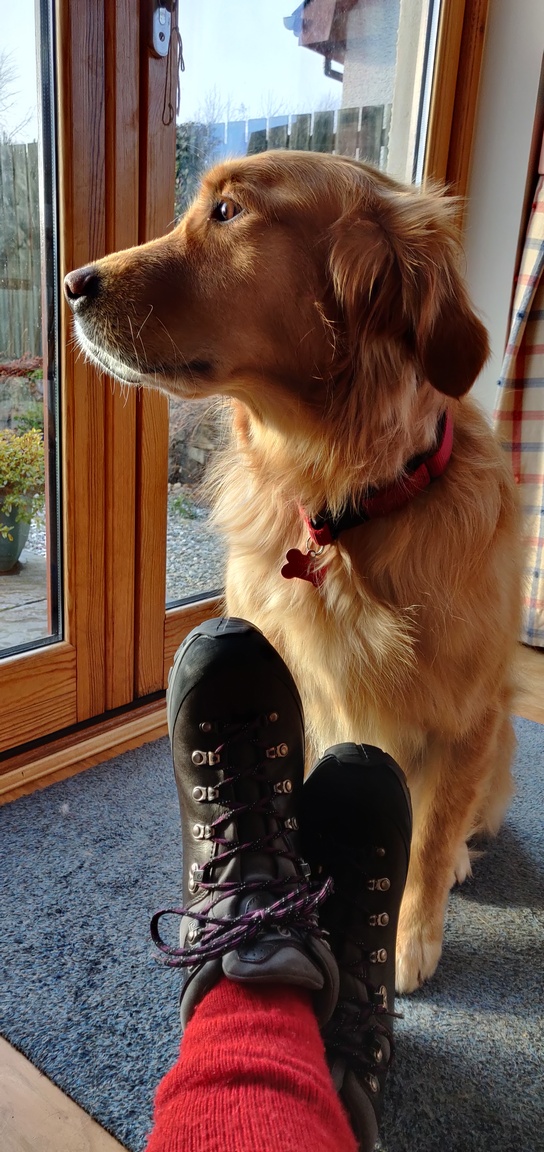
Sileas, our Golden, yearning to get me out there
From the comfort of my sofa in a warm living room, I have just booked myself onto my first ever mountain winter skills course. It is the middle of January in Scotland and having just returned from several weeks of the Australian summer, I feel plunged into darkness. Jet lag casts me onto the endless shores of the night where I lie tired but sleepless, listening to the silence that looms strange and total around the house. My parents’ old weatherboard house in Melbourne is a being of breath and bones, sighing with the see-sawing temperatures, bumping with the passage of creatures inside and out, caressed by trees. The Australian birds are raucous and the road busy.
Here in our village in the Highlands in mid-winter, even morning arrives without sound or light. I keep checking the clock to tell whether it is still some ungodly hour or time for breakfast. By day, rain washes across the landscape, clouds mass and shift with the wind and this morning we woke to a fall of wet snow that by afternoon had dribbled into the mud. None of this inspires me to go mountaineering. Nor does the whole-body misery of bubbling cold, sinusitis and jet lag.
But I want to write a book about the Cairngorms in all their moods, so I need to get up there and broaden my experience. Although I’ve walked in snowy hills many times, it’s always been with more experienced walkers and not long treks or demanding conditions. Late last year, therefore, I became a member of Mountaineering Scotland and this year I need to go on one of their highly recommended Winter Skills courses. The problem is they’re all booked up.
Until a few days ago when an email arrived offering a space on a one-day course this Wednesday – three days’ time. My heart sinks. I should be excited by the opportunity, but I’m feeling rotten and the last thing I want to do is spend nine hours in freezing conditions throwing myself down snow slopes for ice axe practice. Besides, the combination of the festive season, heat in Australia and this virus means I’m not exactly at peak fitness. But I know this might be my last chance this winter, so I gird my loins and book, noting that – at this late stage – no refund will be possible on cancellation.
Reading the kit list, I then note I will need to make a trip into town the following day for proper winter boots, crampons, ice axe and seriously waterproof trousers. (My current ones are budget brand, have lost their seam tapes and are about as effective as a pair of plastic bags.) But ouch. The cost of all that gear may wipe out any author earnings for the book. Wondering how many warm layers to wear, I check the Scottish mountain weather forecast for the day of the course. Here are extracted highlights:
HOW WINDY?
Southwesterly 60-80mph; risk gusts towards 100mph on high tops.
EFFECT OF WIND ON YOU?
Atrocious conditions across the hills with any mobility tortuous; severe wind chill.
That sentence goes through me like a 100mph gust of freezing wind. No, no, no. This is not me. I’m a happy-go-lucky hillwalker, not a polar explorer pitting myself against the elements and prepared to get frostbite, hypothermia and snot crystals hanging from my nose. And it’s not that sort of book I’m writing, anyway: the adventure epic of agony and conquest, the heroic survival memoir pushing the limits of bravery and belief. Who needs a mountaineering disaster? I’m touching the void of my existential crisis right here on the couch.
I go to bed feeling not just unwell, but frankly terrified. Little wonder I barely sleep.
The following afternoon, we head into Aviemore. If there’s one thing this town excels at, it’s outdoor shops, and we do the rounds. My husband Alistair is an experienced hill-walker in all weathers and advises me on winter walking boots, the pros and cons of stiffer soles or a more flexible fit, the lacing techniques. I’m struggling to get my head past the price tag. And that weather forecast. It’s only 2 o’clock in the afternoon, but already the darkness is gathering in the wind-blown skirts of rain. A friend who works in one of the shop learns I’m doing the course this Wednesday and winces. My stomach twists.
The news calls it Storm Brendan. It’s always bad news when the weather has a name.
I’m shown a series of ice axes and Alistair and the staff cheerfully demonstrate the necessary grip to arrest your fall and discuss the pros and cons of leashes. Pro: you don’t lose it. Con: if you fall without getting a grip, the thing is bouncing around and can hit you in the head. The good news is that Mountaineering Scotland will issue us with helmets. The bad news is that my head is already throbbing.
I haul waterproof trousers over my jeans and hubby points out best features for keeping rain, snow and wind out. I silently note that, even in the sale, these are more expensive than any dress I’ve ever bought. We end up in Tiso’s where I plea for time out in the cafe. With tears dripping into my hot chocolate I confess my anxieties. “Do I need to do this? Do I need to buy all this stuff?” It all just seems so scary and expensive.
Alistair is gentle. “No, you don’t have to do the Winter Skills course on Wednesday.” I almost howl with relief. “But yes, if you want to explore the Scottish hills in winter, you need to be safe. For that, you need proper equipment and better skills. You do need this stuff and it will last for years. And there are other opportunities to get the training, so don’t worry.”
Come Wednesday morning I can’t resist another sneaky peak at the mountain weather forecast. It still has those devastating predictions of 100mph gusts and ‘atrocious conditions’ but now includes these lovely lines:
HEADLINE FOR CAIRNGORMS NP AND MONADHLIATH
Stormy winds. Snow & whiteout, focused W Cairngorms NP
HOW COLD? (AT 900M)
-2 or -3C. Wind chill on higher terrain close to -20C.
So I’m sitting snugly – and smugly – at my kitchen table watching the garden trees whipping about and contemplating nothing more adventurous than a dog walk. But I am wearing-in a pair of spanking new leather winter boots that are warm and strong and quietly reassuring me that together, we’re going to move mountains.
Sileas, our Golden, yearning to get me out there
At the start of this year, I decided to embrace my term as Writer in Residence for the Cairngorms National Park as a kind of pilgrimage. Certainly, I would be covering a lot of ground delivering the project, and that has proved true, and fascinating. More significantly, I knew I would be on a personal journey, discovering new thinking about this distinctive landscape and its people, new territory as a writer, and new learning – I hoped – about myself.
Feeling, by mid-year, a bit lost and run down, I realised it was time to undertake a physical pilgrimage. Sometimes it is only through moving the body that we shift the spirit. In my last post I wrote about my place of inner and outer chaos and needing – quite literally – to walk away; about the dream to climb Angel’s Peak in the Cairngorms and about why that mountain, of all mountains, was important.

Here is the story.
We leave the car near the ruins and rambling crofts of Tullochgrue above Aviemore, rope up Sileas, the golden retriever, and shoulder our packs. I haven’t done a camping trek in two years and it feels heavy. The afternoon sky is patchy sun and cloud as the trail takes us through the Caledonian forest of Rothiemurchus; it is deep with Scots pine and mixed with the many greens of silver birch, aspen, and rowan. Blaeberry and heather carpet the woodland floor and the Allt Dhruidh burn chortles swift and shallow through the dappled light. I could lie down here and know peace.
As the trees thin and the path rises, we emerge onto rocky moor with the dark chasm of the Lairig Ghru up ahead, cloud massing on its tops. ‘Lairig’ is Gaelic for pass, but the origins of ‘Ghru’ are debated. Formed some 400 million years ago, this triangular cleft through the middle of the highest Cairngorms was once a route for cattle drovers and smugglers. Today we meet only walkers coming the opposite direction from Deeside and a mountain biker bombing down the track. With his long red hair and beard streaming from under his helmet he looks like an indomitable Gaul. I feel anything but, my heavy pack and boots making my gait clumsy and causing a sharp twang in the hip. Growing up in the Himalayas, I used to be a mountain goat; can I regain my hill feet as well as my head?

The rocky trail is lined with grasses, mosses, bog cotton and wildflowers, from buttercup yellow to the zingy purples of heather and vetch. Meadow pipits rise from the banks with their swift wing beat and bouncy flight, cheeping urgently and we keep Sileas on her lead. Gradually, the path reveals the red shades of the Cairngorm granite: dusky roses, peaches and wines. Though the rock turns grey with exposure, any fresh cut reveals its blood and it’s no wonder the Gaelic name for this range is Am Monadh Ruadh, the russet-coloured hills. The water spilling down from the mountain is so clear it makes the stream bed shine like polished copper, though higher up, it disappears and reappears among the rocks. Further in, the Lairig Ghru dims with mist, the steep scree giving way to the jagged cliffs of Lurcher’s Crag.
It’s nearly 7 when we arrive at the high point of the pass where the Pools of Dee are ice cold and give no sign of their waters flowing in or out. The bank of stones above the second pool and the swirling cloud give a sense of the world vanishing beyond. We pitch camp and cook in a blowing smirr, crawling early into our thermals and down bags. Unfamiliarity has made Sileas hyper-vigilant and she lies out for hours in the rain, staring around, until Alistair eventually tugs her under the bell. All night my sleep is routed by the scant darkness, the tent rattling, and the aching of my hips on the hard ground. I breathe wet dog and socks.

We wait out the rain and it is mid-morning when we pick our way down the boulder fall, the valley unfurling below in the gathering sunshine. The view stretches beyond the buttress of Devil’s Point to the smoky hills south of the Dee. To the west, the twin summits of Cairn Toul and Angel’s Peak are still wreathed in cloud, challenging me to reach them.
As the Garbh Choire opens to our right, we ford the burn that becomes the Dee and strike out across the bog. Small green frogs leap in front of us and the way is dotted with flowers, delicate and exquisite in this wind-battered place. The peaks gradually clear and we can see the rim of the high bowl between them that holds An Lochain Uaine – the green pool – and the waterfall that threads down from it, over dark rock. But we can see no path, for there is none.

We ford Allt a’ Garbh-Choire and push up the slope, finding a way among the stones, sometimes needing hands. Despite that, it’s easier going than yesterday as I don’t have a pack and my body is slowly remembering the footholds of youth. Cresting the rim I go even faster, almost running now across the boulder field until I see the lochan.
Yes. It’s here. It’s real.

My novel and my characters are imagined, but something about being in the actual place that is pivotal for them makes them seem real, too, as if they are not just in my mind, but alive and present. It’s almost as though I might meet them here and I feel like crying. I also feel silly. And elated. The pool keeps changing colour with the clouds, one moment blue, another gun metal grey, rarely, the green for which it is named. In my book, Sorley swims, and though I love outdoor swimming and harboured a fantasy of taking a dip, the cold wind and my cowardice soon snuff that notion.
Over our lunch of oatcakes and soup, we scan the north ridge of Angel’s Peak through binoculars. It was our planned route – because Sorley takes it – but we decide the steep scramble is unsafe for the dog and start up Cairn Toul instead, traversing above the lochan to an easier route. From there it’s still a hard, slow slog and my body’s memory of youth fades. I hear a text ping. Wouldn’t it be amazing if, arriving at the geographic and emotional climax of my novel, I get the news of a publisher? I laugh even before I check. I know it won’t be, and it isn’t.

And, right now, that’s okay. By the time we get to the top of Angel’s Peak, the sun has conquered the sky and the world is falling away below us. Though the wind almost throws me off my feet, I am overjoyed because I am here. Stretching in every direction, the Cairngorms are billowing round tents of stone, rising in waves and walls of granite, falling in cliffs and corries, bathing in light. Snow clings in deep crevices; burns are seams of silver in the grey and green; cloud shadows glide like sea galleons and mythical beasts across the slopes. Right below us, An Lochan Uaine lies dark and fathomless.

I don’t know if I will return to swim there just as I don’t know what will happen with the book, but I do know I am changed. In these mountains I have been washed by rain, shot through with light, blown to bits by wind and hung out to dry. The mountain has shaken me hard enough to make my bones rattle and my head break its locks; it has beaten me like a rug and cast the devils to the dust; it has seared its image on the wall of my mind.
But like Jacob wrestling with the Angel and wounded at the hip, I demand my blessing. As I walk the many hours home, I am remade. The mountain returns the pieces of me one by one in the ptarmigan’s croak and the taste of a clear burn; it restores me in the petals of a wild orchid and the gaze of deer; it reveals my lost path in ancient rock and lights my way in sun.
It restores my soul.
