


Over the years since A House Called Askival was first published, in 2014, I have heard from so many people about the deep conversations it opened up for them, whether in a book group, among friends or within their family. A set of questions from me is not needed to spark these discussions. But, sometimes, they open up new thinking and deeper responses. Here are just some that you might like to chew over with your group. Pick any that interest you and certainly don’t treat them like English homework! If you have ideas for more questions, do send them to me.
- What was most powerful for you about this book?
- Which character did you feel closest to and why? Did this change at all?
- What did you learn about India that was new for you?
- What does fiction offer in the telling of history that non-fiction does not?
- How does the novel explore the complexities of identity, home and belonging?
- What are the challenges in portraying such an international cast emerging from different backgrounds, beliefs and ways of life? How effectively did you feel the characters were created?
- How was a sense of place evoked in the novel and which scenes or descriptions were most powerful for you?
- Askival is a ruin with a mixed history. What is the significance of the house to the whole story?
- A cookbook is an important thread in the story, based on an actual one: The Landour Community Centre Cookbook. What is it’s role in A House Called Askival?
- The Oaklands production of The Gospel of Jyoti is a story within the story. Why did the author include it and what is explored through it?
- Why do you think art-making is important to the novel: Iqbal’s singing, Kashi’s painting, Ruth’s dancing?
- Names are important in the novel: the One Hundred Names of God, The Holy Name, The Beautiful Names, The Beloved Name. Why?
- What did you feel were the strongest themes of the novel? How were these drawn out?
- How did the structure work for you? Why do you think the author chose shifting time-frames and points of view?
- The novel shifts pace and tone, juxtaposing hard-hitting passages with humour, intense emotion with moments of tenderness and calm. How effective was this for you?
- Much of the action is set within the sub-cultures of the mission community and the international boarding school, Oaklands. How were the gifts and the failings of these communities explored?
- The novel explores religious conflict on multiple levels, from the larger geo-political and cultural spheres, to philosophical tensions, to the clashes within communities and families, to the internal struggles of each individual. What questions and reflections did this open up for you?
- The story spans over 70 years from the Independence and Partition of India and Pakistan to the anti-Sikh riots of 1984 and the ongoing tensions of its current timeframe (2008). There is also rebellion and breakaway within families. How does the book explore ideas of freedom?
- What did you feel about the ending?
You might also like to look at the Reviews & Features about A House Called Askival. Remember that you can always pick up the ebook, audiobook and personally signed copies from my shop.
If your group would welcome the author Zooming in for a bit to say hello, get in touch and I’ll come if I can. In any event, do send me a photo of your group holding up copies! And any sharing of photos on line, reviews and recommendations are hugely appreciated. Thank you!
You can read the dedication, epigraph and first chapter of A House Called Askival here:
Chapter 1 A House Called Askival – Merryn Glover
When Of Stone and Sky won Book of the Year at the Bookmark Festival in 2021, the primary criteria was a book that works well for Book Groups. I consider that a huge compliment. People have often asked for a set of discussion questions, so here are some to choose from. Don’t let them feel like an English assignment, though, just starting points for your own questions and ideas. Thank you for reading my book – I hope these are fun for you as you share together.
- In a book of many characters, who were your favourites and why? Who were not?
- What did you make of the two primary narrative points of view: Mo, as overall storyteller, and Sorley, in ‘confessional’.
- It is often observed that Of Stone and Sky does not give the shortbread tin romanticised vision of Highland life. Did it feel like a truthful depiction to you and what created that?
- The novel spans a long period of history, focused through one family. Why was the backstory important and how well was this captured?
- In what ways are the land, the weather and the wildlife integral to the novel?
- How did the novel explore the relationship between people and place, especially the complexities around land ownership, land use, regeneration, ecology and economy?
- How does the novel explore themes of belonging and entitlement, to both family and land?
- What was the purpose of the 12 ‘Signs’ of Colvin’s possessions and how effective was this for you?
- There are strong spiritual and religious threads running through the book. How are these unfolded and how did they land with you?
- How did the language of the novel strike you?
- What scene stands out as most memorable for you?
- What did you think of the ending?
You might also like to look at the Character List, the Reviews & Features and the Background Reading underpinning Of Stone and Sky.
If your group would welcome the author Zooming in for a bit to say hello, get in touch and I’ll come if I can. In any event, do send me a photo of your group holding up copies! And any sharing of photos on line, reviews and recommendations are hugely appreciated. Thank you!

This is the new map that appears in the front of the paperback edition of The Hidden Fires: A Cairngorms Journey with Nan Shepherd. It includes all the key locations mentioned in the book.
Used with kind permission of my publisher, Polygon Books.
It was one of the most exciting days of my author life till then. I was going to meet the publisher for my debut novel and discuss cover designs. It rated closely behind the day a few months before when their email had arrived accepting it, especially after the countless rejections. Freight Books was an offshoot of Freight Design so, unsurprisingly, they produced beautiful-looking books with striking covers. I was glad to be given a say. Many publishers do not consult authors and many authors are dismayed by their covers. But this was a small independent press and indies tend to foster a closer relationship.
The director, Adrian Searle, sat me down to look at a spread of existing designs for books in my genre (accessible literary fiction) and subject area (India, historical with a contemporary frame). The table was a gathering from my dream dinner party: Arundhati Roy, Amitav Ghosh, Salman Rashdie, Kiran Desai. There was also a collection of photographs from the setting of my book: the hillstation of Mussoorie in Uttarakhand, north India, where I went to school. Alongside the panoramic sweep of the Himals, there were scenes of the town sprawled across the ridges, deodar forests and the jewel colours of sunset.
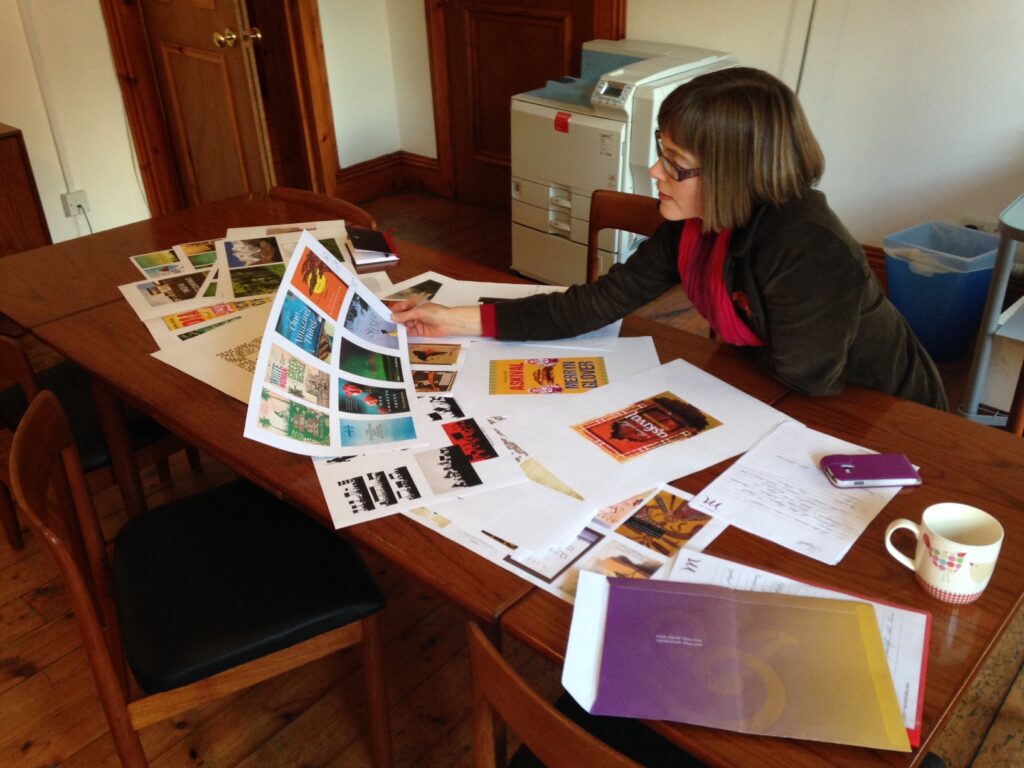
At Freight Books, 2013
We talked about how cover designs work: they should not attempt to tell the story, but to tell the reader what kind of story this is. Primarily, they need to draw people to pick it up and flip to the blurb or the opening pages. It’s an inviting doorway into the world of the book. So, there was an immediate challenge with mine. The novel is set entirely in India but the title – A House Called Askival – references Scotland. It’s because the colonial bungalow at the centre of my story was built by a Scottish army captain and named for a mountain on his native island of Rum.
Freight added ‘A novel’ to the title, lest there be any doubt, and set out to ensure the cover signalled ‘India’ loud and clear. Among the mock up options was a photo of an old wooden door in an elaborate Moghul frame. Of course, it was nothing like the creaking screen door of Askival, falling apart for much of the book, but I loved it. A small lock held its weathered panels shut and spoke perfectly of the secrets of house and family. My only concern was its vibrant orange pallette. To me, this spoke of the heat and intensity of the plains, not the cool, quiet of the hills in autumn. The story takes place almost entirely from August to October, with monsoon so dominant she is like another character. I suggested greens, blues and greys; trees and mist; a ruin. Apparently, according to Freight, green covers don’t sell well. Who knew?
A few weeks later, they emailed a completely new idea. “We commissioned an illustration which is quite painterly – at once saying literary and also ‘epic’. We went with the girl only as this reflects the primary readership and there was a danger of a man and a girl being too ambiguous, in terms of what their relationship is.” A red-headed teenager in skinny jeans stood gazing out at the mountains. My heart plummetted. It was skillfully done but all wrong to me. Sure, my American character Ruth is a teenager for much of the story, but her father is equally important, as is the wider story of the Indians they live amongst.

I immediately sent the design off to a handful of folk who had read it and asked for their opinions, not giving mine. They were all apologetic about their honesty, but I was relieved. I emailed the responses back to Freight with the subject line: Everything But the Girl. The comments included:
‘A cross between M M Kaye’s Far Pavilions and a work of teen fiction… Escapist, dreamy. Not quite the work of a serious adult literary novelist?’
‘Will this look like chic lit? Doesn’t capture the strength of the book. Men wouldn’t pick it up.’
‘I think the figure somehow diminishes that sense of mystery and turns it more into a girl’s adventure in the mountains. Makes it look a bit lightweight.’
I added, ‘Yes, the story contains a moody teenage girl, but a huge amount more. Three of the main characters are men. The story includes a whole chapter on hunting, the devastation of partition, the communal violence of both ’47 and ’84, Gurkhas, murderous mobs, a shooting, a lynching, a fatal fall, the breaking of religious taboos, sexual transgression… and so on.’
I accepted that most book readers and buyers were women, and that so-called ‘women’s fiction’ is commercially successful. Its covers often feature women, often gazing off into the distance. It looked to me that Freight were trying to position Askival in that market. While I would welcome higher sales, I wasn’t convinced the ploy would work. There is a risk the wrong readers choose it and are disappointed and the right readers never discover it. Yes, the cover needs to draw the reader, but the book then needs to deliver on that promise. At the end of my email, I asked if we could revisit the Moghul door. Bright orange no bar.
To his credit, Adrian phoned me immediately and said not to worry. The Girl was out, the Door was in. It soon graced the hardback, in slightly more subdued tones, with overlaid paisley corners, and a font hinting at Devanagari script. No way anyone could miss the India signs or the sense of intrigue. I loved it and readers did too.

A year later, Freight published the paperback and took a radically different approach. Coming out in May and featuring in WH Smith’s travel bookshops, it needed to look like the perfect holiday read. This time the cover was a bold grid of zingy colours, clean capitals and small, but striking images. The ornate verandah of an old colonial building particularly excited me as it is a photo of the actual Mussoorie library; Ganesh the elephant god signalled the religious themes; an Indian woman’s eye was suitably ‘Come hither’; the Himalayas were there and – in an elegant nod to the hardback – an old lock, which sat on the spine as well. I was thrilled.
My readers were divided. Those who had passionately loved the stately mystique of the first cover (including some who had also seen the dreaded Girl) could not accept this jazzed-up imposter. For them, the story was forever framed by the crumbling splendour of a musty Moghul arch and not to be cheapened by day-glo. New readers, however, jumped at the paperback and featured it on Favourite Cover Design blogs.
For this article, I managed to trace Kulbir Gharra, the designer of both those covers and invited her reflections.
 “It’s been almost a decade, but A House called Askival will always hold a special place in my heart as it was the first title that I designed covers for at Freight books. Highlights included putting together the mood boards as I love gathering inspiration with a sense of freedom and play. This is possibly the most important stage in the process for me, as it’s where the concepts are born. I’m Scottish-Indian, so with the setting of A House called Askival, you can imagine the endless possibilities in colours, imagery and textures. My excitement was on another level with 15 pages of source material! I was thrilled to hear that some of it struck a chord with Merryn, the person I had to impress and whose voice I had to convey. That enthusiasm fuelled both the hardback with the old wooden door and lock and the paperback, picking up the pace and conveying the story with a renewed perspective. Even now, I find myself imagining A House called Askival as a film. Who would direct it? Who would feature on the soundtrack? Most importantly, what would the film artwork look like? Hold on, I’ll just refer back to my 15 moodboards.”
Two years later, sadly, Freight Books folded. I got the rights back, re-uploaded to Amazon and bought the remaining stock. Fast forward another two years and those copies were nearly gone. It was time for a new edition and a new cover. By then, my second novel, Of Stone and Sky, had come out with Polygon Books and I had been so captivated by the cover designed by Abigail Salvesen that I commissioned her to do the next iteration for Askival.

Of Stone and Sky design by Abigail Salvesen
I wanted to echo elements of the new novel to bring a unity to the titles. They would have the same fonts, complimentary palletes and overlapping textures to create a landscape. Mountains are my heartland and important to both novels, so that would be another resonance.
The challenge, again, was to suggest India. Abi used hand-made paper and Indian block print textures, but these were subtle. Testing the cover in a Facebook group revealed that while most people loved the design, few recognised the setting. I asked her to put a ghostly ruin in the foreground, but it suggested horror, so we swiped that. I then plumped for a simple gold cut-out of a Hindu shrine which not only stamped the location clearly and hinted at the religious elements, but also added an eye-catching splash of brightness.
Here are Abi’s thoughts. ‘I was delighted when Merryn asked me to create a new cover for Askival to pair with my design for Of Stone and Sky. I so enjoyed designing that cover and Merryn had been a pleasure to work with. In my experience, working independently with authors tends to be more straightforward than the often drawn-out and contentious process of cover approval within a publisher! We had a shared vision for the design from the start; a rural Himalayan landscape rich with texture, bright colours and Indian patterns. Merryn provided some stunning reference photos and her own experience in India was helpful in picking out certain elements of the scene – the native Deodar trees, and the iconic shape of the shrine – that helped to convey the setting more clearly. The illustrative style intends to reflect Merryn’s evocative writing, and the finished cover will, I hope, draw readers into her wonderfully vivid and poignant story.’

It was a hugely rewarding process for me to work directly with a cover designer, but also to benefit from the experience of the preceding covers. As I launched this new edition on the 75th Anniversary of India’s Independence in 2022, I was excited to welcome new readers through the door of A House Called Askival.
Available in paperback, harback and ebook wherever you get your books and personally signed copies in my store here.
This article first appeared in Spine Magazine.
To see what others have said about The Hidden Fires, follow the links below. If you’ve read it, please do add your own review on Amazon, Goodreads or other retailer sites. If you would like to feature the book in your publication, site or broadcast, please contact Polygon Books for a review copy.
REVIEWS
7 Dec 2023 ‘Glover’s own voice – thoughtful, honest, funny, and utterly full of feeling – shines.’ Francesca Donovan The Great Outdoors Magazine
26 May 2023 ‘… vividly perceived and powerfully expressed…’ John Dempster Inverness Courier
April edition of Scottish Field – 5 star review: ‘…a pilgrimage that is touching, elemental, brave and deeply affecting.’
10 March 2023 “This book will sit comfortably and deservedly on the same shelf as Nan Shepherd’s masterpiece.” Alan Massie The Scotsman
March 2023 “An evocative and immersive slice of travel writing about how the beauty and grandeur of the Cairngorms spoke to her soul.” Waterstones
27 Feb 2023 “A truly inspiring and beautiful book about the Cairngorm mountains, our natural world, and beyond.” Star Book, Review by Liz Robinson, Love Reading
9 Jan 2023 “Glover writes so well about mountains.” David Robinson, Scotsman Ones to Watch in 2023
INTERVIEWS, FEATURES & BROADCASTS
16 April 2023 Conversation with Breege Smyth on Sunday Morning Breakfast with Breege for Oban FM. Search here under that title and date. We are at 21 minutes in.
14 April 2023 Conversation with Nicola Meighan on The Afternoon Show for BBC Radio Scotland. We’re at 1:43.
10 April 2023 Conversation with Joanna Penn on The Creative Penn podcast about Writing Nature Memoir (The full transcript is also available there to read)
13 March 2023 Talking about Nan Shepherd with Paul Murton on Grand Tours of Scotland’s Rivers Series 2, Episode 1 (My segment is right at the beginning)
12 March 2023 “As I follow her in recounting the ‘grace accorded from the mountain’, I sense her blessing.” My article in the Courage issue of Books from Scotland
11 March 2023 “On my first ascent of the great mountain, I could barely believe how benign she was.” Extract from The Hidden Fires about Braeriach WalkHighlands
8 March 2023 “Like Shepherd, my love of mountains is as old as my memory, but the ground of my childhood was the Himalayas.” Remembering Nan Shepherd on International Women’s Day – Cairngorms Voices – Cairngorms National Park
02 March 2023 Hidden Fires Book Launch Strathspey & Badenoch Herald
26 Feb 2023 Interview with Tony Kearney and Lise Wortley on Radio Scotland Sunday Morning at 1:40
26 Feb 2023 “Setting out on the journey not knowing the destination.” Interview with Alice Hinds Sunday Post
18 Feb 2023 “These peaks were her friends and she loved them.” Profile by Neil Drysdale Press & Journal
Feb 2023 “Nan Shepherd: Exhibition to mark 130th birthday of environmentalist” The National
This page lists journals and other publications that feature writing on nature, landscape, place and ecology, many of which are open to pitches and submissions. Just click on each title to go to their website. If you are aware of others I could include, please contact me.
ARCHIPELAGO is a literary magazine…preoccupations with landscape, with documentary and remembrance, with wilderness and wet, with natural and cultural histories, with language and languages, with the littoral and vestigial, the geological, and topographical, with climates, in terms of both meteorology, ecology and environment; and all these things as metaphor… Its concerns with the state of the planet could not be more of the hour.
Conceived as an online meeting place for pursuits of a distinctly non-digital variety — walking, fishing, looking, thinking, birdsong and beer, adventure and poetry; life’s small pleasures, in all their many flavours — it was, and still is, about stepping out of daily routines to re-engage with nature. Finding new rhythms. Being.
Together, we are walking away from the stories that our societies like to tell themselves, the stories that prevent us seeing clearly the extent of the ecological, social and cultural unravelling that is now underway. We are making art that doesn’t take the centrality of humans for granted. We are tracing the deep cultural roots of the mess the world is in. And we are looking for other stories, ones that can help us make sense of a time of disruption and uncertainty.
Professionally produced, Earthlines magazine’s founders don’t like the term “nature writing”. They explain that trying to generalize and label things isn’t going to do any good to anyone. Defining that their magazine is much more than a simple nature catalog, they produce it with the intention of delving deep into the relationship between humans and nature, and the ecocide that results from it.
An independent literary journal with a focus on nature writing and visual storytelling. We commission work from both established and emerging writers and artists, actively seeking out voices that speak from differing perspectives and that offer the reader new insights. Bringing together the scientist’s findings and the artist’s response, the ecologist’s observation and the writer’s reflection, we ask questions as well as seek to answer them, retaining a sense of wonder at the unseen and unknowable. By exploring our connection to nature through stories of transformation and startling imagery, we hope we will better understand our place, our responsibilities and the possibilities open to us.
Elsewhere is a print and online journal dedicated to writing and visual art that explores the idea of place in all its forms, whether city neighbourhoods or island communities, heartlands or borderlands, the world we see before us or landscapes of the imagination.
It has always been a radical act to share stories during dark times. They are regenerative spaces of creation and renewal. As we experience a loss of sacred connection to the earth, we share stories that explore the timeless connections between ecology, culture, and spirituality.
Inkcap Journal is a publication about nature and conservation in Britain. We publish longform journalism about the natural world, in the form of a twice-weekly newsletter. Subscribers receive an original article on Wednesday and an in-depth digest of the week’s environmental news on Friday.
The Land Lines Blog began in 2017 as part of the Land Lines: British Nature Writing research project funded by the AHRC, which ran from 2017–2019. Since then, due to its popularity, the blog has continued independently… we are proud to share pieces kindly submitted by our interested readers: including academics, scientists, naturalists, photographers, and others who enjoy reading and writing about the natural world, and their connections with it.
New Nature is the only natural history magazine written by young people with a passion for the natural world. Released online for free every month, articles include a broad range of topics: from countryside issues and related opinion to more traditional nature writing. Articles from contributors under the age of thirty are accepted.
“It is Orion’s fundamental conviction that humans are morally responsible for the world in which we live, and that the individual comes to sense this responsibility as he or she develops a personal bond with nature.”
Panorama: The Journal of Intelligent Travel is a British literary journal, with a modern focus on travel literature, art, and photography.
If you’re looking for a lively magazine covering a wide range of issues around sustainability and forest culture, the Reforesting Scotland journal is for you. Published twice a year, in full colour, for 20 years it has ranked among the UK’s best ecological publications.
Resurgence & Ecologist Magazine
Resurgence & Ecologist offers positive perspectives on a range of engaging topics covering ecology, social justice, philosophy, spirituality, sustainable development and the arts – an eclectic mix that cannot be found anywhere else.
The voice of Scotland’s mountain walkers and climbers, Scottish Mountaineer is a quarterly, full colour magazine, exclusive to Mountaineering Scotland members, containing news, views, comment and features on our work and play.
Sidetracked has always been rooted in inspirational journeys. We were born from the passion of wanting to tell the stories of those who put themselves out there, setting aside fear and doubt in order to experience the breathtaking, the awe-inspiring and the magical.
Spelt Magazine is on a mission to celebrate and validate the rural experience. With four seasonal print issues per year, we aim to provide a platform for rural writers and to those creatives exploring nature, landscape, the interconnected nature of creative writing and the natural world and the liminality of natural areas within the urban landscape.
Terrain.org is an independent magazine founded in 1997 that focuses on place. Searching for the interface—the integration—among the built and natural environments that might be called the soul of place.
The Clearing is an online journal offering a space for writers and artists to explore the landscapes we live in, run by Little Toller, an independent publisher particularly attuned to writers and artists who seek inventive ways to reconnect us with the natural world.
The Great Outdoors is the UK’s original hiking magazine. Through compelling writing, beautifully illustrated stories and eye-catching content, across a range of platforms, we seek to convey the joy of adventure, the thrill of mountainous and wild environments, and the wonder of the natural world.
Daily despatches on the countryside and nature from the oldest newspaper column in the world.
“We bring together great writing and visual arts from islands all over the world, and provide a second home for islanders and island lovers everywhere.”
Our aim is to bring our readers both the best of hillwalking, climbing and mountaineering from around the World and the best experience that Web technology can provide. We will give you the most up-to-date and most comprehensive information and news that we can, about everything to do with hillwalking, climbing and mountaineering from around the World.
Discover the real Scotland, one step at a time.
Connecting wild women from around the world, sharing thoughts, ideas, and insights about the things that matter most to them…creating a better world, thread by thread and word by word.
“The Willowherb Review aims to provide a digital platform to celebrate and bolster nature writing by emerging and established writers of colour. We publish each of our issues online and entirely for free. We pay writers, illustrators, and editorial assistants.” Created by author and environmental historian Jessica J. Lee.
In a New Light is a tapestry of words, images and sound about the Cairngorms. The warp is Merryn’s book, The Hidden Fires: A Cairngorms Journey with Nan Shepherd; the weft is Hamish’s music, weaving in and out through the narrative. Together, they are set against images of this landscape and its life, mostly taken by Merryn. The show title reflects how both artists explore the Cairngorms, always seeking fresh perspectives, surprising discoveries and more ways of seeing old ground in A New Light.

The show premiered at the inaugural Cairngorms Nature Festival in May 2023, with support from the Cairngorms National Park. It then toured to the Edinburgh International Book Festival 22nd Aug, the Badenoch Heritage Festival, 19th Sept, the Plenty? Festival in Banchory, 6th October and the Paisley Book Festival on 26th April 2024. We are always eager to find new audiences for this performance, so if you would like to invite us, please contact Merryn here.
You can watch a beautiful recording of the whole performance at EIBF by following this link.
See below for full information and credits for the music, field recordings and images from the show.
Music
The music through the show is all played live by award-winning folk musician, multi-instrumentalist and composer Hamish Napier. Some pieces are traditional tunes of the Cairngorms while others are his own compositions. All his music is available to buy in CD or download here.
Music, in the order played in In a New Light:
SLOW AIR: Meall a Bhuachaille [The Shepherd’s Hill] – Hamish Napier
A popular hill in Strathspey, looking towards the Cairngorm plateau. Listen here.
9/8 MARCH: St Finan’s of Kinlochmoidart – Hamish Napier
Composed on site in the church very recently. Watch here.
STRATHSPEY: South of the Grampians – James A Porteous (1762-1847)
Found in James Scott Skinner’s Harp & Claymore Collection. See the sheet music here.
STRATHSPEY: The Forest of Gaick – William Marshall (1748–1833)
The Forest of Ga-ick was a deer estate near Glen Feshie, owned by the Duke of Gordon. Marshall was Steward of the Household and an excellent shot. Learn more about the tune here.
SLOW THEME: The Wells of Dee – Hamish Napier
The Wells of Dee are the source of the River Dee on Braeriach in the high Cairngorms. Listen here.
WALTZ: The Dance – Hamish Napier
From his debut solo album The River. Listen here.
SLOW AIR: Farewell tae a Buchan Loon – Hamish Napier
Commissioned for Frances Argo in memory of her son Martin. Listen here.
REEL: Druimuachdar [Drumochter] – Trad
From The Simon Fraser Collection, also called Highland Road to Inverness. Learn more here.
SONG: Allt an Lochain Uaine [Burn of the Green Lochan] – Uilleam Ruigh ‘n Uidhe [William Gow/Smith]
Attributed to legendary 18th century Cairngorms deer stalker and Gaelic bard William Gow of Rynuie (Uilleam Ruigh ‘n Uidhe). To the north of Derry Lodge and Derry Dam, the Lochan Uaine is in a high corrie to the west. This is where Uilleam Ruigh ‘n Uidhe wrote a poem which later became the well-known song “Allt an Lochain Uaine”. The melody was used for the even more popular song Mo Chalian Dillias Donn [My Faithful Brown Haired Girl] by Hector MacKenzie from Loch Broom. Learn more here and see the Gaelic version with English translation here.
SLOW AIR: Before the Sun Comes – Hamish Napier
One of the finale tracks on Duncan Chisholm’s much acclaimed new album Black Cuillin. Listen here.
SLOW AIR: N Carn gorm [Cairngorm Mountain] – Trad
From The Simon Fraser Collection: The Airs and Melodies Peculiar to the Highlands of Scotland and the Isles. Learn more here.
THEME: Craobh Phillidh [The Tree of the Return] – Hamish Napier
From The Woods, about the tree marking the upper limit of Rothiemurchus forest. Listen here.
THEME: The Tree of Blessings – Hamish Napier
From The Woods, about the juniper tree. ‘I run my hand through juniper… for the joy of the wet drops trickling over the palm.’ Nan Shepherd, The Living Mountain. Listen here.
FIELD RECORDINGS
Helen Needham & Hamish Napier – mainly recorded in the Cairngorms
IMAGES
All images and video in In a New Light are by Merryn Glover except for:
- Title image of Hamish and Merryn: Michael George for National Geographic
- Nan Shepherd in her 80s: Erlend Clouston
- Nan Shepherd and family: Nan Shepherd Estate, photographer unknown
- Nan Shepherd walking: Nan Shepherd Estate, photographer unknown
- Cairngorms from Loch Morlich: William Lamond Howie, 1902, Scottish Mountaineering Club Image Archive
- Merryn as a child with family: Warren Glover
- Blue tit: Duncan Macdonald
- Ptarmigan & crested tit: Mark Denman
- Swifts & golden plover: J Hope, Speyside Wildlife
- Lapwings, curlews, osprey & Slavonian grebe: Wendy Hamlet
- Other images of Merryn: Alistair Appleby
‘To know Being, this is the final grace accorded from the mountain.’
Nan Shepherd
Here’s a (growing) list of Scots and Gaelic words that appear in my writing and sometimes baffle folks from other parts. If you discover more that need definitions, do let me know.
ben – mountain or hill
cairn – pile of stones, often at a summit, though also marking a pass or waypoint
corrie – a steep-sided hollow at the head of a valley or on a mountainside; a glacial cirque
dreich – dreary, bleak (especially of weather)
glen – valley
loch – lake
lochan – small lake
smirr – fine drifting rain or drizzle, so thin it is almost mist
strath – a large wide valley, typically a river valley
To see what others have said about A House Called Askival, follow the links below. If you’ve read it, please do add your own review on Amazon, Goodreads or other retailer sites. If you would like to feature the book in your publication, site or broadcast, please contact me for a review copy.
REVIEWS & ENDORSEMENTS
“In light of what is happening on the world stage today, A House Called Askival is a book which demands our engagement.” Dr Carol Leon in Wasafiri Magazine A journal of international contemporary writing – Read the full review here
“The central themes — about love, parental influence, hidden secrets, loyalty, and the importance of faith — produce a gripping storyline. And Askival, the backdrop for Ruth’s heartbreak and redemption, is where all deception is stripped aside, and the true cost of sectarianism is exposed.” Church Times – Read the full review here
‘There are authors like Jhumpa Lahiri, Amitava Ghosh, Salman Rushdie, Neel Mukherjee, Kiran Desai, etc, who have brought alive this country… I would gladly put Merryn Glover’s name on the same list of authors who could represent India so vividly with it’s colors, scent and culture along with the history.’ Aditi Saha on Bookstop Corner – Read the full review here
“Askival is just what the best historical fiction should be: the individual story from the heart of great events. She does it with humour, compassion, and an acute sense of moral drama. Excellent.” Jonathan Falla author of The Craft of Fiction
“It wrestles with battles for independence both personal and national, and with the shocking fallout, in families and in countries, that ensue wherever power struggles take place. I was transported to the monsoons of Mussoorie, a hill station in the Northern State of Uttarakhand… Glover gives us an epic and raging sweep of history through many eyes, for there are no victors. The road to independence and its aftermath is indeed a bloody and complex process.” Northwords Now – Read the full review on Page 20
“Glover understands houses are never just houses. Askival will break your heart.” Cynthia Rogerson, author of I Love You, Goodbye
“It is so very good – the writing, the characterisation, the thematic concerns and the impressively subtle management of a complex structure. I also found it very moving.” Sara Maitland author of The Book of Silence and Gossip from the Forest
“a wonderfully involving, moving and enlightening novel… a moving tribute to India with its struggle for peace and independence” Joanna Baird on Portobello Book Blog – Read the full review here
‘History is blended into the narrative to add to the overall understanding – what Partition meant for millions of people and how the conflict between religions flared up and caused so much strife between peoples. And it is a story about family, about rejection and loyalty and so much more.’ Trip Fiction – Read the full review here
‘Merryn Glover is quite simply a wonderful writer; honest, perceptive, with humour, a zest for life and a love for people and nature. She knows how to keep her readers turning the pages. At times she writes like an angel.’ Dr John Dempster in The Complicated Evangelical – Read the full review here
‘If India interests you in anyway I recommend this book. The imagery created by Glover is exquisite and the book has a lot to offer.’ The Literary Snob – Read the full review here
‘The star of it really is India – its sights, sounds and smells, and turbulent history from Partition to the death of Indira Gandhi.’ Book Reviews Online – Read the full review here
“addresses the political and personal turmoil of religious conflict. Spanning the partition to the present day, it looks at historical events through the lens of three generations of one expat family and tells the story of a father and daughter seeking peace with each other and with their past.” Daily Telegraph
FEATURES
“Writing Partition: Merryn Glover on History, Home and the Hill Stations of India” – Interview with Joanna Penn on the Books & Travel podcast. Read the post and listen to audio here. Watch on YouTube here.
“It’s an inviting doorway into the world of the book.” Article for Spine Magazine about the four covers of Askival. Read it here
“It was beside an outdoor fire in Mussoorie, in the presence of stars and giant pines, that Kavi recited the verses from the Sufi poet, Bulleh Shah, that became the opening of my novel.” Article for The National newspaper about my interviews with eye witnesses of India’s Partition in 1947. Read the full article here
‘The World in My Kitchen’ Article about the cookbook in the novel on My Reading Corner
“Anyone who has made a home in another country and culture will relate to the novel’s exploration of being a stranger in a strange land and yet falling in love with it and being forever marked by it.” Asian Books Blog – Read the full interview here
“But what has never changed about Mussoorie is its beauty.” Article on the book’s setting for Linda’s Book Bag
‘One of the big themes of Askival is relationships across religious (and cultural) boundaries and the need for a deep understanding of one another in order to find peace.’ Asian Image – Read the full piece here
‘Telling a truthful story of Partition.’ Article on Books for Scotland
“Writing it was a way of returning to a place and an experience that profoundly shaped me. The book is all made up, but it is also my story.” Interview for Moniack Mhor, Scotland’s Writing Centre – Read the full interview here